
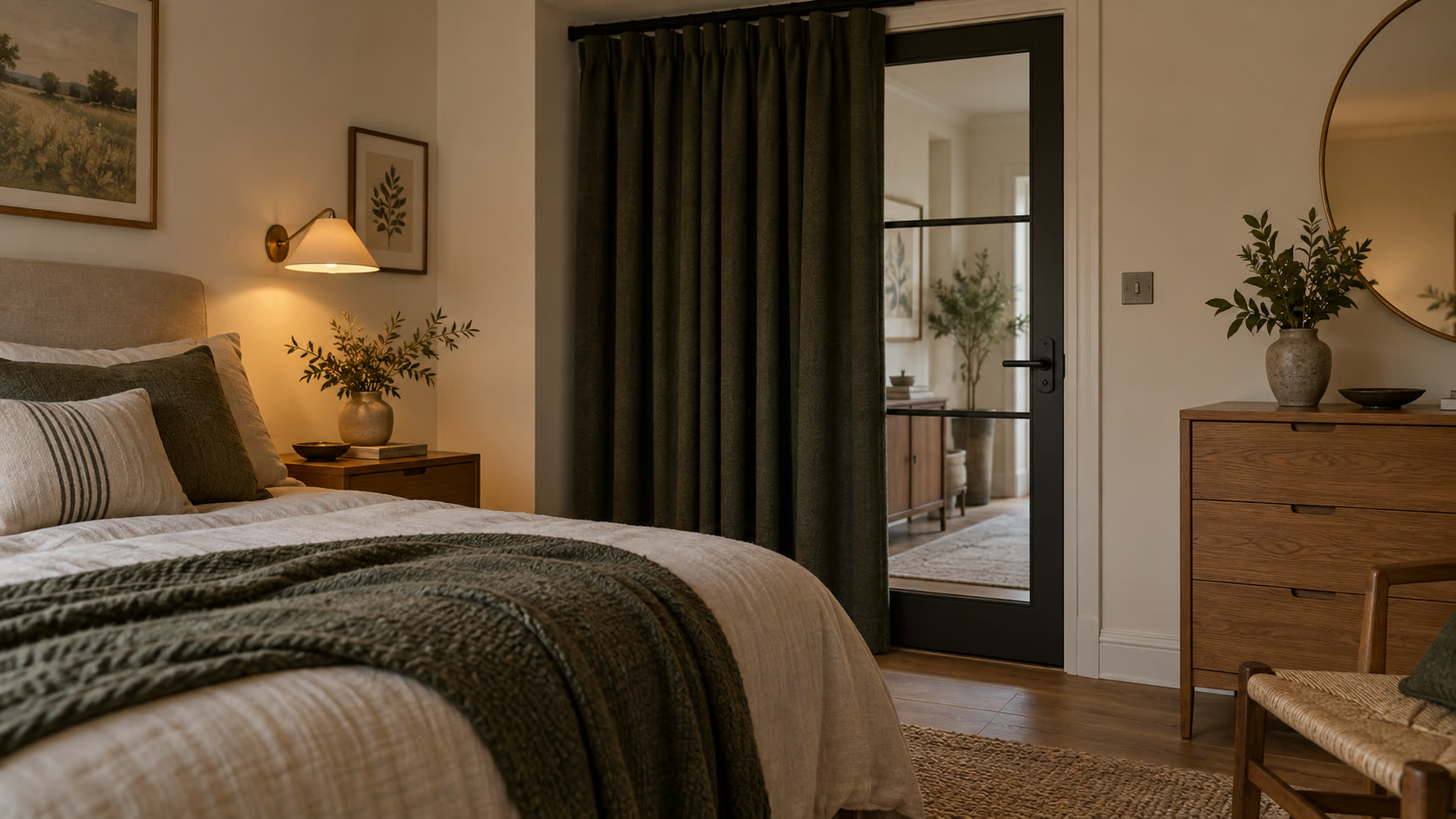
Identify what kind of glazed door you have
A bedroom door may have one small internal glass pane, several decorative glazed panels, or full-height glazing to a balcony or garden. Those are not the same fitting problem. A removable cover attached to glass may be practical for an internal pane yet inappropriate if it can fall across a frequently used external door. A long curtain may cover a full-height glazed opening well but can foul a handle or create a trip point if its track sits in the wrong place. Measure the door and its movement before choosing the treatment.
| Door feature | Why it matters | Record before choosing |
|---|---|---|
| Door swing | A room-side cover may be struck by the leaf | Direction, arc and open resting position |
| Handle and lock | A panel can block grip or visibility | Height, projection and required clearance |
| Glass and frame | Adhesive or suction may not suit every surface | Pane material, finish, coatings and seals |
| Glazed area | A panel that covers only glass may leave frame glow | Each pane and total bright outline |
| Exit role | A covering must not obstruct required access | Whether this door is a normal or emergency route |
Stand in the room after dark and identify whether the bright area is actually the glass or a gap around the door. If the glow comes from the hallway through a panel, a glass cover can be proportionate. If it outlines the frame, a curtain across the doorway may be more effective than a smaller sheet. If light is coming under the leaf, a pane covering will not address that path. Our streetlight guide explains how to trace directional light before adding layers.
Compare panel, blind and curtain options
A stick-on blackout sheet is useful when the glass or surrounding frame offers the surface specified by its maker. The Maritown example below is a trim-to-fit format. It may be easier to cut a panel for a small glazed insert than to find a ready-made door blind, but cutting and attaching it securely are part of the job. Do not place adhesive over rubber seals, fragile paint, a door closer, a moving edge or a vent. If the panel stays up only with improvised extra tape, reconsider the format. The stick-on removal guide covers finish-sensitive removal.
A blind mounted directly to a compatible door frame can move with the leaf. Some frame-fit systems are designed for particular uPVC glazing beads. They are not interchangeable with a generic roller bracket. Ask the supplier for the correct bead depth, handle clearance and door suitability. Our Perfect Fit guide explains why a familiar-looking frame can still be incompatible. A standard chain-operated roller on a swinging leaf adds a moving control and should not be improvised from window instructions.
A curtain fixed to the wall or ceiling on the room side can cover several panes and the surrounding frame with one layer. The Joydeco pencil-pleat pair below is one long ready-made example; check the exact panel widths, heading, drop and required track or pole. A curtain must draw fully clear of the door when passage is needed and must not snag the handle. If the doorway is narrow, a single panel drawing away from the handle may be more workable than a centre-opening pair, but only if its width still covers the lit area. Our curtain track guide explains the support and return options.
Measure the glazed area and the usable space around it
For a door-mounted panel, measure each pane and the available attachment surface separately. Do not assume the whole door height is usable: hinges, locks, handles and seals may reduce it. Photograph the door closed and open. Check whether the proposed covering will scrape a frame or wall during the swing. A cover that fits only while the door remains shut is not a sound everyday solution.
For a room-side curtain, measure the width of the opening plus room-side overlap, then locate where the fabric can stack without crossing the handle or walkway. Confirm that the ceiling or wall will carry the hardware. Check the fabric drop against the floor and any threshold so it does not drag or bunch where people step. If the room has a radiator, socket or switch beside the door, add those to the sketch. The curtain's lining specification and the way the sides return matter as much as its colour.
Renters should ask before drilling or applying adhesive to painted doors. “Removable” is not a promise of residue-free removal. A suction panel may avoid frame glue on suitable smooth glass, but it still needs a clear cup position away from textured portions and should be checked each time the door is used. Our temporary fitting comparison helps choose between these attachment routes without assuming either is universally safe for a finish.
Keep the door functional after darkening it
Test the fitted covering with the door fully open, closed and partly open. Can everyone in the household grasp the handle, operate the lock and move through without catching fabric? Do not conceal a required exit or door safety feature. If the door provides fresh air, retain a practical way to use it; England's existing-home ventilation guide makes clear that ventilation must remain effective. The exact building requirement depends on location and layout, so seek local professional advice if a cover affects a required route.
In a child-used room, check existing blind chains or curtain cords as well as the new covering. The Office for Product Safety and Standards warns about looped controls and advises moving cots and climbable furniture away. A removable sheet also introduces loose fixings: keep them out of a child's reach and inspect for detachment. The goal is a darker room that still works as a room, not a door that becomes hard to operate.
Products for this job
Two contrasting door-covering routes
A removable stick-on sheet and a long curtain pair illustrate different approaches. Neither should be fitted where it impedes a required exit or exceeds the maker's surface and size limits.
Maritown stick-on temporary blackout blind, 120 × 180 cm
Best for: A broad removable cover without suction cups
A cut-to-size black fabric panel with self-adhesive fixing and adjustable clips. It offers more coverage than many suction products where the frame finish is suitable.
What stands out
- 120 × 180 cm size
- Can be cut down
- No drilled holes
Keep in mind
- Adhesive can mark or lift delicate finishes
- Daily removal is less convenient than a roller
- The panel must be kept securely fitted and out of children's reach
- 120 × 180 cm
- Cut to size
- Self-adhesive fixing
- Adjustable clips
Joydeco black pencil-pleat curtains, 55 × 96 in, pair
Best for: A long, track-compatible curtain pair
A long two-panel black curtain set with a pencil-pleat heading for hooks or a compatible track. The listing describes light reduction rather than a sealed whole-window result.
What stands out
- Two 55-inch-wide panels are listed
- Pencil-pleat heading can use rings or a suitable track
- Long 96-inch drop suits some tall openings
Keep in mind
- Hooks are not included
- Seller describes partial light blocking rather than a room seal
- The large drop may need alteration for a shorter window
- 55 × 96 in each panel
- Two panels
- Pencil-pleat heading
- Hooks not included