
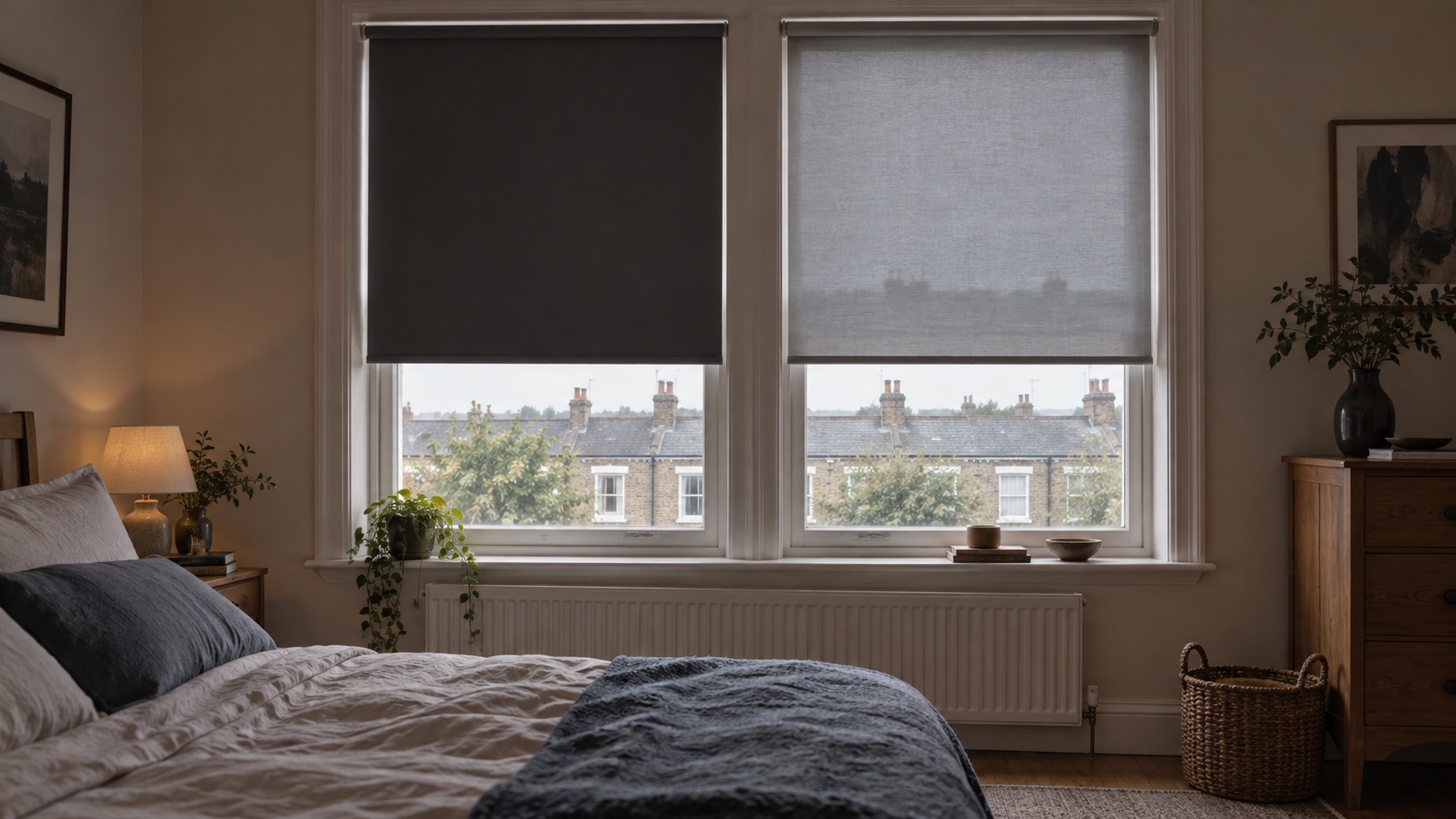
What the two labels tell you
“Blackout” is most useful as a description of the material. An opaque backing or construction can prevent a bright window from showing through the cloth itself. “Room-darkening” describes a softer reduction: a closed blind can still glow when the sun is behind it. Neither term promises a certain level of darkness in the whole room. The BBSA's product-characteristic guidance distinguishes fabric behaviour from the inevitable clearances in common blind designs.
The simplest comparison is a sample held against daylight. Look for pinpricks at stitch lines, a glowing weave and whether a pale face has a separate opaque backing. If buying a Roman blind, even blackout lining can be pierced by stitching. A coated roller may have no light through the main panel yet leave visible strips at either side. That is why a fabric-only claim should never settle a window decision.
| Question | Blackout fabric | Room-darkening fabric |
|---|---|---|
| Light through the main panel | Intended to be opaque | Some transmission may remain |
| Light around a standard roller | Usually remains at edges | Usually remains at edges |
| Useful when | Fabric glow itself is a problem | Softer light control is enough |
| Still needs checking | Complete width and fitting | Transmission and fitting |
Why the same window can look bright with either blind
A roller needs operating clearance. Its cloth is commonly narrower than the bracket-to-bracket measurement, so ordering a recess-width blackout roller may still leave two vertical bands. Top light can spill over the roll; an uneven sill can leave a bottom gap. The BBSA roller-blind guidance explains these characteristics. A framed cellular blind can address edges differently, but only if its frame suits the opening and is installed as specified.
Stand where the darkness matters. From a bed, a small side strip near eye level may be more noticeable than a glow through the centre of a room-darkening cloth. In a living room, some transmitted daylight may be desirable, while a concentrated gap beside a television is distracting. Our light-gap guide helps trace the route before replacing an otherwise useful blind.
Choose for the room rather than the label
For a bedroom, start with opaque material if the fabric itself glows. Then check whether the window can accept an outside-fit blind with generous overlap, a cassette with side guides, or a curtain layer. For a room used mainly in daytime, a room-darkening fabric may feel less stark and make it easier to moderate light without fully raising the blind. If you also need privacy at night, test the material with an interior light on; a daylight-only sample check is incomplete.
The FURNISHED roller below illustrates a conventional opaque roller whose fabric is narrower than its mechanism. The Luxevoir cellular example is ordered to size and operated without a side chain, but its free edges also need assessing. They are examples of different constructions, not interchangeable answers for one window. For a narrower overview of fit types, use our blackout blind buying guide. In a child's room, follow the OPSS guidance on blind cords for any accessible loop or chain.
A quick check before replacing your current blind
Close the blind in daylight and turn off the room lights. Look first through the centre of the panel, then around each edge. If the whole panel glows, a more opaque fabric may be worthwhile. If the centre is dark but the wall beside it is lit, replacing it with another free-hanging blind of the same width will probably leave the same problem. Hold a removable piece of dark card over the gap briefly to see whether more overlap would help; do not attach anything permanently over a vent or opening control. The exercise identifies a light path, not a product performance score. Repeat from the position where you sit or lie, because a high gap visible from the doorway may be almost invisible from the bed, and vice versa.
Products for this job
Compare the actual systems
These catalogue examples have different fabrics and fitting methods. Neither should be judged by a blackout label alone.
FURNISHED blackout roller blind, black, 60 × 165 cm
Best for: A familiar daily blind in a standard bedroom
A conventional coated roller blind with a broad size range and several fitting positions. It is useful when you want an everyday blind rather than a panel that must be removed each morning.
What stands out
- Many width and drop options are listed
- Can be fixed inside or outside the recess
- A trim-to-width route for awkward standard sizes
Keep in mind
- The fabric is about 4.5 cm narrower than the complete mechanism
- The looped chain and supplied safety device must be fitted correctly
- An ordinary roller does not seal the sides
- 60 × 165 cm
- Coated polycotton
- Bracket mounted
- Chain controlled
Luxevoir Panoramix cordless cellular blackout blind, light grey, custom size
Best for: A custom-sized honeycomb blind without a hanging chain
A handle-operated honeycomb blind supplied to a chosen size. Its pleated cells offer a softer appearance than a roller, while the advertised no-drill fitting needs a compatible frame and careful measurement.
What stands out
- Handle-operated cordless control
- Custom-size ordering
- No conventional drilling advertised for compatible frames
Keep in mind
- Fitting compatibility and grip must be checked on the actual frame
- A free-hanging cellular blind can still admit light at the edges
- Custom dimensions need careful confirmation before ordering
- Custom size
- Honeycomb fabric
- Cordless handle
- No-drill fitting