
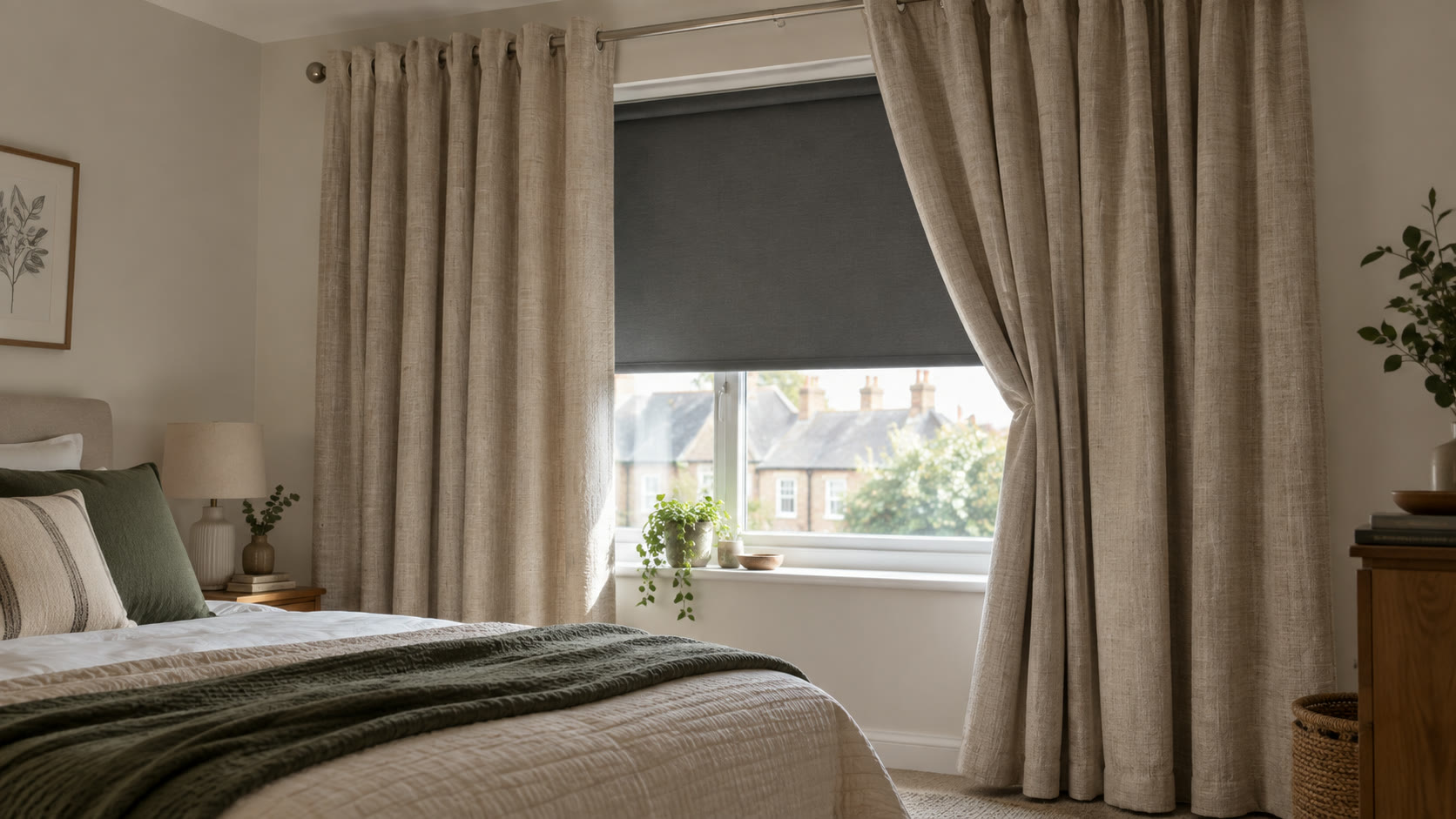
The darker option depends on the light path
Blackout curtains and blinds can both use opaque material. Their characteristic gaps are different. A roller's cloth often runs narrower than its complete mechanism and sits away from the side reveal. Curtains can extend past the window, but a short pole or narrow pair can leave side and centre gaps. Eyelets on a low pole may expose the top. The right question is not “which fabric is blacker?” but “which installation covers the daylight I can see?”
Close the current treatment and stand at the bed or desk. Follow each bright line to its source. A thin glow through the middle calls for a genuinely opaque fabric. A strip down the roller side may need wider outside overlap or a tracked system. Light over a curtain pole may need a higher pole, different heading or pelmet. The BBSA roller-blind characteristics help explain why ordinary blind clearance exists, while our curtain fitting guide shows how pole position changes coverage.
The FURNISHED roller example is a conventional opaque covering. It is quick to operate and comes in a range of sizes, but its fabric is narrower than its bracket-to-bracket width. The pale-khaki Deconovo curtains illustrate a coated fabric that can remain light in colour on the room side. Their effectiveness still depends on buying enough width and the right drop. The colour label alone cannot tell you how dark either finished bedroom will be.
| Consideration | Blackout blind | Blackout curtains |
|---|---|---|
| Typical edge | Gaps at bracket side, roll and bottom | Gaps at pole, sides, centre and hem |
| Daily use | Raise or lower one panel | Pull one or two panels across |
| Window access | Clear when fully raised | Clear when stacked beyond opening |
| Visual effect | Compact and architectural | Softer and more layered |
| Fitting | Correct bracket, depth and width | Correct pole or track, fullness and length |
Neither row in the table is universal. A side-tracked cassette differs from a basic roller; a ceiling-mounted curtain track differs from a low eyelet pole. Compare the actual systems you could install on your window, including obstructions and tenancy constraints.
When a blind is the better first move
A blind is useful when you want the sill and surrounding wall visually clear, open the covering frequently, or have limited space for curtain stack-back. A recess-fitted roller can look restrained in a small room. A framed or tracked blackout blind may also address light at the edges more directly than a free curtain, but it needs a suitable straight opening and more exact measurements. Read best total-blackout blind systems for that specialised route.
An ordinary roller will not suit every window. Handles can foul the cloth, inward-opening sashes may need the blind fully raised first, and a narrow recess can make the operating gaps highly visible. A roof window needs a product matched to its code rather than a normal vertical roller. If you are also considering a fixed treatment, read blinds versus shutters for the different installation and slat-gap trade-offs. In a child's room, any accessible chain must have its supplied safety device properly installed. The OPSS blind-cord guidance makes that requirement clear.
When curtains are easier to live with
Curtains can cover a wider area than the glass and bring fabric softness to a bare room. If there is already a well-positioned pole, they may be the least disruptive change. A generous pair can overlap a window's sides and hide the edge gap of an existing blind. It also remains relatively easy to replace the fabric without changing the whole fitting system.
Measure each panel's usable width after folds, not just the flat fabric width. Extend the pole or track beyond the reveal so the curtain can stack clear of the glass and close beyond its edges. Allow for a centre overlap and a sensible finish at the sill or floor. Very long curtains may interfere with radiators or furniture, while too-short ones admit light beneath the hem. The blackout curtain buying guide walks through headings and linings.
Care differs. Some curtain fabrics can be washed according to their label; coated ones may require gentler treatment. A roller generally needs dusting and careful spot cleaning in place. Both can conceal moisture near cold glazing. Open them periodically to inspect the frame and maintain ventilation. The GOV.UK existing-home ventilation guide for England explains why background ventilation should not be blocked in pursuit of a darker room.
A useful decision for your room
If you already have an opaque roller but see side strips, try a curtain layer or change the fitting before buying a similar roller. If you have a narrow curtain pair on a low pole, improve coverage before switching to a blind. If the opening is irregular or the room needs very low edge light, investigate a custom framed or tracked solution. A rental may favour an existing pole or removable cover; check permission and surfaces before assuming no-drill means no marks.
Temperature and bill claims deserve restraint. The Energy Saving Trust considers window coverings as part of the whole window, not a standalone guarantee. Choose the covering primarily for its everyday light control and practical fit. For a more detailed heat comparison, see thermal versus blackout curtains. The best result may be one blind for routine control and curtains for the remaining edges, provided the layers do not obstruct the window or each other.
Products for this job
Two familiar starting points
A coated curtain pair and a standard roller show the different ways fabric can cover a bedroom window; neither removes all perimeter light by itself.
Deconovo total-blackout coated curtains, pale khaki, 46 × 72 in, pair
Best for: A lighter face with an opaque backing
A coated-back eyelet pair intended to stop light through the cloth itself. The lighter face gives a softer room look while the backing does the opacity work.
What stands out
- Coated backing rather than relying only on a dark yarn
- Pair format
- Multiple listed colour and size variants
Keep in mind
- Coated fabrics need care-label-led cleaning
- Heavier curtains need a suitable pole and fixings
- Perimeter gaps remain unless the track or pole extends well beyond the window
- 46 × 72 in
- Pair
- Eyelet heading
- Coated back
FURNISHED blackout roller blind, black, 60 × 165 cm
Best for: A familiar daily blind in a standard bedroom
A conventional coated roller blind with a broad size range and several fitting positions. It is useful when you want an everyday blind rather than a panel that must be removed each morning.
What stands out
- Many width and drop options are listed
- Can be fixed inside or outside the recess
- A trim-to-width route for awkward standard sizes
Keep in mind
- The fabric is about 4.5 cm narrower than the complete mechanism
- The looped chain and supplied safety device must be fitted correctly
- An ordinary roller does not seal the sides
- 60 × 165 cm
- Coated polycotton
- Bracket mounted
- Chain controlled