
The short answer
Buy enough curtain for the wall, not just enough cloth for the glass
An opaque panel can still leave a bright top band, centre split and side glow. Choose a construction you can care for, calculate fullness from the pole or track, extend beyond the opening and plan the heading, drop and returns as one installation.
Confirm whether the listing width is per panel and keep useful folds when the pair is closed.
Choose coated, woven or separately lined construction by appearance, weight and care needs.
Layer over a recess blind when demanding darkness matters more than one-product simplicity.
Product shortlist
Three ready-made curtain constructions to compare
The examples include an opaque coated-back neutral, a dark pair and a soft grey pair. Use them to compare construction and sizing rather than treating one as universally best.
Deconovo total-blackout coated curtains, pale khaki, 46 × 72 in, pair
Best for: A lighter face with an opaque backing
A coated-back eyelet pair intended to stop light through the cloth itself. The lighter face gives a softer room look while the backing does the opacity work.
What stands out
- Coated backing rather than relying only on a dark yarn
- Pair format
- Multiple listed colour and size variants
Keep in mind
- Coated fabrics need care-label-led cleaning
- Heavier curtains need a suitable pole and fixings
- Perimeter gaps remain unless the track or pole extends well beyond the window
- 46 × 72 in
- Pair
- Eyelet heading
- Coated back
Deconovo blackout eyelet curtains, black, 46 × 54 in, pair
Best for: An affordable ready-made eyelet pair
A widely sized pair of soft eyelet curtains made for a standard pole. The dark colour is useful where room darkening matters more than a pale decorative finish.
What stands out
- Many size and colour variants are grouped under the listing
- Pair format suits conventional bedroom windows
- Simple eyelet heading is quick to hang on a compatible pole
Keep in mind
- Darkening depends on pole position, width and centre overlap
- Eyelets can leave a bright band above a low-mounted pole
- The listing's thermal wording is not a measured room-saving guarantee
- 46 × 54 in
- Pair
- Eyelet heading
- Polyester
PONY DANCE blackout eyelet curtains, grey, 46 × 54 in, pair
Best for: A grey pair across a standard window
A soft grey two-panel eyelet set with a very broad group of size variants. It is a practical neutral choice when you can create useful overlap beyond the window.
What stands out
- Two-panel set
- Many width and drop combinations are listed
- Neutral colour works with layered blinds
Keep in mind
- Room darkening varies with the selected colour and installation
- A pole close to the recess can expose top and side light
- Exact dimensions must be checked on the selected variant
- 46 × 54 in
- Two panels
- Eyelet heading
- Grey
Blackout curtains at a glance
The featured dimensions are specific variants. Verify whether width is per panel, the number of panels and the selected heading before buying.
| Option | Opacity route | Visual effect | Useful when | Watch for |
|---|---|---|---|---|
| Deconovo pale khaki | Coated back | Light neutral room face | Pale décor needs opaque cloth | Coating-led care |
| Deconovo black | Dense dark polyester | Deep dark face | A broad ready-made size family matters | Dark colour is not a fit guarantee |
| PONY DANCE grey | Dense neutral fabric | Soft mid-grey | Layering over an existing blind | Check opacity and size by variant |
A one-page curtain buying record
Write these answers down before comparing panel variants. Keep the supplier’s ordering convention beside this record: a panel’s flat width, the usable pole or track span and the finished closed coverage are not interchangeable.
| Decision | Record for this window |
|---|---|
| Opening and hardware | Opening width _____ mm; usable pole/track span _____ mm; fitting and support _____ |
| Side coverage | Left pole extension _____ mm; right extension _____ mm; intended wall returns _____ / _____ mm |
| Pair and heading | Heading _____; supplier fullness guidance _____; panels _____; listed width is per panel / per pair (circle one) |
| Drop reference | Measure from eyelet pole top / hook position / track reference (circle one); finished drop _____ mm |
| Construction and care | Coated / woven / separate lining (circle one); lining/back colour _____; care label _____ |
| Room constraints | Open-stack space _____ mm; radiator _____; vent _____; handle/window opening _____; child-control check _____ |
| If adding a blind | Blind/bracket projection _____ mm; curtain track depth _____ mm; moving clearance confirmed? _____ |
Then use the pair-width calculator for fabric quantity and returns, the coverage diagrams to distinguish pole extension from fabric coverage, and the layering profiles if a blind sits behind the curtains. For heading-specific drop references, keep the measuring sheet with the order. This record narrows the choice; the exact supplier’s measurements and fitting limits still decide the final size.
Begin with the light problem
Look at the room when it is brightest. Is the glow coming through the cloth, around the sides, above the heading or where the pair meets? A true opaque material solves only the first route. Curtain dimensions and hardware solve the rest.
Photograph the window from the bed or working position. Measure the full opening, surrounding wall, ceiling clearance, radiator, handles and furniture. This prevents buying a technically opaque pair that cannot extend far enough or has nowhere to stack when open.
Choose the blackout construction
Coated curtains
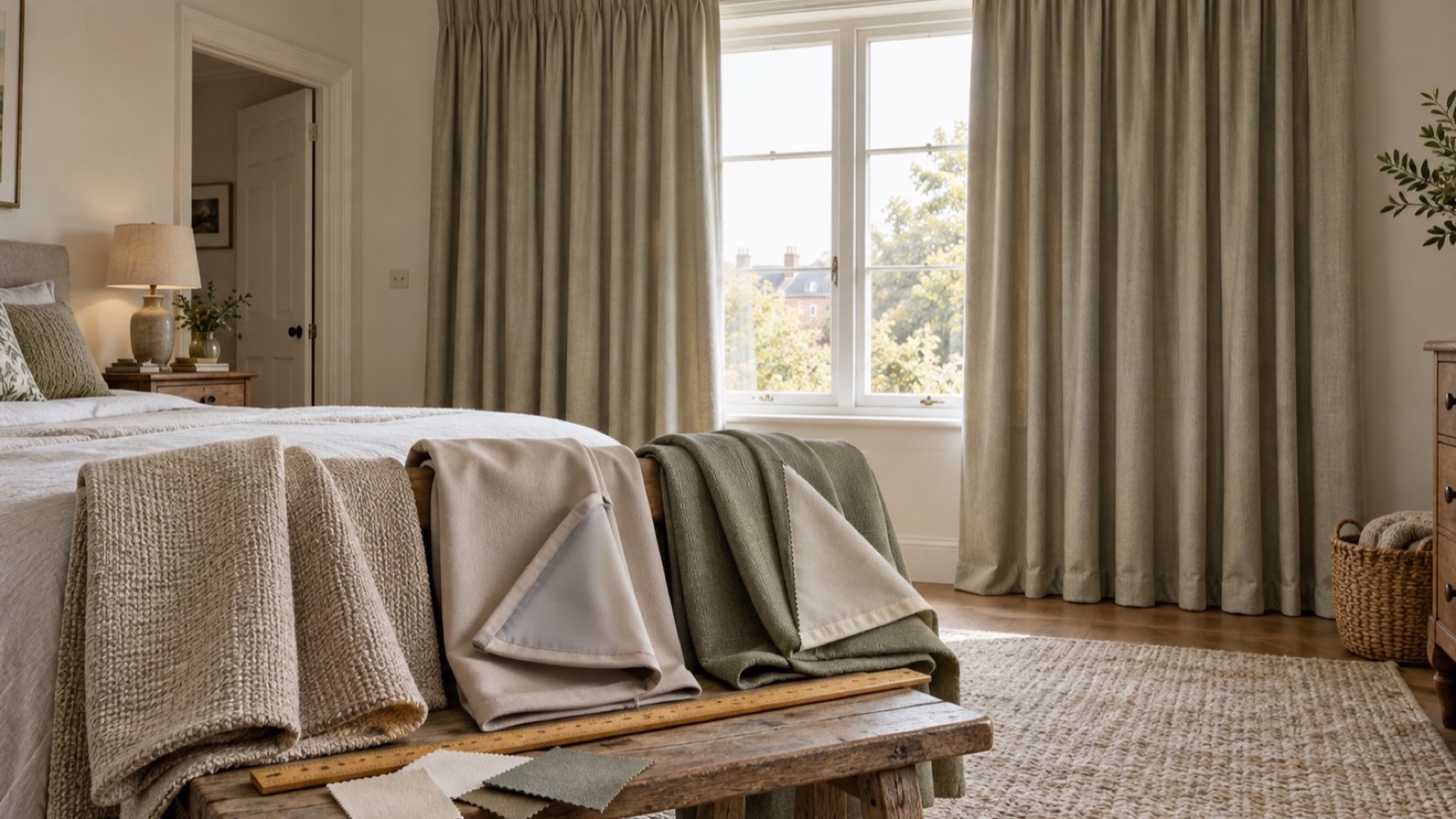
A coating on the window-facing side stops light without requiring a dark face colour. It can make pale neutral curtains practical. The backing needs careful handling: unsuitable heat, washing, folding or abrasion can cause marks, cracking or sticking. Read the care label before buying if easy home washing matters.
Woven blackout fabric
Some fabrics use dense or multi-layer yarn construction rather than a visible coating. They can feel softer and look similar on both sides. Opacity can vary by colour within one range, so check the exact selected variant rather than a generic family description.
Separate blackout lining
A decorative face with a sewn or detachable lining offers a furnished appearance and can be repaired or replaced more flexibly. It is heavier, so the pole, track, brackets and wall fixings must carry the full load. Different layers may have different cleaning needs.
Calculate width correctly
Measure the working pole or track between stops, excluding decorative finials. Check whether the retail width is for each panel or the pair. Two curtains labelled 117 cm wide provide 234 cm of flat fabric, but their useful closed width is less because folds consume material.
Use the heading maker’s fullness guidance. A pair stretched flat across the track tends to expose both sides and pull open at the centre. Aim for comfortable folds plus overlap at the join. On a track, an overlap arm can bring the leading edges past one another. Check curtain fullness and window overlap as separate calculations.
Extend the hardware beyond both sides of the window where wall space allows. This increases closed coverage and lets open curtains stack away from the glass. In a narrow alcove, prioritise the side receiving the strongest low-angle light.
Choose the drop
Measure from the actual hanging point: the pole position for eyelets, or the hook/track reference for pleated headings. Decide whether the curtain finishes at the sill, below it or near the floor. Account for uneven floors and radiators.
Floor-length panels can reduce the lower gap and create a calm vertical line. They should not lie on heaters, block vents or become damp against a cold wall. In a child’s room, avoid arrangements that encourage climbing or conceal unsafe blind controls.
Ready-made drops are stepped. If the ideal length falls between them, buying longer and having the pair altered usually looks better than accepting a bright gap. Preserve any special backing during alteration.
Heading and hardware
Eyelets slide directly onto a pole and give even large folds. Their top edge sits below and around the pole, which can admit a bright band. Mounting high and using a recess blind behind helps.
Pencil pleat headings work on poles or tracks and allow adjustable gathering. Correctly placed hooks can bring the top closer to the track. Pinch pleat gives a structured made-to-measure look and fixed fullness. Wave headings form regular folds on a compatible track but need space to stack.
A ceiling or wall curtain track can sit closer to the surface than a projecting pole. Tracks with return bends bring the outer edge towards the wall. A pelmet hides the top route and hardware. Check fixings against the wall or ceiling construction; heavy lined curtains need more than convenient-looking plugs.
Colour and the window-facing side
Choose room-face colour for the interior, then inspect the back separately. A light or reflective window-facing layer can be useful on sunlit glazing, while a black face is not proof of better summer performance. Follow window and curtain guidance where intense sun or heat-sensitive glazing is involved.
Samples should be viewed against a bright window, not only on a table. Fold the sample because the installed curtain will not be flat. Ask whether different colours in the range share the same construction.
Layering for stronger darkness
A blind inside the recess controls the glass and preserves easy daytime privacy. Curtains mounted high and wide cover the blind’s side and top clearances. Because their edges do not line up, the combination is more forgiving than either treatment alone.
For a standard bedroom, an ordinary opaque roller plus curtains may be enough. For daytime sleeping, consider a cassette or side-track blind behind the pair. Do not add inaccessible chains; choose cordless controls or install supplied safety devices where they remain visible for inspection.
Thermal claims and ventilation
Dense, lined curtains can create a still-air layer beside the window and reduce some cold discomfort. They cannot guarantee a fixed energy saving. The Energy Saving Trust includes thermally lined curtains among window improvement options, while the installed result still depends on glazing, draughts and coverage.
Keep working radiators clear. Open curtains to inspect condensation and preserve required ventilation. In hot weather, close them before direct sun heats the room and ventilate when it is safe and cooler outside. Curtains are a movable shade, not active cooling.
Care before purchase
Read the label or online care section for the exact colour and construction. The face being polyester does not guarantee machine washing. Coated and multi-layer panels may require professional cleaning. Consider whether a very large panel will fit the machine even if washing is permitted.
Vacuuming with low suction and prompt compatible spot care can delay deep cleaning. Choose hardware that lets panels come down without strain. Keep the window dry so the backing is not pressed against condensation.
A final buying checklist
Confirm the number of panels, width per panel, drop, heading, construction, colour of the back, care method and total weight. Measure the pole or track, wall overlap and stacking space. Check radiator and vent clearance. For rooms used by children, remove accessible looped-control risks in any blind behind the curtains.
The right pair is not simply the fabric with the strongest claim. It is the pair that closes with folds, meets in the middle, covers the surrounding wall, suits the hardware and remains practical to open, inspect and clean. Compare the ready-made curtain shortlist only after the measurements and fitting route are clear.
Clear answers
Frequently asked questions
Short answers to the fitting, use and care questions that most often change the result.
What colour blackout curtains work best?
Dark colours often appear more opaque, but a dedicated coating or lining can make pale curtains effective too. Construction and edge coverage matter more than face colour alone.
How wide should blackout curtains be?
Measure the pole or track and use the heading manufacturer’s fullness guidance. The combined panel width should exceed that span enough to retain folds and centre overlap when closed.
Should blackout curtains touch the floor?
Floor length can reduce the lower light route and look polished, but it is unsuitable where fabric would cover a radiator, collect moisture or obstruct access. Sill or below-sill drops can be more practical.
Are eyelet or pencil-pleat curtains better for blackout?
Either can work. Eyelets are easy to hang but can leave a top route around the pole. Pencil pleat or track headings can sit closer to the wall and work with returns or a pelmet.
Do blackout curtains need a separate blind?
Not always. A well-fitted pair may be enough for ordinary bedrooms. For daytime sleeping or strong low sun, a recess blind plus outside curtains creates staggered edges and usually controls more routes.