
The short answer
Secure, cord-free and well away from the cot
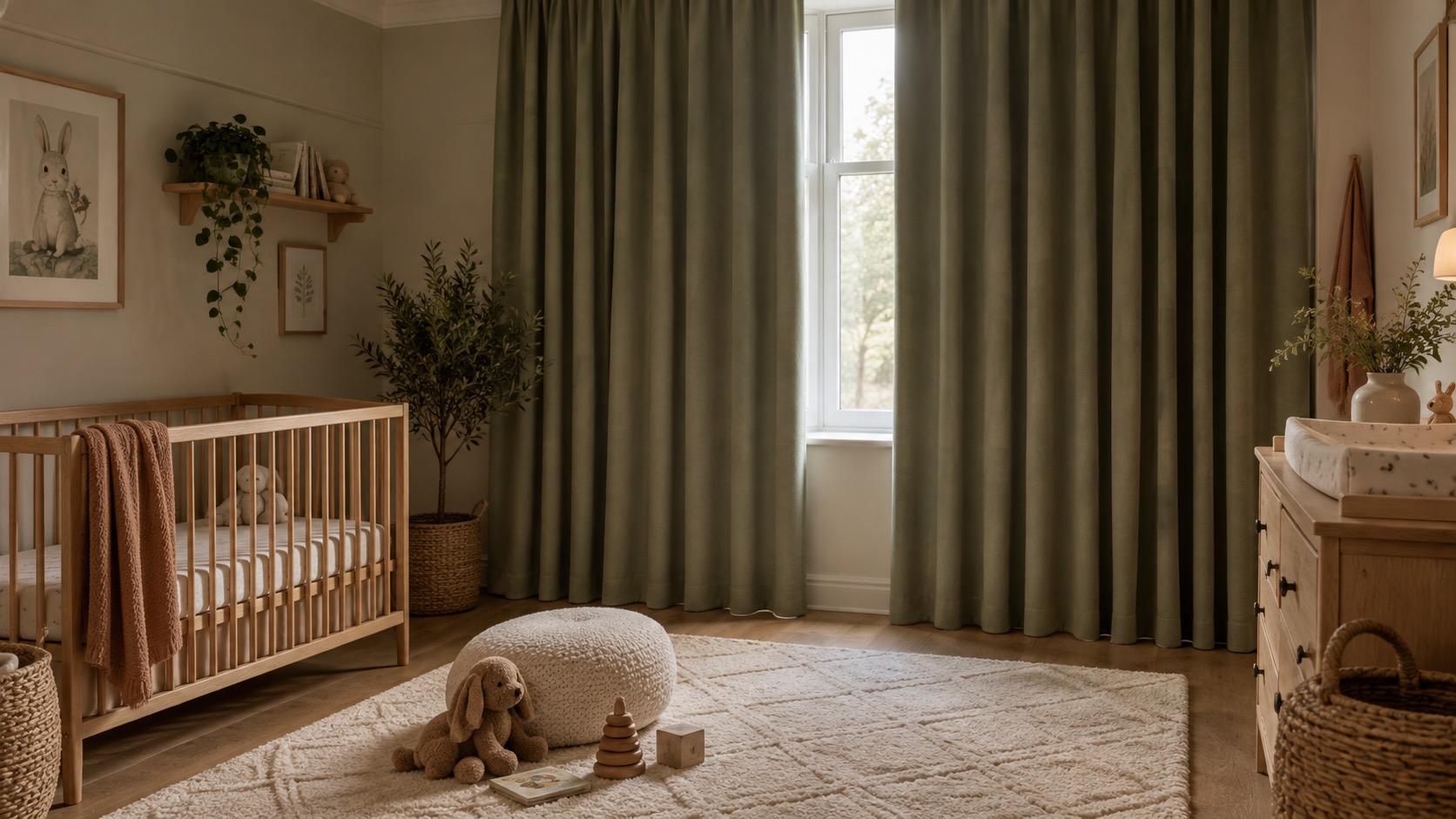
A nursery curtain should darken the opening without introducing reachable loops, loose tiebacks or unstable hardware. Choose an opaque pair with enough width for folds and overlap, mount it securely, and keep the cot and climbable furniture away from the entire window area.
A simple hand-drawn pole or track avoids curtain pull cords; do not add looped tiebacks within reach.
Use fixings suitable for the wall and the full weight of lined curtains.
Blackout is not a sleep treatment or a guarantee of temperature; keep normal ventilation and safe room monitoring in place.
Product shortlist
Three ready-made curtain formats
These pairs offer different colours and constructions. The safest choice is the one that can be securely fitted, operated without a reachable loop and kept away from the cot.
Deconovo total-blackout coated curtains, pale khaki, 46 × 72 in, pair
Best for: A lighter face with an opaque backing
A coated-back eyelet pair intended to stop light through the cloth itself. The lighter face gives a softer room look while the backing does the opacity work.
What stands out
- Coated backing rather than relying only on a dark yarn
- Pair format
- Multiple listed colour and size variants
Keep in mind
- Coated fabrics need care-label-led cleaning
- Heavier curtains need a suitable pole and fixings
- Perimeter gaps remain unless the track or pole extends well beyond the window
- 46 × 72 in
- Pair
- Eyelet heading
- Coated back
PONY DANCE blackout eyelet curtains, grey, 46 × 54 in, pair
Best for: A grey pair across a standard window
A soft grey two-panel eyelet set with a very broad group of size variants. It is a practical neutral choice when you can create useful overlap beyond the window.
What stands out
- Two-panel set
- Many width and drop combinations are listed
- Neutral colour works with layered blinds
Keep in mind
- Room darkening varies with the selected colour and installation
- A pole close to the recess can expose top and side light
- Exact dimensions must be checked on the selected variant
- 46 × 54 in
- Two panels
- Eyelet heading
- Grey
Deconovo blackout eyelet curtains, black, 46 × 54 in, pair
Best for: An affordable ready-made eyelet pair
A widely sized pair of soft eyelet curtains made for a standard pole. The dark colour is useful where room darkening matters more than a pale decorative finish.
What stands out
- Many size and colour variants are grouped under the listing
- Pair format suits conventional bedroom windows
- Simple eyelet heading is quick to hang on a compatible pole
Keep in mind
- Darkening depends on pole position, width and centre overlap
- Eyelets can leave a bright band above a low-mounted pole
- The listing's thermal wording is not a measured room-saving guarantee
- 46 × 54 in
- Pair
- Eyelet heading
- Polyester
At a glance
Confirm each selected variant’s panel width, drop, heading and care instructions before ordering.
| Option | Best for | Construction | Heading | Main check |
|---|---|---|---|---|
| Deconovo coated pair | A lighter nursery palette | Opaque coated back | Eyelet | Pole strength and care label |
| PONY DANCE grey pair | A soft neutral room | Dense polyester | Eyelet | Opacity can vary by colour |
| Deconovo black pair | Maximum visual depth | Dark polyester | Eyelet | Dark face may dominate a small room |
Safety comes before darkness
A nursery window is not just a source of light. It may include blind chains, curtain pull cords, tiebacks, a radiator, opening restrictors and climbable furniture. Review the complete area before choosing a fabric.
The Office for Product Safety and Standards warns that looped blind cords and chains can endanger young children. Its guidance says to install supplied safety devices and keep cots, beds, highchairs, playpens and furniture away from window blinds. The same layout principle applies to curtain cords, tiebacks and hanging accessories: remove avoidable loops and keep all controls out of reach.
A plain eyelet curtain drawn by hand on a securely fixed pole is simple. If you choose a corded track, use a compliant system and have it installed correctly. Never loop a tieback around the fabric near the cot or leave spare cord inside the room.
The three options in more detail
Deconovo coated pair: a light face with an opaque back
The pale khaki pair is the least visually heavy of the shortlist. Its coating provides opacity rather than relying only on dark face colour, so the nursery can still look calm and light when the curtains are open. The 72-inch drop suits taller arrangements, but measure from the top of the pole to the intended finish.
Coated cloth needs care-label-led cleaning. It can also be heavier than an unlined decorative pair, so use a pole and wall fixings rated for the load. Check the full sweep of each panel and keep it beyond the cot’s reach.
PONY DANCE grey pair: a flexible neutral
Grey works easily with timber, white and muted colour schemes. The two-panel set is offered in numerous sizes, which can help create enough combined width for full folds rather than stretching the curtains flat.
Do not infer identical opacity across every colour and size variant. Confirm the selected option, then check that each panel’s width is sufficient. If existing blinds remain at the window, their control safety still needs a separate review.
Deconovo black pair: deep visual darkening
Black cloth can make residual glow through the fabric less noticeable and is available in a broad ready-made size family. It suits a nursery where visual darkness matters more than a pale daytime appearance.
Dark face colour does not eliminate top, side or centre gaps. It may also feel dominant in a small room. Use the same high-and-wide fitting logic as any other pair and avoid claims that a dark curtain alone controls room temperature.
How to measure nursery curtains
Measure the usable pole or track from end to end, excluding finials. Choose a combined panel width that retains folds when shut and allows the panels to overlap at the centre. If the cloth is stretched flat, the centre is more likely to separate and light will pass around the sides.
The pole should extend beyond the window where the wall and furniture layout allow. That gives the open fabric somewhere to stack and helps the closed pair cover the recess. Mounting above the opening reduces the bright band at the top, but first check the lintel and use the correct fixings.
Measure the drop from the point where the heading will actually hang. Eyelets place the top edge slightly above the pole. Keep fabric clear of a working radiator and away from furniture a child may later climb. A layout that is safe for a newborn may not be safe for a standing toddler.
Pole, track and wall fixings
Lined blackout curtains create significant leverage on their brackets. Plasterboard-only fixings may be unsuitable without appropriate anchors or a secure timber position. Identify the wall construction and lintel before drilling. If uncertain, use a competent installer.
Fit all brackets supplied for the span and load, including a centre support where required. Check that finials and end stops cannot loosen into small parts. Operate the pair several times, watching for a bracket that flexes or a pole that bows.
Do not hang toys, bags, mobiles or decorative garlands from the pole. The curtain hardware is for the treatment only.
Reducing light gaps without creating hazards
Wall overlap is the cleanest first step. A return track that brings the curtain towards the wall can reduce side light, and a properly designed pelmet can address the top. Any addition must be secure and inaccessible to the child.
Layering a curtain over a cordless recess blind can improve coverage because their edges do not align. Avoid adding temporary cords, loose clips or magnets. Portable panels with detachable pieces are better reserved for supervised travel use and must be checked before every sleep period.
If a small glow remains, decide whether it is genuinely disruptive before adding complexity. A safe, repeatable installation is more important than chasing theoretical total darkness.
Heat, ventilation and condensation
Blackout curtains can shade a sunlit window, but they do not provide temperature control. GOV.UK hot-weather guidance for England recommends covering sun-facing windows and ventilating when the air outside is cooler, where safe. Use a suitable room thermometer and follow current health guidance during hot conditions.
Keep trickle vents and required ventilation operating. In winter, inspect behind closed curtains for condensation, wipe moisture and investigate persistent damp. Do not press fabric against wet glass or use the curtain to hide a mould problem.
If a radiator sits beneath the window, choose a safe drop that does not trap heat behind the curtain or place cloth on a hot surface. Never position the cot beside a radiator to make room for curtains.
Cleaning around a baby or toddler
Vacuum with a clean low-suction upholstery attachment while supporting the fabric. Treat stains according to the care label. Avoid fragranced sprays and improvised chemical treatments on the curtain; they can mark coatings and add residues without improving blackout performance.
Inspect hems, eyelets, hooks, pole screws and wall brackets during routine cleaning. Remove the curtain from use if hardware loosens or fabric tears around an eyelet. Store spare hooks, rings and packaging outside the nursery.
Bottom line
Choose the pale coated Deconovo pair for a softer daytime palette, the PONY DANCE grey pair for a versatile neutral, or the black Deconovo pair when deep face colour suits the room. In every case, buy enough width for overlap and make the installation secure.
The nursery standard is simple: no reachable loops, no curtain fabric near the cot, no unstable hardware and no unsupported promises about sleep or temperature. For blind alternatives, compare our nursery blackout blind guide.
Clear answers
Frequently asked questions
Short answers to the fitting, use and care questions that most often change the result.
Are blackout curtains safe in a nursery?
They can be when the pole or track is securely fixed, there are no reachable control loops or tiebacks, and the cot is well away from the window and hanging fabric. Recheck the layout as the child becomes mobile.
What colour blackout curtain is best for a nursery?
Colour is secondary to an opaque backing and good coverage. A pale coated curtain can be effective without making the room feel dark when open. Confirm the selected colour’s construction because variants can differ.
Should nursery curtains reach the floor?
Floor length can cover the opening well, but long fabric must remain completely beyond the child’s reach and clear of heaters. A shorter drop may be safer and more practical depending on the cot and radiator position.
Can curtains make a nursery too hot?
Curtains can shade direct sun, but they do not control temperature on their own. Follow current heat-health guidance, ventilate safely when outside air is cooler and use an appropriate room thermometer rather than judging by the curtain label.
Do blackout curtains help a baby sleep?
They can reduce unwanted daylight and create a consistent room cue, but they do not guarantee sleep or address medical concerns. Use them as one practical part of the room, not as a health product.