
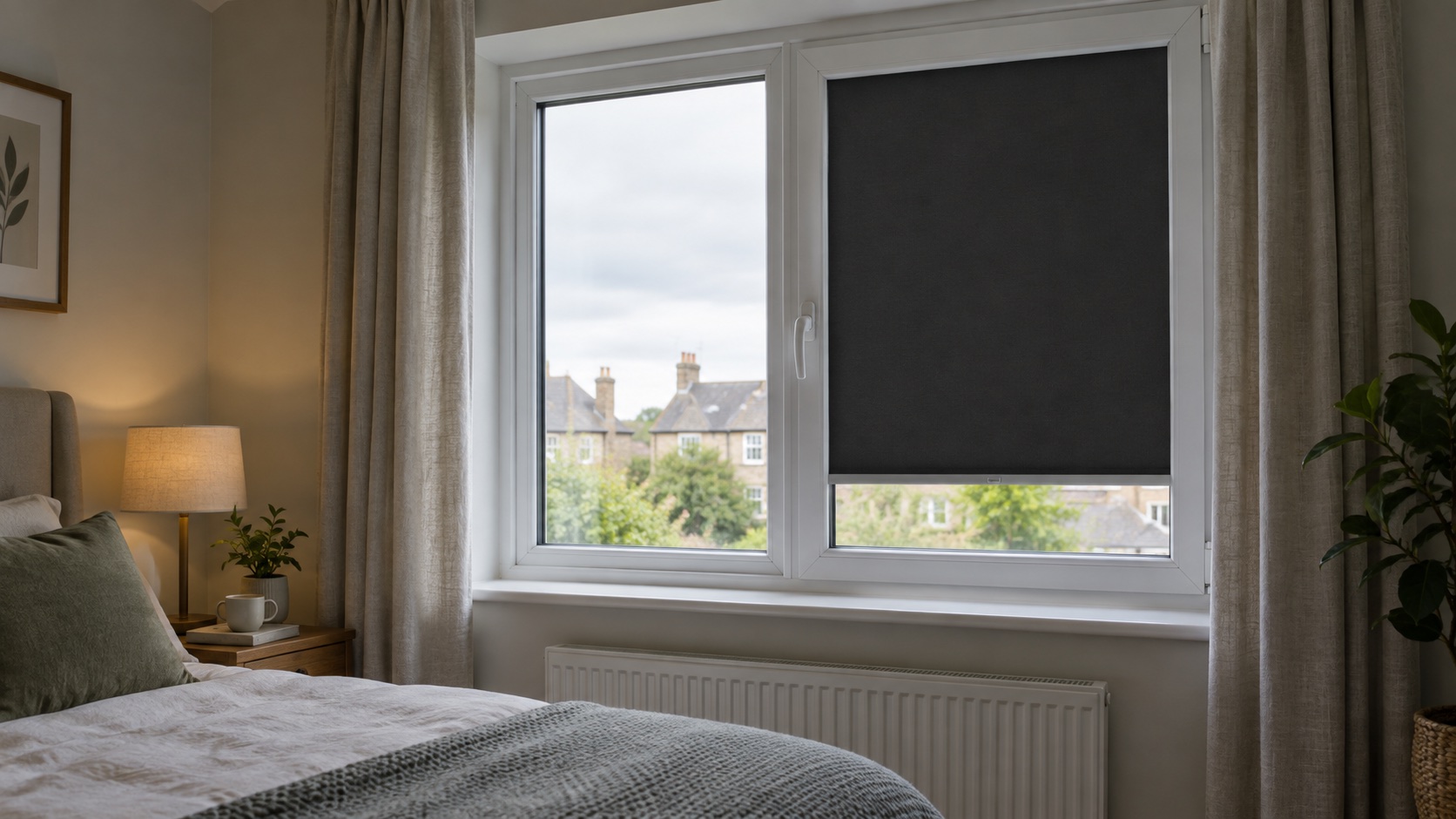
What “Perfect Fit” describes
Perfect Fit is a frame-fitting approach rather than a promise about darkness. A slim frame clips into suitable glazing beads so the blind sits against an individual window or door sash. A common appeal is that the treatment moves with the sash instead of hanging from the wall. The manufacturer's suitability guide explains why bead form and depth must be checked before ordering. A normal roller fixed to the reveal is a different product, even if a retailer calls it a “perfect fit” in ordinary language.
The frame may house a pleated, cellular or roller blind. Some fabrics are translucent; some have an opaque backing. Ask for the actual system and fabric, not just a generic frame photograph. A frame can reduce the large side strips of a free-hanging roller, but a blackout fabric in a framed sash is still not proof of a sealed room. Specialist suppliers themselves note that light can pass around the frame edges.
Check the window before the fabric
Measure the visible glass and the bead depth by the chosen supplier's method. Look at the gasket and bead shape and photograph the corners. Check the handle projection, hinge clearance and whether the sash is tilt-and-turn, inward opening or unusually close to a wall. The wrong bracket can fail to grip securely or cause the frame to interfere with the handle. The bead-depth guidance shows why a few millimetres change which bracket is supplied; do not substitute a guess from a photograph.
For a multi-pane window, each opening sash may need its own frame. That creates vertical lines and more individual controls, but it allows one sash to be used without opening the treatment over every pane. For a broad wall of glass, compare the cost and appearance of several sash frames with one outside-fit blind or curtains. Our wide-window guide sets out the centre-gap trade-off.
Judge the finished light path
Hold a sample to daylight to check fabric opacity. Then consider the gaps between blind, frame and glazing bead, and the line where adjacent frames meet. A shade close to the glass can feel neater than a projecting roller, but its construction and the window's own geometry still govern edge light. If near-total darkness is important, compare a purpose-designed side-tracked or cassette system and ask the supplier to explain the remaining top and bottom paths.
No-drill does not mean maintenance-free. The clips need correct engagement, the frame must not obstruct an escape or ventilation function, and any control must meet the OPSS blind-cord safety guidance in a child-used room. Clean the glazing and inspect the frame for condensation periodically. If the bead or sash is incompatible, use the no-drill fitting guide to compare other methods rather than forcing the wrong clip-in system.
What to send when requesting a quote
Take a clear front-on photograph of the whole sash and a close-up of its glazing bead, handle and hinge. Record the glass dimensions as the supplier requests, then measure bead depth with the recommended tool or template. State whether the window tilts, turns or opens outward and how close it sits to a side wall or curtain. Ask the supplier to confirm the exact frame, bracket and fabric that their quote includes. On French doors, check that the handle and floor clearance still work when the framed blind is fitted. For a bedroom, ask how the chosen system manages light between its frame and the glass rather than relying on the word “blackout” in the fabric name. Keep the confirmed fitting specification with your order.
If the beads are unusually shallow or the gasket is damaged, do not force a generic clip behind it. A poor connection can distort the frame and leave the blind insecure. Have the supplier assess photographs or arrange an in-person measurement before ordering a non-returnable custom unit.