
The short answer
A cassette controls the perimeter that an ordinary roller leaves open
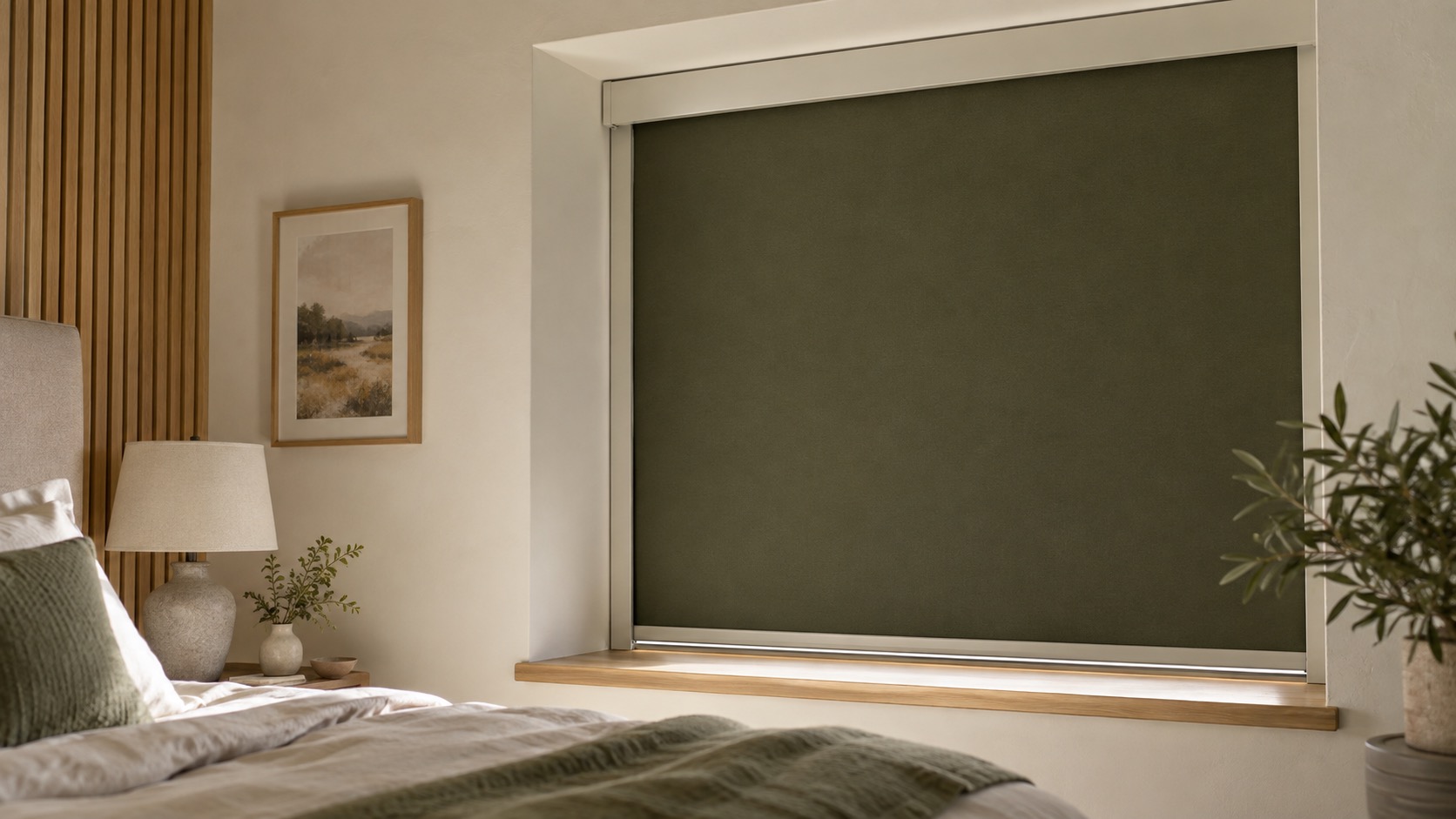
A true room-darkening cassette system encloses the roll at the top and guides the fabric in side channels. It can reduce direct edge light much more effectively than an open roller, but the frame must match a square, compatible opening and be installed precisely.
Do not confuse a decorative top fascia with a complete light-control system; side channels do most of the edge work.
Roof-window blinds are common rail-guided examples because the fabric must follow the glazing slope.
[object Object]
Product shortlist
Three rail-guided roof-window examples
These products are for the stated VELUX window codes, not standard vertical windows. They show how a cassette and rails differ from an open roller.
VELUX original replacement blackout blind, M04/M34, black
Best for: An older VELUX M04 or M34 window
An original VELUX replacement blind for older M04 and M34 window codes. It is a precise compatibility purchase: the label on the top sash decides whether this variant belongs on the window.
What stands out
- Made by the window manufacturer
- Cordless manual operation
- Code-matched rail system
Keep in mind
- This replacement range is not the same as every current MK04 product
- Compatibility must be checked before ordering
- A genuine blind may cost more than a third-party alternative
- M04 / M34
- Cordless
- Manual
- Black
Itzala blackout blind for VELUX M04 and MK34 roof windows
Best for: A compatible VELUX M04 or MK34 roof window
A code-specific roof-window blind with aluminium rails and stepless manual positioning. It follows the slope of a compatible VELUX window rather than hanging away from the glass.
What stands out
- Aluminium rails manage side light on a sloping window
- Manual stepless positioning
- Uses the roof-window code to select the fit
Keep in mind
- Only compatible with the stated VELUX codes
- Not a substitute for checking the label on the open window
- Colour and code combinations sit under related variants
- M04 / MK34 variant
- Aluminium rails
- Manual
- Code-specific fit
Bloc Skylight blackout blind for VELUX MK04, black
Best for: A code-matched MK04 roof window
A rail-guided roof-window blind made for the MK04 code. It is a third-party alternative that follows the window slope and is selected by the window label rather than room-side glass measurements.
What stands out
- Code-specific roof-window fit
- Side rails guide the blind on a slope
- Manual handle positioning
Keep in mind
- The MK04 variant must not be assumed to fit another code
- Third-party fit should be checked against the entire compatibility statement
- Black fabric is visually strong when open
- MK04
- 603 × 780 mm listed
- Side rails
- Manual
At a glance
Match the complete code on the window’s identification plate. M04 and MK04 are not interchangeable labels simply because the glass looks similar.
| Option | Listed fit | Guidance method | Control | Key check |
|---|---|---|---|---|
| VELUX replacement blind | M04 / M34 generation | Side rails | Manual | Older-code compatibility |
| Itzala compatible blind | M04 / MK34 | Aluminium rails | Manual | Exact listed code |
| Bloc Skylight blind | MK04 | Side rails | Manual | Newer MK04 code |
What the cassette actually does
An ordinary roller has a tube, two brackets and an exposed sheet of fabric. The cloth must be narrower than the complete mechanism, so daylight can travel beside it. A cassette adds a housing around the roll. In a complete room-darkening system, side channels receive the fabric edges and a bottom detail closes the final route.
The top box alone is not enough. Some products use “cassette” to describe a decorative fascia that hides the tube but leaves the sides open. That can look neater without materially changing the bright strips beside the cloth. Look for a drawing or photograph showing the complete top, sides and bottom—not just a close-up of the header.
When a cassette system is worth it
The upgrade makes most sense when a narrow line of direct light is the remaining problem. Day sleepers, home cinemas and rooms with bright exterior lighting can find edge light more intrusive than a low background glow. A properly specified framed system tackles that geometry directly.
It is also useful on sloping roof windows. Gravity cannot hold an ordinary blind against angled glass, so guide rails keep the fabric close to the sash and allow it to stop in position. This is why code-specific skylight blinds are among the clearest ready-made examples.
A cassette may be unnecessary when full curtains already hide the perimeter, when occasional darkening is enough, or when the recess is too uneven to accept a rigid frame. A removable panel can be more practical in a rental or irregular opening.
Measuring a vertical window for a framed system
Measure the width at the top, middle and bottom and the drop at the left, centre and right. Record diagonals if the supplier requests them. Check recess depth, sealant beads, handles, vents, tiles and projecting hinges. Photograph the opening with a rigid tape visible.
The channels need a continuous flat surface. A reveal that narrows behind tiles or bows in the middle may accept an ordinary cloth but not straight aluminium rails. Do not average the differences. Send the supplier the smallest and largest readings and ask whether packers, a face-fixed frame or professional measuring is required.
Clarify whether the quoted dimensions refer to the outer frame, the fabric or the daylight opening. For made-to-measure products, follow the manufacturer’s deduction rules exactly once. A DIY allowance can make the cassette loose; a frame that is too large may not enter the recess at all.
Roof windows: use the code, not the glass size
VELUX’s window-identification guidance states that roof windows made after 1968 carry a type sign, normally at the right corner of the top sash behind the ventilation flap. It identifies type, size, variant and production code. Open the window safely and photograph the complete plate.
Codes that appear close can belong to different generations. M04, MK04 and MK34 should not be treated as typographical variations. Buy only a blind whose compatibility list includes the exact code. Approximate glazing dimensions are not a substitute because rail, bracket and sash details can differ.
Our VELUX blackout blind guide gives a code-first selection process. For a non-VELUX roof window, find that manufacturer’s plate and use its own accessory guide.
The featured formats
VELUX original replacement blind
This listing is aimed at older M04 and M34-coded windows and uses the familiar manual rail-guided format. It is relevant when replacing a blind on the stated generation, not as a generic “about the right size” option. Confirm the complete code and selected colour before checkout.
Itzala compatible blind
The Itzala listing states compatibility with M04 and MK34 codes and uses aluminium rails with stepless manual positioning. It demonstrates why the written code matters: the product groups old and transitional labels that must be checked against the actual plate.
Bloc Skylight blind
The Bloc option is listed for MK04. That newer code is common, but it is still only one size. The rail-guided design is intended to follow the window slope. Do not order it for M04 merely because both names contain “04”.
Installation details that affect edge light
The top cassette must seat fully, the two side rails must meet it flush and the bottom brackets must land in their specified positions. VELUX’s support guidance notes that excessive light around a blind can be associated with a cassette that is not recessed far enough, side channels that do not align with the top, or a control bar that has not reached its final position.
Those principles apply more broadly: a tiny mitred gap becomes a bright line. Check squareness before tightening everything. Operate the blind repeatedly and look for rubbing, waviness or a side that rises faster. Never force a stiff blind; investigate alignment and refer to the supplied instructions.
Controls and safety
Many manual roof-window blinds use a cordless control bar, but generic vertical cassette systems may use chains, cords, motors or spring mechanisms. Do not assume the frame makes the control child-safe. Inspect the exact specification.
Where a chain or cord is supplied, install every safety component. Current UK product-safety guidance says blind loops can endanger young children and that tensioners or other devices must be fitted securely. Keep cots, beds and climbable furniture away from the window. A safe-by-design cordless system is the preferred starting point for a child’s room.
Cleaning and repair
Dust channels with a soft brush or low-suction tool so debris does not score the fabric. Wipe metal parts with a barely damp cloth if the instructions permit, then dry them. Do not oil rails unless the manufacturer specifies a lubricant; oil can mark fabric and attract grit.
If the cloth leaves a rail, the cassette drops or a brake stops holding, use the maker’s repair guidance. Pulling harder can crease the material or detach components. Keep the model and window codes with your paperwork so replacement parts can be matched later.
Bottom line
A cassette with side channels is a structural answer to edge light, not simply a premium cover for a roller tube. It is worth considering when ordinary overlap cannot deliver the darkness you need and the opening can accept a precise frame. Measure the system, not just the glass, and for a roof window let the identification code decide the fit.
Clear answers
Frequently asked questions
Short answers to the fitting, use and care questions that most often change the result.
What is a cassette blackout blind?
It is a roller system whose fabric retracts into a top housing and, in stronger room-darkening designs, travels inside side channels. The frame helps control direct light that would otherwise pass around an open roller.
Does a cassette blind make a room completely dark?
It can substantially reduce perimeter light, but no installation should be assumed perfectly sealed. Accuracy, frame squareness, bottom closure and the specific channel design all affect the result.
Can I add side channels to an existing roller blind?
Only with a compatible system designed for that blind. Improvised channels can snag fabric, overload controls or obstruct a window. A complete matched kit is the safer route.
Are roof-window blackout blinds cassette systems?
Many use a top cassette and side rails so the fabric follows the sloping sash. That makes them a useful example, but they are code-specific accessories and should not be adapted to ordinary windows.
Are cassette blinds suitable for nurseries?
A cordless, correctly fitted cassette can avoid an accessible loop and manage edge light well. Check the exact control, follow the instructions and keep the cot and furniture away from the window.