
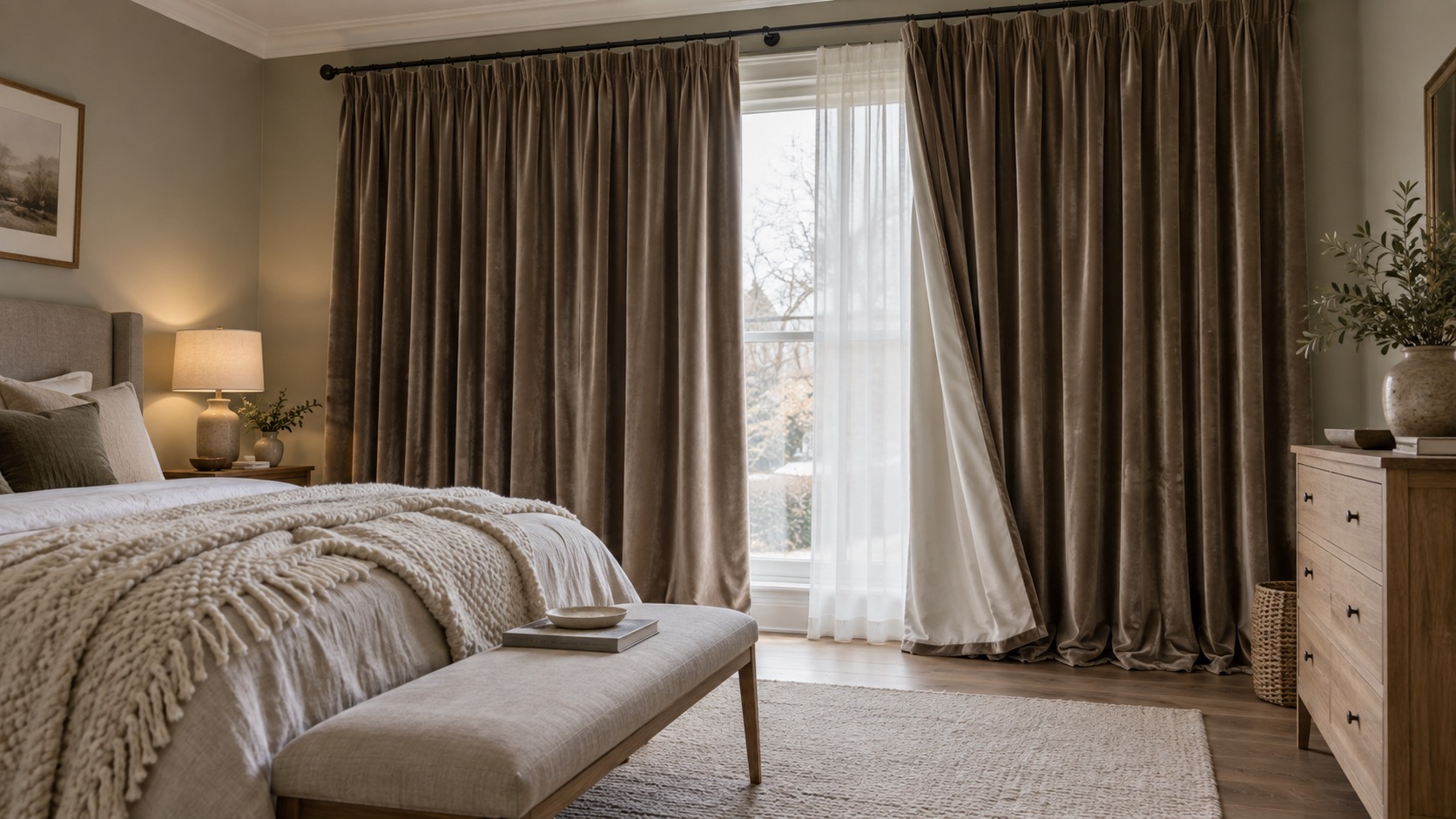
The short answer
Fit and layers matter more than the word thermal
A dense or coated curtain can add a still layer beside the window and shade direct sun, but the result depends on full coverage, close edges and correct use. Treat thermal as a construction clue, not a guaranteed room-temperature or energy-saving figure.
Choose enough total width for full folds and a centre overlap; stretched-flat panels perform poorly at the join.
Mount high and wide, while keeping radiators, vents and opening windows clear.
In hot weather, shade sunlit glass before the room heats and ventilate when outside air is cooler.
Product shortlist
Three curtain constructions to compare
The options show a coated pale face, a dark conventional pair and a neutral grey pair. Size, heading and installation determine the finished result.
Deconovo total-blackout coated curtains, pale khaki, 46 × 72 in, pair
Best for: A lighter face with an opaque backing
A coated-back eyelet pair intended to stop light through the cloth itself. The lighter face gives a softer room look while the backing does the opacity work.
What stands out
- Coated backing rather than relying only on a dark yarn
- Pair format
- Multiple listed colour and size variants
Keep in mind
- Coated fabrics need care-label-led cleaning
- Heavier curtains need a suitable pole and fixings
- Perimeter gaps remain unless the track or pole extends well beyond the window
- 46 × 72 in
- Pair
- Eyelet heading
- Coated back
Deconovo blackout eyelet curtains, black, 46 × 54 in, pair
Best for: An affordable ready-made eyelet pair
A widely sized pair of soft eyelet curtains made for a standard pole. The dark colour is useful where room darkening matters more than a pale decorative finish.
What stands out
- Many size and colour variants are grouped under the listing
- Pair format suits conventional bedroom windows
- Simple eyelet heading is quick to hang on a compatible pole
Keep in mind
- Darkening depends on pole position, width and centre overlap
- Eyelets can leave a bright band above a low-mounted pole
- The listing's thermal wording is not a measured room-saving guarantee
- 46 × 54 in
- Pair
- Eyelet heading
- Polyester
PONY DANCE blackout eyelet curtains, grey, 46 × 54 in, pair
Best for: A grey pair across a standard window
A soft grey two-panel eyelet set with a very broad group of size variants. It is a practical neutral choice when you can create useful overlap beyond the window.
What stands out
- Two-panel set
- Many width and drop combinations are listed
- Neutral colour works with layered blinds
Keep in mind
- Room darkening varies with the selected colour and installation
- A pole close to the recess can expose top and side light
- Exact dimensions must be checked on the selected variant
- 46 × 54 in
- Two panels
- Eyelet heading
- Grey
At a glance
No curtain can promise a fixed saving in every home. Window type, draughts, radiator position, fabric area and user behaviour all change the result.
| Option | Construction cue | Best for | Heading | Main trade-off |
|---|---|---|---|---|
| Deconovo coated pair | Opaque coated back | A light neutral face | Eyelet | Coating needs care-label-led cleaning |
| Deconovo black pair | Dark polyester | A broad ready-made size family | Eyelet | Dark face may absorb solar heat |
| PONY DANCE grey pair | Dense neutral fabric | Layering over an existing blind | Eyelet | Variant opacity and dimensions need checking |
What “thermal blackout” means in practice
The phrase often combines two different jobs. Blackout material aims to stop visible light through the cloth. Thermal construction may use dense layers, an applied coating or a separate lining to slow heat movement and reduce the sensation of cold air falling beside the glass.
Neither word describes the whole window installation. Heat still moves through glazing, frames, gaps and walls. Daylight still travels above a pole, beside the panels and through a centre split. A curtain works as a large movable layer, not as a substitute for repairs or insulation.
Be cautious with exact percentages on a general retail listing. A result measured with one window, fabric size and test method cannot be transferred automatically to a different home. Compare construction and fit, then judge comfort in the real room.
The three options in more detail
Deconovo coated curtains: pale face, opaque backing
This pair is useful when you want a lighter neutral room during the day but a dedicated coating to provide opacity. The 46 × 72 inch variant suits a taller standard window, and the listing groups other sizes and colours.
The coated back is also the main care consideration. Avoid assuming it can tolerate hot washing, tumble drying or ironing on the coated surface. Follow the selected variant’s label. Heavier cloth also needs a properly fixed pole that can carry the full pair.
Deconovo black curtains: a dark ready-made route
The black pair is a straightforward option where appearance and deep face colour suit the room. A broad family of sizes makes it easier to create wall overlap, but select the exact dimensions deliberately: retail variants can reset when colour changes.
A dark face is not proof of a thermal result. The way the pair closes at the centre and edges remains decisive. In strong summer sun, avoid claiming that black fabric will always cool a room; shading timing, window orientation and the window-facing layer all matter.
PONY DANCE grey curtains: a neutral layer
The grey pair sits between the pale coated and black options visually. It can work well over a recess blind, where the curtain’s main job is to cover side gaps and add a second still layer. The neutral face also suits rooms where a black wall of fabric would dominate.
Check the chosen colour because opacity can differ across variants in a family. Confirm that the listed width is per panel and calculate the combined width with the pair closed.
How to size curtains for useful coverage
Measure the pole or track, not just the glass. Include the part that extends beyond the recess, excluding decorative finials. The combined flat width of the panels must exceed that span so the cloth keeps folds when shut. A pair stretched flat is more likely to pull apart at the centre and expose the sides. The curtain measuring guide and fullness guide turn those checks into dimensions.
Mounting the pole higher and wider can hide more of the opening. Leave enough stacking space so open curtains do not permanently cover much glass. At the bottom, decide whether the curtains will finish at the sill, below it or near the floor. Floor length can reduce the bottom route but may be unsuitable over a radiator.
For an exposed window, a wraparound pole or track that returns towards the wall can reduce side openings. A pelmet can address the top route. These details often matter more than changing from one opaque fabric to another.
Winter use without overpromising
Close curtains when the room no longer benefits from daylight or solar warmth, and open them when useful sun reaches the window. Keep the cloth clear of condensation and allow the window area to dry. Heavy curtains pushed tightly against cold glass can hide moisture rather than solve it.
Check draughts separately. Replace failed seals or arrange repairs where appropriate. Curtains may reduce discomfort but should not conceal a damaged frame. Keep trickle vents operating as designed and do not block required ventilation.
If a radiator sits below the window, do not trap it behind a full-length closed curtain while heating. A shorter drop, a sill arrangement or careful tucking behind a shelf may be more practical, provided it is safe and does not place fabric on a hot surface.
Summer shading and overheating
Current GOV.UK hot-weather guidance for England recommends shading or covering windows, and notes that external shutters, roller blinds or awnings can be particularly effective. Internal curtains are a useful accessible measure, especially when closed before direct sun heats the room.
The sequence matters. Shade sun-facing glass during the hot part of the day. Open windows when it is safe and the air outside feels cooler, often later in the evening or overnight. A curtain cannot actively cool a room that is already hot, and it should not be sold as a substitute for heat-health advice.
For a strongly sunlit window, consider a pale window-facing lining. Avoid leaving dark fabric pressed against very hot glass without checking the window and curtain maker’s advice.
Layering curtains with blinds
A recess blind controls the main glass area and preserves a tidy daytime look. Curtains mounted outside the opening cover the blind’s narrow sides and top. The staggered edges make this combination more forgiving than either treatment alone.
Layering also lets each component do a clear job: the blind provides quick daily privacy; the curtains add overlap and softness. Keep both controls accessible, and in a child’s room choose a cordless blind or fully install every supplied safety device.
Care, condensation and longevity
Vacuum curtains with a clean low-suction upholstery tool, supporting the fabric. Treat marks according to the care label. Blackout coatings can crease, stick or separate when exposed to unsuitable heat or washing, so do not infer care instructions from the face fibre alone.
Inspect the window periodically for condensation, particularly behind closed curtains in winter. Wipe moisture, ventilate appropriately and investigate persistent damp. Ensure the pole, brackets and wall fixings remain secure; lined panels are heavier than sheers.
Bottom line
Choose the coated Deconovo pair when a pale face and opaque backing are the priorities. Choose the black pair when deep colour and a wide ready-made range fit the room. Choose the grey PONY DANCE pair when you want a neutral second layer over a blind.
The most “thermal” purchase is not automatically the thickest-sounding listing. Buy enough fabric, fit it to cover the real opening, use it at the right time and keep ventilation, radiators and window condition in the plan.
Clear answers
Frequently asked questions
Short answers to the fitting, use and care questions that most often change the result.
Do thermal blackout curtains keep heat in?
They can reduce some heat transfer and cold downdraught near a window by adding a covered air layer, but performance varies widely. They do not repair failed glazing, seals or building insulation, and a universal energy-saving percentage is not credible.
Can blackout curtains keep a room cooler in summer?
Closing curtains before direct sun reaches the glass can reduce solar gain inside the room. External shading is generally more effective because it stops more heat before it enters. Ventilate when outside air becomes cooler, if safe.
Is a dark curtain more thermal than a pale one?
Not necessarily. Lining, coating, thickness, fit and air gaps matter. In strong sun, a dark interior surface can absorb more heat, so a pale or reflective window-facing layer may be preferable.
Should curtains cover a radiator?
Avoid trapping a working radiator behind long closed curtains. It can send heat towards the window and reduce circulation into the room. Choose a suitable drop or adjust the arrangement while heating is on.
How wide should thermal blackout curtains be?
The pair needs enough combined width to form folds when closed and overlap at the centre, plus wall coverage beyond the opening. Use the heading maker’s fullness guidance rather than matching panel width exactly to window width.