
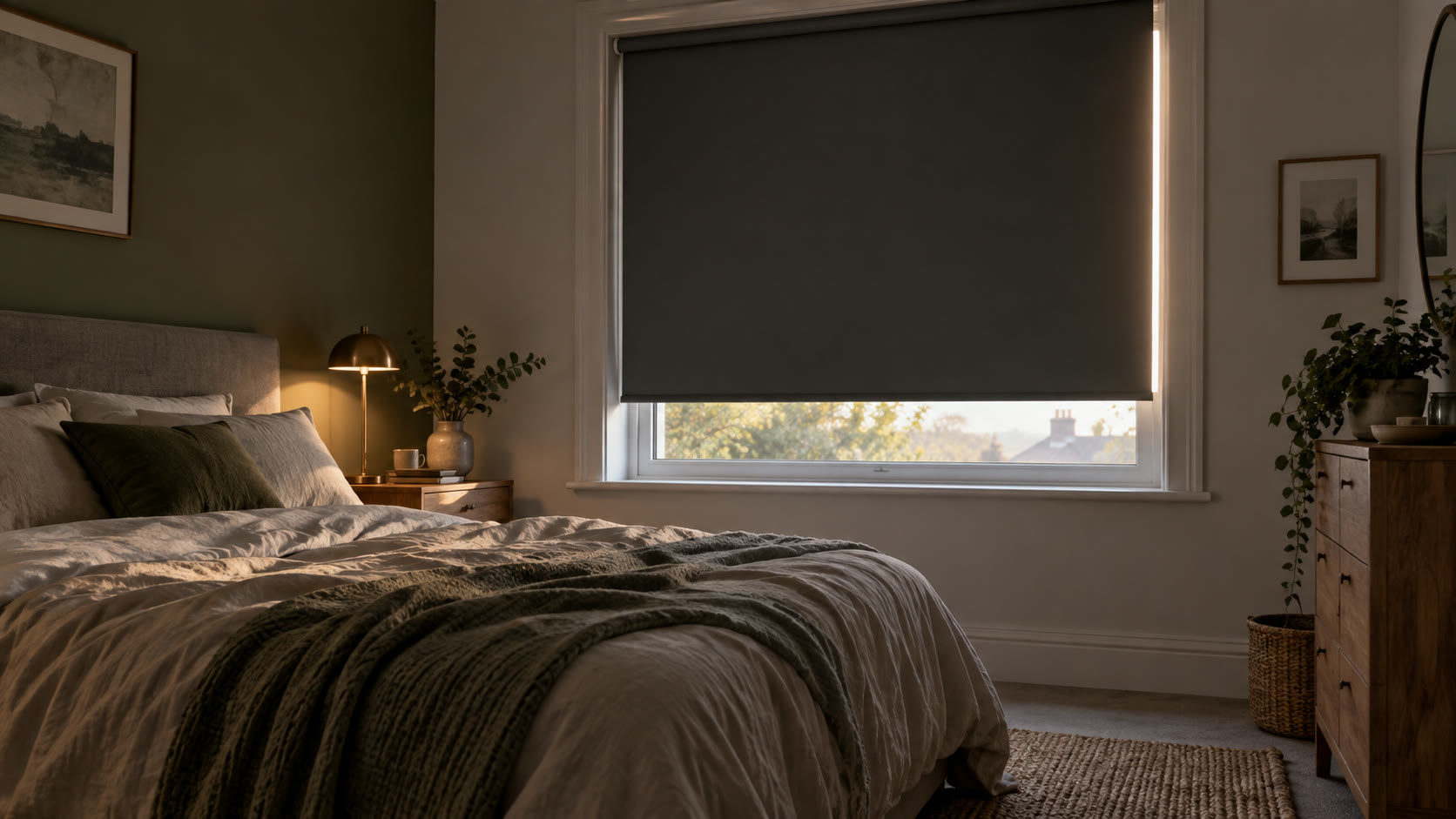
The short answer
Start with the light that actually reaches you
If small amounts of daylight are bothersome, opaque fabric alone is unlikely to be enough. Look at the top, sides and bottom of the window from the bed. A tracked or framed blind addresses edge light more directly than an ordinary roller, but every system still depends on accurate fit and the rest of the room.
Map visible light paths before choosing a product or paying for a custom size.
Check the full mechanism, control and window opening, not just the cloth's blackout label.
Treat a dark room as a comfort preference, not a treatment for light sensitivity.
Product shortlist
Three ways to control bedroom daylight
These formats serve different windows and tolerance for edge light. A tracked cassette or framed cellular blind asks more of the fitting; a standard roller is simpler when moderate darkening is enough.
Sol Royal K24 cassette blackout blind with side rails, black, 90 × 175 cm
Best for: A framed no-drill installation on a smooth window
A no-drill cassette roller supplied with adhesive side rails. The frame manages the routes around the fabric more directly than an open roller, provided the window surface is flat, smooth and carefully prepared.
What stands out
- Top cassette and side rails are supplied as one system
- Adhesive installation avoids conventional drilling
- Several listed widths and three neutral colours
Keep in mind
- Surface preparation and flatness are critical
- The cloth is narrower than the complete mechanism
- The looped chain and safety device need careful positioning
- 90 × 175 cm variant
- Polyester
- Adhesive side rails
- Chain controlled
TIPIACE framed top-down bottom-up cellular blackout blind, black
Best for: A made-to-size recess with flexible top-down control
A custom-size honeycomb blind inside a full aluminium frame. The fabric cells conceal the internal lift cords, while the frame addresses side leakage more directly than a free-hanging cellular blind.
What stands out
- Full frame manages perimeter light
- Cordless top-down bottom-up operation
- Custom dimensions for non-standard openings
Keep in mind
- Needs a deep, square recess and screw fixing
- Custom products require especially careful measurement
- The configured item may not be returnable if dimensions are wrong
- Custom size
- Honeycomb fabric
- Aluminium frame
- Cordless manual control
FURNISHED blackout roller blind, black, 60 × 165 cm
Best for: A familiar daily blind in a standard bedroom
A conventional coated roller blind with a broad size range and several fitting positions. It is useful when you want an everyday blind rather than a panel that must be removed each morning.
What stands out
- Many width and drop options are listed
- Can be fixed inside or outside the recess
- A trim-to-width route for awkward standard sizes
Keep in mind
- The fabric is about 4.5 cm narrower than the complete mechanism
- The looped chain and supplied safety device must be fitted correctly
- An ordinary roller does not seal the sides
- 60 × 165 cm
- Coated polycotton
- Bracket mounted
- Chain controlled
Bedroom blind formats at a glance
The result depends on the selected size, reveal and installation. No blind can promise a medically meaningful sleep outcome.
| Format | Edge approach | Daily control | Main limitation |
|---|---|---|---|
| Tracked cassette | Side rails and top housing | Chain | Needs compatible surface and correctly fitted safety device |
| Framed cellular | Fabric sits within a surrounding frame | Cordless handle | Custom fit and window access need checking |
| Standard roller | Outside overlap if space permits | Chain | Side and top gaps remain possible |
Identify the problem before buying another blackout blind
The phrase “light-sensitive sleeper” covers several practical situations: a bright dawn through a south-east window, a streetlamp that lands on the pillow, or small white strips around an otherwise opaque blind. Those are different fitting problems. Stand or sit where the light bothers you and trace it. Is it coming through the fabric, down the side of the reveal, above the roll, beneath the bottom bar, through a door or from a device in the room? A new blind only helps with the paths it covers.
If sensitivity to light is painful, new or associated with eye redness or vision changes, this is not simply a decorating problem. The NHS advice on eye pain identifies light sensitivity alongside eye pain as a reason to seek urgent clinical advice. This guide is about practical room darkening, not diagnosis or treatment. We cannot promise better sleep, fewer symptoms or a particular health result from a blind.
The central fabric of many blackout blinds is opaque, but the whole opening rarely behaves like one solid panel. A roller has operating clearance at its brackets. A recess may be out of square. A pale sill can reflect a thin shaft of sunlight into the room. For a useful result, compare the complete blind with your exact window, not just a claim attached to a fabric swatch.
When a tracked cassette makes sense
The Sol Royal K24 example puts the roll into a top housing and uses side rails to contain the moving fabric. That construction targets two common sources of a bright perimeter: a bare roll above the glass and free side edges. It can be a worthwhile route when a normal roller's side strips remain conspicuous after you have checked its width and overlap. It is not a universal seal. Uneven frame surfaces, a shallow sill or poorly aligned rails can still admit light.
Before choosing it, measure the uninterrupted surface where the cassette and rails must attach. Check handle travel, opening direction and whether the adhesive method is approved for your frame. The K24 uses a looped chain, so plan the tensioning device before you buy. The Office for Product Safety and Standards' blind-cord guidance explains why accessible loops are hazardous around children and why supplied safety devices matter. If that device cannot be fitted securely in the required position, choose another system.
What a framed cellular blind changes
A framed cellular design such as the selected TIPIACE model gives the fabric a surrounding structure rather than letting it hang free. Its cordless control also removes the ordinary side chain. The cellular material folds compactly, which can look softer than a roller in a bedroom. The advantage for this use case is the frame, not a claim that the honeycomb material itself guarantees darkness.
Custom dimensions bring a different risk: a mistake in the reveal measurement or an obstruction in the movement path may make the whole unit unsuitable. Confirm exactly where the frame fixes, the minimum clearance and whether your sash can open with the blind installed. Ask the seller to explain how it deals with bottom corners and any tolerance for an uneven opening. A custom blind that seals one edge but blocks a required vent or window handle is not a good choice.
When the ordinary roller is enough
The FURNISHED roller illustrates the simpler option: familiar raise-and-lower operation, many stock sizes and several fitting positions. Its cloth is narrower than the complete mechanism, so the stated width is not the same as covered fabric width. An outside-recess installation can add useful overlap where there is wall space. Our outside-recess measuring guide explains how to plan that overlap without assuming a stock size will cover the bright edge.
This is a reasonable starting point if the current problem is direct light through a thin blind rather than a severe perimeter leak. If a standard opaque roller is already fitted and the cloth is sound, replacing it with a second standard roller may make little difference. First try to identify a fitting adjustment, a wider outside mount or a curtain layer. The light-gap guide helps separate those choices.
The room matters beyond the window
Check light leaking around the bedroom door, an uncovered roof window, indicator lamps and reflective surfaces. A bedside lamp or a phone screen may be the most noticeable source once the window is darker. Choose a blind that you can operate easily every day and that does not trap condensation unseen against cold glazing. Open the covering periodically to inspect and dry the window area. Do not block trickle vents or remove essential ventilation to make a room darker.
For daytime sleeping, the sun's position changes the useful overlap. A low bright sun can make a narrow side opening much more visible than it appears on a cloudy afternoon. Inspect the room at the time the light is actually troublesome. Our daytime bedroom guide covers the wider routine of managing daylight without making medical claims.
If you rent, consider whether a tracked cassette is acceptable under the tenancy and whether adhesive removal could damage paint or seals. A removable cover may be less permanent, although it needs more effort to take down and refit. Where children use the room, assess cords, detachable parts and furniture placement even if the chosen blind is called cordless. A calm, dark bedroom should not come at the cost of a blocked exit or an unsafe fitting.
Clear answers
Frequently asked questions
Short answers to the fitting, use and care questions that most often change the result.
Which blackout blind leaves the least side light?
A well-fitted tracked cassette or framed system is designed to manage side gaps more directly than a free-hanging roller. Actual performance still depends on an even reveal, the bottom edge and other room light sources.
Will a blackout blind cure light sensitivity?
No. A window covering changes the room's light level; it does not diagnose or treat the cause of light sensitivity. If symptoms are new, painful or accompanied by vision changes, seek appropriate clinical advice.
Are dark-coloured blinds always better than pale ones?
Not necessarily. An opaque pale fabric can block transmission through the panel, while a dark fabric with large perimeter gaps still admits daylight. Check the selected fabric and complete fit.
Is a sleep mask better than changing the blind?
A mask may be convenient for some people, but comfort and fit vary. A blind can also reduce light for other occupants and during waking hours. Neither should be represented as a medical solution.
What if I cannot fix tracks to the window?
Consider an outside-mounted roller with generous overlap, layered curtains or a removable window cover. Keep vents and escape routes usable, and choose an installation permitted by the window and tenancy.