
The short answer
Choose the fixing before choosing the fabric
No-drill products use different attachments. A spring or clip blind needs the right frame geometry; adhesive rails need a compatible, sound surface; a removable panel is flexible but less convenient daily. Opaque material helps, but edge coverage still decides how dark the room feels.
Check opening type, frame depth, gasket and handle clearance before ordering.
Prefer cordless controls where young children may use the room.
Treat adhesive and clamp marks as possible; document the surface and follow removal instructions.
Product shortlist
No-drill formats for different windows
These options use a cordless spring, adhesive-and-clip roller, custom cellular fitting and adhesive cassette rails. They are alternatives for different frames rather than a ranking for every home.
LazBlinds cordless no-drill blackout shade, black, 36 × 72 in
Best for: A window where a control loop is best avoided
A spring-operated cordless shade that attaches without conventional drilled brackets. It removes the hanging loop found on many ready-made rollers, but its stick-on installation still needs a compatible, clean surface.
What stands out
- Cordless spring operation
- No conventional drilling
- Opaque black fabric in the featured variant
Keep in mind
- A fixed ready-made width will not suit every recess
- Adhesive or pressure fittings still depend on the surface and instructions
- No-drill does not guarantee mark-free removal
- 36 × 72 in
- Cordless
- No-drill mounting
- Black
Amazon Basics blackout roller blind, dark grey, 56 × 150 cm
Best for: A compact adhesive-and-clip installation
A compact roller blind whose clip-and-adhesive mounting avoids drilling into the frame. The listed fabric is opaque, but the roller mechanism still leaves perimeter routes for daylight.
What stands out
- Mounting clips are listed as requiring no drilling
- Available in several compact widths
- Raises and lowers like a normal roller blind
Keep in mind
- Adhesive removal can affect delicate surfaces
- The cord tensioning device is safety-critical
- The 150 cm drop will not suit every window
- 56 × 150 cm
- Polyester
- No-drill clips
- Cord controlled
Luxevoir Panoramix cordless cellular blackout blind, light grey, custom size
Best for: A custom-sized honeycomb blind without a hanging chain
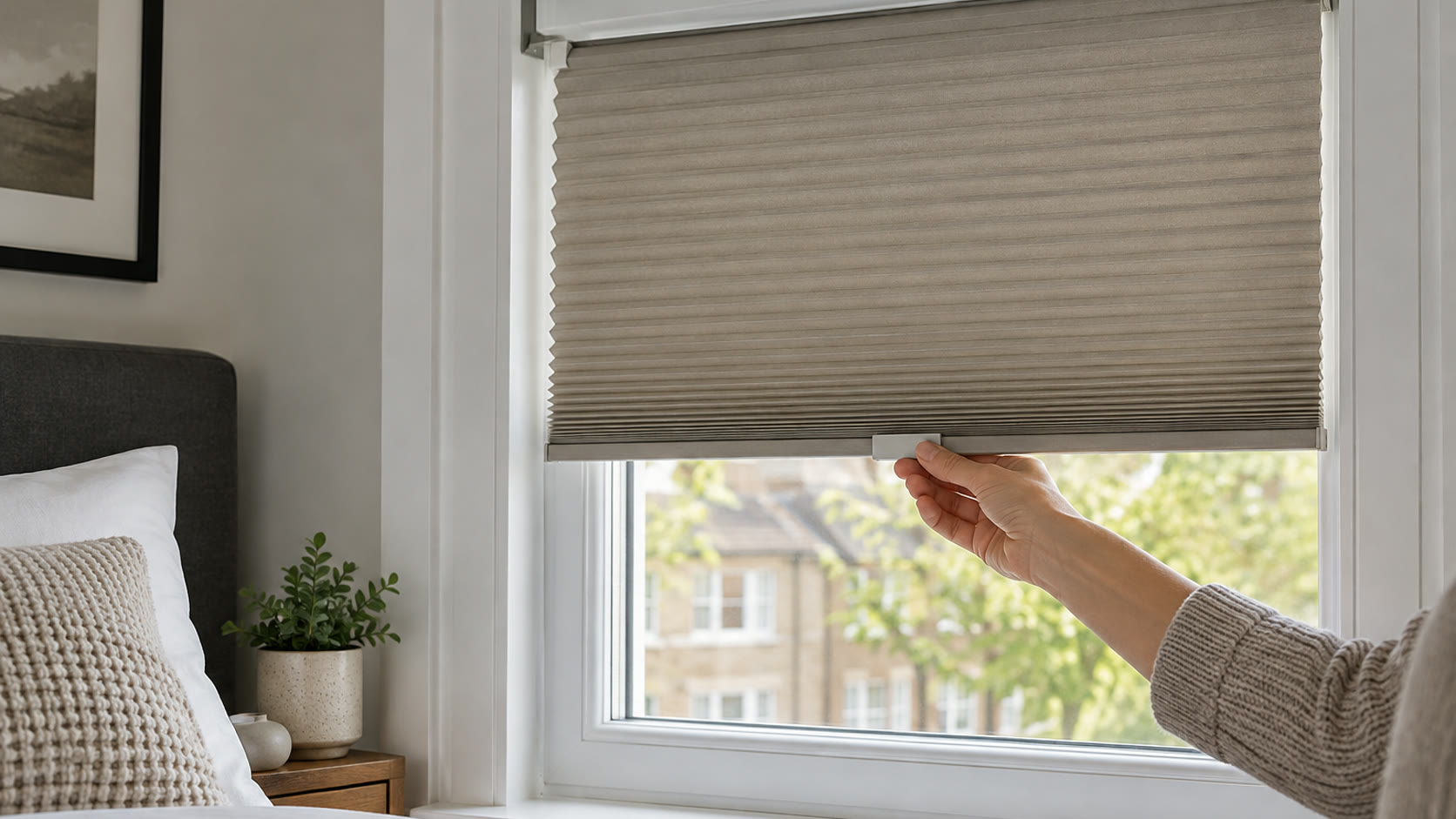
A handle-operated honeycomb blind supplied to a chosen size. Its pleated cells offer a softer appearance than a roller, while the advertised no-drill fitting needs a compatible frame and careful measurement.
What stands out
- Handle-operated cordless control
- Custom-size ordering
- No conventional drilling advertised for compatible frames
Keep in mind
- Fitting compatibility and grip must be checked on the actual frame
- A free-hanging cellular blind can still admit light at the edges
- Custom dimensions need careful confirmation before ordering
- Custom size
- Honeycomb fabric
- Cordless handle
- No-drill fitting
Sol Royal K24 cassette blackout blind with side rails, black, 90 × 175 cm
Best for: A framed no-drill installation on a smooth window
A no-drill cassette roller supplied with adhesive side rails. The frame manages the routes around the fabric more directly than an open roller, provided the window surface is flat, smooth and carefully prepared.
What stands out
- Top cassette and side rails are supplied as one system
- Adhesive installation avoids conventional drilling
- Several listed widths and three neutral colours
Keep in mind
- Surface preparation and flatness are critical
- The cloth is narrower than the complete mechanism
- The looped chain and safety device need careful positioning
- 90 × 175 cm variant
- Polyester
- Adhesive side rails
- Chain controlled
No-drill blinds at a glance
Confirm the current chosen size, surface and complete fitting kit in each listing. A no-drill label does not confirm suitability for every window.
| Option | Attachment | Control | Edge coverage | Main check |
|---|---|---|---|---|
| LazBlinds | Stick-on no-drill fitting | Cordless spring | Ordinary roller edges | Surface compatibility and grip |
| Amazon Basics roller | Clips and adhesive | Cord with tensioner | Ordinary roller edges | Safety-device fixing and 150 cm drop |
| Luxevoir cellular | Custom no-drill fit | Cordless handle | Free-hanging sides | Custom measurements and frame compatibility |
| Sol Royal K24 | Adhesive cassette and rails | Looped chain | Side rails address edge strips | Flat clean surface and chain safety device |
Start with the window, not the no-drill label
“No drill” describes what you do not put into the frame or wall. It does not describe one universal mechanism. Products may clamp over an opening sash, expand against a recess, stick to a frame, clip into a bead or attach a fabric panel with hook-and-loop tape. Each needs a different surface and leaves different light gaps. A blind that looks convenient online can be incompatible with a handle, gasket, vent or shallow reveal.
Measure the opening width at several points and note which part moves when the window opens. Photograph the top frame and the narrowest usable space. Include the projection of handles and the path of an inward-opening sash. If the product attaches to glass, frame or painted plaster, read that exact surface requirement. Avoid assuming a removable product is automatically suitable for a rental.
The British Blind and Shutter Association's product guidance is useful background for understanding how different blind constructions affect fit and light control. A no-drill fitting changes the mount, but it does not change the basic clearance needed by a roller or the perimeter gap around a cellular shade.
The shortlisted options in detail
LazBlinds: an everyday cordless roller
The selected LazBlinds option uses a cordless spring mechanism. You pull the lower bar to set the height rather than leaving a chain at the side. That is a meaningful control difference for rooms used by children, although mounting security and furniture placement still need attention.
It suits a window that matches the listed width and fitting range. As a normal roller, its cloth does not seal the vertical edges. If side strips are the main problem, consider outside overlap where the fitting permits it or add a compatible curtain layer. Check whether the quoted 36 × 72 inch variant fits the complete opening and whether it can be mounted without fouling the sash.
Amazon Basics: compact clip-and-adhesive roller
The selected dark-grey 56 × 150 cm roller uses a no-drill clip-and-adhesive mounting arrangement. Its compact dimensions may suit a smaller window that does not need a custom blind. It retains a cord control and a tensioning device. The UK government's blind-cord guidance makes clear that supplied safety devices must be fitted and accessible loops kept away from children.
The adhesive element needs a compatible clean surface, and its removal may affect a delicate finish. Check whether the chosen variant attaches to the part of the frame you actually have. A no-drill blind that blocks the opening sash or a required vent is not a workable fit.
Luxevoir Panoramix: custom cordless cellular
This light-grey cellular option is ordered to a custom size and operated by a handle, without a hanging chain. The honeycomb material adds a softer layered appearance than a roller. The listing advertises no-drill fitting, but verify the precise mount and eligible frame profile before entering dimensions. A custom order deserves particular care because a measurement error may not be easy to return.
It is a free-hanging shade rather than a complete light-sealing frame. Blackout material in the centre does not remove a perimeter halo. For stronger edge control, a full frame or an overlapping curtain may be preferable if the room and tenure allow it.
Sol Royal K24: adhesive cassette with rails
The K24 combines a top housing with side rails attached to a compatible smooth surface. This is the most direct option here for reducing the bright side strips of an ordinary roller while retaining normal daily raise-and-lower operation. It asks the most of the fitting surface: the adhesive must be prepared and aligned correctly, and the casing must clear handles.
It also uses a looped chain. Plan where the supplied chain safety device will fix before placing the cassette. If there is no safe compatible position for that device, choose a different control. The rails can still leave a bottom corner gap on an uneven sill, and adhesive may not suit painted plaster or textured frames.
A removable panel can be the better fifth route
If the window is an unusual shape or only occasionally needs darkening, an Easynight trim-to-fit cover may provide generous overlap without a permanent roller. It attaches around the opening with hook-and-loop fixing and can be stored away. The trade-off is having to detach or fold it each time you want the view. It is a practical temporary solution, not a substitute for an everyday blind when you open the window frequently.
For a simpler adhesive shade, see our stick-on blackout blind guide. Pleated paper-like products are easy to fit but usually look and wear differently from a fabric roller.
Measure the fitting area, not only the glass
Check the maker's diagram for the width of the entire unit. Roller fabric may be narrower than bracket width. A clamp may need a certain sash thickness and seal profile. A cellular blind may need enough recess depth for the headrail. Adhesive rails need uninterrupted flat strips on both sides. These are separate measurements.
Trial-position the product with removable tape or a paper outline if the surface allows it. Open and close the window. Check whether the handle is still reachable and whether the blind interferes with trickle vents or escape use. Never cover drainage slots or manufacturer-required openings in a uPVC frame.
No-drill options can fail through poor preparation rather than poor product design. Dust, moisture, silicone residue, old paint and cold surfaces all affect adhesive. Follow the supplied cleaning and cure instructions. Do not add household glue to compensate for a surface the maker excludes. For pressure fittings, confirm that the frame can safely take the force and inspect it for movement after repeated use; the twist-fit guide explains that recess-specific route.
Rental and removal considerations
Before buying, check the tenancy agreement and any requirement to seek permission for adhesives or frame attachments. A claim of “damage free” cannot account for your paint, varnish, wallpaper or aged uPVC. Photograph the surface and test the adhesive in an inconspicuous permitted area. Keep packaging and removal instructions, because the method used to release a strong tape can determine whether the finish survives.
If a product falls or shifts, stop using it until the cause is corrected. Repeatedly pressing a failed strip into place is not a reliable long-term fix. A heavy blind above a bed or cot needs secure mounting, regardless of whether holes were drilled.
Child safety and room use
The Office for Product Safety and Standards identifies looped blind cords and chains as a serious hazard. The BBSA's safety guidance favours safe-by-design products without accessible loops. A cordless control can be a good starting point, but check the complete product: pull tabs, clips, mounting hardware and any separate curtain layer must also be secure and inaccessible where appropriate.
Keep cots, beds and climbable furniture away from the window. Fit all supplied safety components exactly as directed. Never tie a loop up as a substitute for the supplied tensioner. A removable panel also needs regular checking so loose clips or attachments do not fall into a child's reach.
Which option should you choose?
For a standard everyday bedroom, the LazBlinds cordless roller is a straightforward control-led choice if its fitting range matches the window. For a compact compatible frame, the Amazon Basics roller is a familiar format but needs careful chain safety. For a custom dimension and softer finish, examine Luxevoir's cellular format. For stronger edge control on a smooth surface, the Sol Royal cassette is more specialised.
If you cannot make the mounting, control and window operation work together, change format. Our no-drill fitting guide takes you through the practical checks, and outside-recess measuring guide explains how overlap affects darkness.
Clear answers
Frequently asked questions
Short answers to the fitting, use and care questions that most often change the result.
Do no-drill blackout blinds really leave no marks?
Not necessarily. Clamps can compress gaskets or finishes and adhesive can leave residue or lift paint. Follow the maker's surface and removal instructions and test where practical.
Which no-drill blind blocks the most side light?
A correctly fitted cassette with side rails usually addresses side strips more directly than a free-hanging roller or cellular blind. Window shape and adhesive alignment still determine the result.
Can a no-drill blind go on uPVC windows?
Many are designed for compatible uPVC frames, but sash shape, gasket, opening direction and warranty vary. Check the exact fitting diagram and avoid obstructing drainage or the moving sash.
Are no-drill blinds suitable for a nursery?
The fixing method does not determine child safety. Prefer an inherently cordless product, check that the mount is secure, fit every supplied safety device and keep cots and furniture away from the window.
What should a renter check before buying?
Check the tenancy terms, ask permission if an adhesive or frame attachment may alter the finish, photograph the surface and keep the installation and removal instructions.