
The short answer
Reversible depends on the surface, not the label
A removable panel can cover an opening without drilling, a suction cover avoids frame adhesive, and a no-drill roller gives daily operation. None is guaranteed to leave a delicate surface unchanged. Check tenancy terms and the actual frame before choosing.
Ask what attachments your agreement permits and keep a record of the original finish.
Choose by surface: smooth glass, sound frame or a compatible no-drill fitting plane.
Confirm removal instructions and test a discreet area where practical.
Product shortlist
Four low-commitment formats
These options differ in how they attach and how often you can use them conveniently. A portable cover is not a direct substitute for a daily roller.
Easynight Blackout Blind, regular 150 × 145 cm
Best for: A removable cover with generous edge overlap
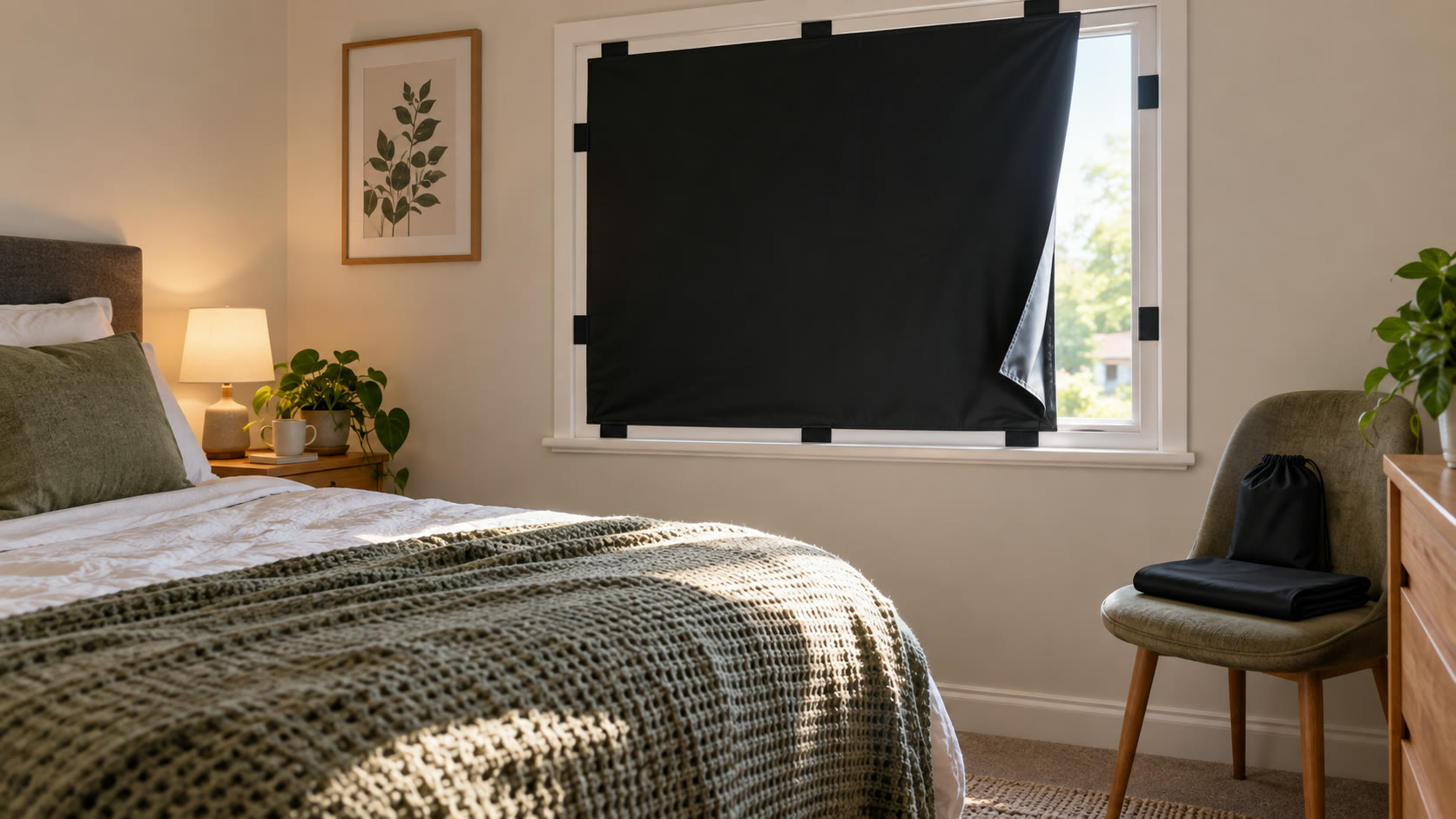
A cut-to-size blackout sheet fixed around the window frame with removable hook-and-loop attachments. It can cover the complete opening more closely than an ordinary roller blind and packs into a storage bag between uses.
What stands out
- Can be cut for an unusual window shape
- Hook-and-loop attachment can reduce perimeter gaps
- No drilling and a storage bag is included
Keep in mind
- Adhesive suitability depends on the frame finish
- Less convenient than a blind for frequent daylight access
- The fabric can look utilitarian in a finished bedroom
- 150 × 145 cm
- Cut to size
- Hook-and-loop fixing
- Storage bag
Maritown stick-on temporary blackout blind, 120 × 180 cm
Best for: A broad removable cover without suction cups
A cut-to-size black fabric panel with self-adhesive fixing and adjustable clips. It offers more coverage than many suction products where the frame finish is suitable.
What stands out
- 120 × 180 cm size
- Can be cut down
- No drilled holes
Keep in mind
- Adhesive can mark or lift delicate finishes
- Daily removal is less convenient than a roller
- The panel must be kept securely fitted and out of children's reach
- 120 × 180 cm
- Cut to size
- Self-adhesive fixing
- Adjustable clips
Amazon Basics Portable Blackout Curtain, beige, 127 × 198 cm
Best for: A large suction-mounted travel cover
A large polyester blackout cover that attaches to smooth glass with suction cups. Hook-and-loop tabs let the fabric gather to suit smaller windows, and the supplied bag makes it practical to store or pack.
What stands out
- No drilling or adhesive on the frame
- Large 127 × 198 cm panel
- Includes a travel bag and is listed as machine washable
Keep in mind
- Requires clean, smooth glass and careful suction-cup removal
- Needs taking down to restore the full view
- Availability and exact colour can change by retailer variant
- 127 × 198 cm
- Suction cups
- Hook-and-loop adjustment
- Travel bag
LazBlinds cordless no-drill blackout shade, black, 36 × 72 in
Best for: A window where a control loop is best avoided
A spring-operated cordless shade that attaches without conventional drilled brackets. It removes the hanging loop found on many ready-made rollers, but its stick-on installation still needs a compatible, clean surface.
What stands out
- Cordless spring operation
- No conventional drilling
- Opaque black fabric in the featured variant
Keep in mind
- A fixed ready-made width will not suit every recess
- Adhesive or pressure fittings still depend on the surface and instructions
- No-drill does not guarantee mark-free removal
- 36 × 72 in
- Cordless
- No-drill mounting
- Black
Rental options at a glance
“No drill” does not mean damage-free. Check current fitting and removal directions for the exact variant.
| Format | Attachment | Useful for | Main risk |
|---|---|---|---|
| Easynight cover | Hook-and-loop around frame | Irregular or occasional window | Adhesive mark or tedious daily removal |
| Maritown panel | Stick-on attachment | Quick temporary coverage | Surface damage and short-life fitting |
| Portable curtain | Suction cups on smooth glass | Travel or temporary use | Cups may release and glass must be cleaned |
| LazBlinds roller | No-drill stick-on fitting | Everyday operation | Fixed width and adhesive suitability |
First check what the rental already gives you
The least disruptive blackout upgrade may be a better curtain pair on an existing pole, not a new blind. If there is a usable pole or track, measure its width, extension beyond the opening and height above it. A generously sized opaque pair can cover side light without touching the frame. If the existing fitting is too low or narrow, however, a different fabric alone may not solve the bright strips. Ask the landlord or managing agent before moving brackets, drilling or using an attachment that could alter paint or uPVC.
Take photographs of the window, frame, wall and current fittings before installation. Read the tenancy terms and the product's removal instructions. “Temporary”, “no drill” and “damage free” are not guarantees for aged paint, wallpaper, varnish, silicone-contaminated frames or a cold damp surface. Test a discreet permitted area where practical. Keep the packaging and any adhesive release instructions so that removal is not improvised at the end of a tenancy.
Removable fabric for awkward openings
The Easynight cover can be trimmed to fit and attached around the opening with hook-and-loop pieces. Its advantage is adaptable coverage: it can overlap a frame more generously than a stock roller, including an unusual window shape. The trade-off is routine. If you need to open the window and restore daylight every morning, detaching or folding a large sheet may become tiresome. Its appearance is practical rather than tailored.
Measure the area you want to cover, not just the glass, and leave access to handles and ventilation. Confirm that the chosen frame surface is compatible with the hook-and-loop adhesive. Do not bridge a trickle vent with fabric or tape. The GOV.UK ventilation guide for England explains why vents should remain available and moisture should not be trapped behind a covering. If condensation is common, remove the sheet periodically to inspect and dry the window.
The Maritown stick-on panel is another quick route. It is simpler and can suit a short stay or a room where a temporary finish is acceptable. It is not necessarily a robust everyday blind and may be affected by repeated raising, folding or removal. Check the actual supplied width and how its adhesive joins the frame. An adhesive strip on old paint can be more consequential than a small screw hole that the tenancy permits; judge the real surface rather than the marketing label.
Suction cups keep adhesive off the frame
The selected Amazon Basics portable curtain attaches to clean smooth glass with suction cups and packs away. That makes it useful for a temporary bedroom or travel, and it avoids applying adhesive to a painted frame. Suction can fail on textured, dirty or unsuitable glass, and a large fabric panel needs careful positioning. Check that the cups do not interfere with an opening sash and remove them by the maker's method rather than pulling sharply on the fabric.
This option is best for occasional use or a window where daily removal is acceptable. It may leave a perimeter gap if the panel cannot reach beyond the glass. If the glass is recessed inside a wide white frame, the frame can reflect light around the edge. Compare the panel dimensions with the full bright opening before ordering. Our suction-cup blind guide explores that fit in more detail.
No-drill roller for normal daily use
The LazBlinds cordless roller operates more like a conventional blind and may be preferable when the room is occupied long-term. The selected variant uses a no-drill fitting and has no hanging side chain. Its ready-made width still has to fit the actual frame, and its free edges can let daylight through. Measure the complete opening at several positions and check the installation surface, sash, gasket and handle. An adhesive headrail that later releases is not a small cosmetic issue, especially above a bed. For a curved top, use the arched-window options rather than assuming a rectangular headrail can follow the shape.
Other no-drill products use clamps or clips rather than adhesive, but each has its own frame limits. Do not force a clamp over a gasket or seal if the maker excludes it. Check the window warranty and ask permission if in doubt. The no-drill blind guide compares the main systems, while how to fit one covers preparation and clearance.
| Situation | First format to consider | Check before fitting |
|---|---|---|
| Existing pole, standard bedroom | Wider opaque curtains | Pole height, panel fullness and centre overlap |
| Unusual opening, occasional need | Trim-to-fit removable cover | Adhesive surface and removal routine |
| Smooth glass, short stay | Suction-cup portable panel | Cup grip, full-panel size and sash operation |
| Long-term daily use | Compatible no-drill roller | Headrail security, width and edge light |
Safety, removal and a realistic darkening result
Where children use the room, favour a safe-by-design control where suitable and keep cots and climbable furniture away from the window. The Office for Product Safety and Standards' blind-cord guidance applies even in rentals: a no-drill mount does not make a looped chain harmless. Check for loose suction cups, adhesive tabs and detachable parts as well. A temporary item should not be left in place after its attachment starts to fail.
Do not block an escape window, lock a sash shut with a covering or remove background ventilation to gain darkness. Inspect for condensation behind any panel and manage the underlying moisture. At removal time, follow the maker's release steps and stop if paint begins lifting; seek the landlord's agreement on the safest repair rather than pulling harder. The aim is a bedroom that is darker and still easy to live in, without turning a reversible fitting into a deposit dispute. If edge gaps remain, diagnose them with the light-gap guide before adding more adhesive.
Clear answers
Frequently asked questions
Short answers to the fitting, use and care questions that most often change the result.
Do I need landlord permission for stick-on blinds?
Check your tenancy agreement and ask if the attachment may alter the finish. An adhesive product can leave residue or lift paint even when marketed as removable.
Which rental blackout option avoids adhesive on the frame?
A suction-cup cover can attach to suitable clean glass, but check its size and whether the cups stay secure. It still needs removing for full window access.
Can no-drill blinds damage uPVC?
Adhesive can leave residue, while clamps can compress seals or mark a frame. Follow the maker's restrictions and the window warranty.
What is the easiest daily solution?
A compatible no-drill roller or an existing curtain pole may be easier to operate each day than a removable fabric sheet. The right choice depends on fit and permission.
How can I reduce light gaps without changing the window?
Size a removable panel to overlap the bright opening, or use curtains on an existing pole. Keep vents, handles and emergency window use accessible.