The short answer
Honeycomb texture does not by itself mean blackout
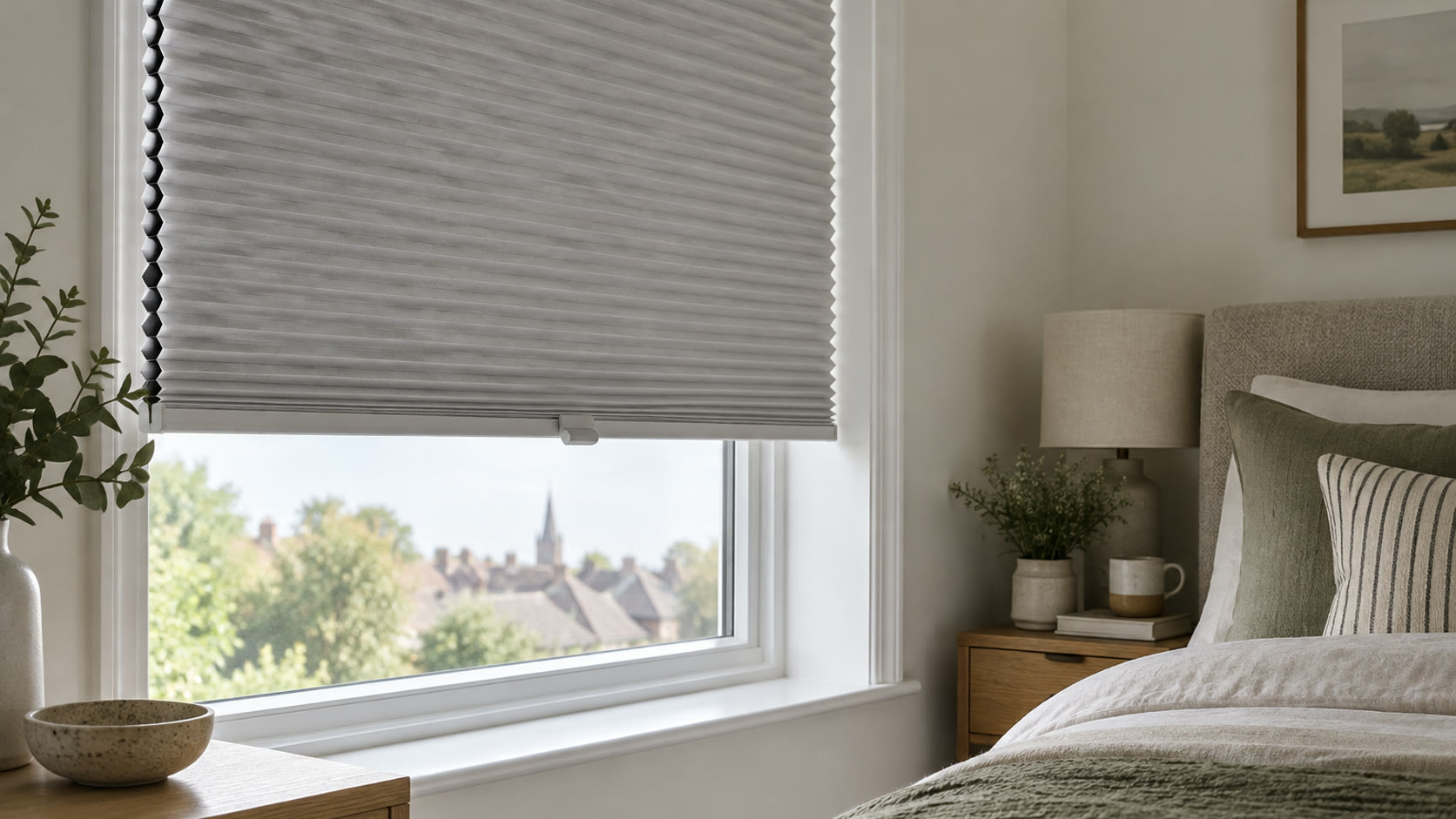
A cellular blind has pleated pockets that create a soft layered panel. Choose the specific blackout fabric if you want to block light through it, then decide whether ordinary side gaps are acceptable or a frame is needed. Check custom measurements and the control as carefully as the colour.
Confirm the selected fabric is blackout rather than light-filtering.
Compare free-hanging, no-drill and full-frame installations by their edge coverage.
Treat thermal claims as product-specific; do not infer a fixed room or bill saving.
Product shortlist
Two different cellular routes
The cordless Luxevoir shade is a custom no-drill option; the TIPIACE system adds a full frame and top-down bottom-up movement. Their fitting requirements differ substantially.
Luxevoir Panoramix cordless cellular blackout blind, light grey, custom size
Best for: A custom-sized honeycomb blind without a hanging chain
A handle-operated honeycomb blind supplied to a chosen size. Its pleated cells offer a softer appearance than a roller, while the advertised no-drill fitting needs a compatible frame and careful measurement.
What stands out
- Handle-operated cordless control
- Custom-size ordering
- No conventional drilling advertised for compatible frames
Keep in mind
- Fitting compatibility and grip must be checked on the actual frame
- A free-hanging cellular blind can still admit light at the edges
- Custom dimensions need careful confirmation before ordering
- Custom size
- Honeycomb fabric
- Cordless handle
- No-drill fitting
TIPIACE framed top-down bottom-up cellular blackout blind, black
Best for: A made-to-size recess with flexible top-down control
A custom-size honeycomb blind inside a full aluminium frame. The fabric cells conceal the internal lift cords, while the frame addresses side leakage more directly than a free-hanging cellular blind.
What stands out
- Full frame manages perimeter light
- Cordless top-down bottom-up operation
- Custom dimensions for non-standard openings
Keep in mind
- Needs a deep, square recess and screw fixing
- Custom products require especially careful measurement
- The configured item may not be returnable if dimensions are wrong
- Custom size
- Honeycomb fabric
- Aluminium frame
- Cordless manual control
Cellular blinds at a glance
Both are custom-size examples. Check the exact selected blackout fabric, depth, fixing method, return terms and complete dimensions before ordering.
| Option | Fitting | Control | Side coverage | Main trade-off |
|---|---|---|---|---|
| Luxevoir Panoramix | No-drill fitting on a compatible frame | Cordless bottom handle | Free-hanging panel | Edge light remains possible |
| TIPIACE framed | Screw-fixed full aluminium frame | Cordless top-down bottom-up | Frame addresses perimeter | Deep square recess and precise custom sizing |
What a cellular blind is
A cellular blind is made from pleated material joined into pockets or cells. Seen from the side, these can resemble a honeycomb. The front presents a neat horizontal texture; the internal space separates layers of fabric. Some designs hide lift cords inside the cells so there are no visible holes through the face. Others use a separate liner to make the material opaque. The pleated-blind guide distinguishes single pleats, honeycomb cells and temporary pleated panels.
The British Blind and Shutter Association's cellular-blind overview explains the construction and available controls. Its product-characteristics guidance notes that blackout fabric is available but light can enter at the extremities unless a frame or channel addresses them. This is the key buying distinction: a dark centre panel and a dark finished room are not the same thing.
Cellular blinds often suit bedrooms where a softer appearance is wanted than a flat roller. The pleats stack at the head when raised, which may partly cover the top of the glass. Check the stack height on a small window before ordering. A deep recess can hide the stack more neatly but must also allow the sash and handle to move.
Blackout, dim-out and light-filtering fabrics
“Cellular” tells you the shape, not the opacity. A pale light-filtering fabric can soften glare while leaving the room bright. A blackout variant has an opaque layer or construction intended to stop visible light through the central panel. Confirm the selected colour and fabric code in the order, because sellers may group several opacities under one listing.
Look at samples in direct daylight if the supplier offers them. Check both sides and any seams. A photograph of a darkened room can be affected by exposure and is not a substitute for a fabric specification. If the room is used for daytime sleeping, consider the side and top routes as well as fabric transmission.
The term “thermal” often appears beside cellular products. The pockets create an air layer, but that does not let us promise a fixed heating-bill saving or temperature drop. The Energy Saving Trust's window guidance puts window coverings in the context of glazing and draughts. Consider the complete window and actual use rather than converting a fabric marketing number into a household result.
Two product formats in detail
Luxevoir Panoramix: a cordless custom shade
The selected light-grey Luxevoir is listed as blackout, custom-size and handle-operated. It is marketed for no-drill installation on a compatible window. That combination can appeal to renters or households that prefer to avoid a hanging cord. Measure the actual fitting surface and request the maker's exact method before entering a custom dimension.
Because the panel is not inside a complete perimeter frame, it can leave a light line beside the cloth. The size of that line depends on the reveal and how the blind sits. If strong edge darkness matters more than a simple mounting method, a framed option may be worth the additional work.
Customisation increases the consequences of an incorrect measurement. Record width at the top, middle and bottom, plus clear depth and any handle projection. Check the order summary and return terms. A blind made to your numbers may not be covered by ordinary change-of-mind returns.
TIPIACE: framed top-down bottom-up cellular
The TIPIACE option places the honeycomb shade inside a full aluminium frame and uses cordless top-down bottom-up control. You can reveal upper glass while keeping lower glass covered, useful where privacy and daylight need to coexist. The surround is intended to manage perimeter light more directly than a free-hanging shade.
This is a permanent, screw-fixed custom installation. It needs adequate recess depth and a square enough opening. Measure in several places and check diagonal differences. Account for handles, vents and an opening sash. If the reveal tapers significantly, ask for a professional survey or the maker's advice before paying for a made-to-size frame.
The frame cannot guarantee absolute darkness at every corner. Uneven plaster, sill geometry and fitting tolerance still matter. The trade-off is clear: stronger integrated coverage in exchange for more demanding specification and installation.
Free-hanging versus framed: choose by the light path
Lower a current blind or hold an opaque sheet across the glass and look for the remaining bright edges. If the main problem is light through the old fabric, a blackout free-hanging cellular blind may be enough. If side and top leakage dominate, a full frame or curtain layer is more likely to address what you can actually see.
The colour of a cellular blind changes the interior look but is not a reliable proxy for darkness. Pale blackout fabrics exist; dark light-filtering fabrics also exist. Edge fit and opacity must be checked separately. For a comparison with another common format, read roller versus cellular blackout blinds.
Measuring and installing a cellular blind
Use the chosen manufacturer's measuring method. For a recess fit, take width and height in multiple places and note the smallest clear point, but do not apply your own deduction unless the instructions require one. For a face fit, account for the full headrail and desired side overlap. A framed product also needs diagonal, sill and depth checks.
Check how the blind stacks when raised and how the bottom handle moves. A low handle can catch a window lock or furniture. A top-down section needs room for its rails and may expose a different line of light when partly open. Do not block trickle vents, drainage or an escape opening.
An adhesive or no-drill version needs a clean compatible surface; a screw-fixed frame needs a sound substrate and suitable fixings. Neither should be improvised. Operate the completed blind gently through its full travel. If it sticks, binds or drops unevenly, correct alignment before repeated use.
Child safety and care
Cordless controls remove a hanging operating chain, but product safety still depends on the complete assembly. The Office for Product Safety and Standards and BBSA child-safety guidance favour designs without accessible loops and advise keeping cots and furniture away from windows. Check the mount regularly, especially a no-drill fitting above a child's sleeping area.
Dust pleats gently with a soft brush or low-suction upholstery tool if the maker permits it. Do not crush or wet a lined cell without care instructions. Open the blind to inspect condensation on the glass and frame. A close-fitting shade can conceal moisture that still needs ventilation and cleaning.
Which cellular format is right?
Choose a free-hanging cordless blind when you want the honeycomb appearance, a simpler fitting method and can tolerate some edge light. Choose a framed system where strong perimeter control, flexible top-down positioning and a permanent precise installation justify the extra cost and measurement risk. If the window is shallow or irregular, a cassette roller guide or curtain layer may offer a more forgiving solution.
Clear answers
Frequently asked questions
Short answers to the fitting, use and care questions that most often change the result.
Are cellular and honeycomb blinds the same thing?
In everyday buying language, yes. Both describe pleated fabric with internal cells; constructions, cell sizes, linings and controls vary by product.
Are all cellular blinds blackout?
No. Many are light-filtering. Choose a specifically stated blackout fabric and confirm the exact colour and variant; light can still enter around the edges.
Are honeycomb blinds more insulating than rollers?
Their cell construction is intended to create an air layer, but the effect in a particular room depends on glazing, fit and use. Avoid assuming a fixed saving from the shape alone.
What is top-down bottom-up control?
It lets you open part of the blind from the top while keeping the lower part covered, or move it from the bottom. Check the mechanism's travel and the exact frame it requires.
Can cellular blinds be safe for a child's room?
An inherently cordless model avoids an accessible operating loop, but the whole blind must be fitted securely and suitable for the room. Keep cots and furniture away from the window and follow current UK safety guidance.