
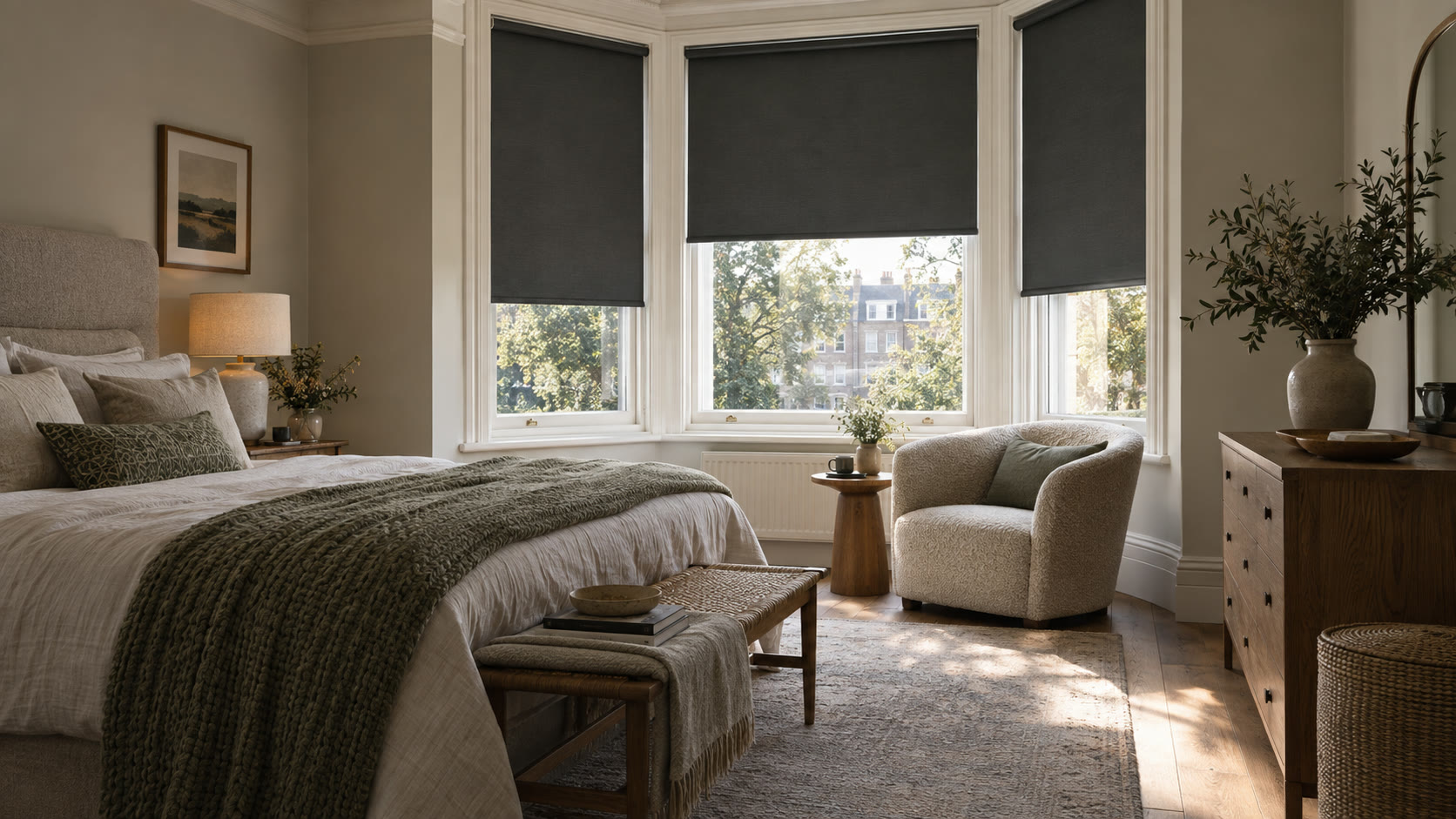
Identify the bay shape before choosing a blind
An angled bay usually has a broad central face and two sides meeting it at oblique corners. A square or box bay has 90-degree returns. Bow windows can have several narrower facets. These shapes change where headrails meet, how much projection each blind can have and which side receives its control. Make a plan view of the bay before looking at fabric colours. Write down each face width, the inside angles if known and the depth from glass to room-side edge of the reveal.
The main complication is at each joint. A roller tube, brackets and control end are often wider than the cloth itself. Two adjacent blinds may each fit their own glass but collide at the corner. Blinds2go's angled-bay measuring guide covers several formats with product-specific corner allowances rather than a universal subtraction. Its projection figures vary with the product and fixing position, so use the exact selected system’s instructions rather than transferring another system’s numbers. Our bay measuring guide gives a neutral recording process to take to the chosen supplier.
Check whether you want to mount within each recess, on each window frame, on the ceiling above the bay or outside the entire bay opening. The last option can reduce some junctions but requires room-side projection, a straight fixing line and enough width to cover the full aperture. It can make access to the sill and opening windows less convenient. The first option keeps the bay usable but may leave a narrow line of daylight at each corner. No single mounting route is automatically darkest in every room.
Plan view: where neighbouring hardware can collide
Look down through the bay instead of judging it from a front photograph. The shaded bands below represent the space occupied by brackets, a roll or a headrail—not simply the cloth line. If those bands overlap at a corner, two apparently suitable widths may not operate together.
Angled bay: separate the hardware envelopes
Square corner: check more than the top rail
Use the deepest relevant part at each junction
A tube, end bracket or cellular headrail may govern the top clearance, while a lower bar governs another height. A projecting handle can push the intended blind line farther into the room. That increases the space the neighbouring system needs at the corner. Do not assume a tidy headrail join proves the bars or opening windows will clear.
| Position | Record | Resolve before ordering |
|---|---|---|
| Left face | Full unit width; deepest bracket/roll; control end | Clearance to centre hardware and left handle |
| Centre face | Both end profiles; roll depth; lower-bar ends | Two corner interfaces, which may differ |
| Right face | Full unit width; deepest bracket/roll; control end | Clearance to centre hardware and right handle |
| At operating height | Sash/handle movement, lowered bar and vent position | Free movement and intended ventilation in every routine position |
Blinds2go’s angled-bay guide (PDF) illustrates why projection matters and uses a template based on the chosen construction. Follow the selected supplier’s current bay method; the diagrams here do not supply a universal subtraction. Mark your intended mechanism envelopes on the bay measuring record, then compare the remaining corner-light routes with a bay curtain layer.
Compare separate-panel blind formats
Separate roller blinds are straightforward to operate face by face. Their fabric can be specified as blackout, but look closely at the mechanism width and side gap. A conventional chain-operated roller also needs safe control positioning. The FURNISHED roller below is an example of a standard drilled format for one rectangular bay face; it does not include a corner template or multiple matching units. Check its precise selected width and whether the listing dimension describes the full unit or the fabric.
Cellular or honeycomb blinds are another route when the headrail and mounting depth suit the window. A cordless model avoids a hanging loop, but that does not by itself prove a dark edge seal. The Luxevoir product below illustrates a custom-size cellular format. Ask the seller for the minimum and maximum width, rail dimensions and fitting tolerance of the selected option. Our cellular-blind guide explains fabric and rail differences in more detail.
Pleated, frame-fit and shutter-like systems may suit particular glazing or frame designs. A frame-fit system requires compatible glazing beads and may not work on old timber frames; an adhesive temporary shade needs a surface that can safely take its fixing. Choose the mounting method first, then the operating style. If a room is used by children, use the OPSS blind-cord guidance when assessing any loop or chain. Do not assume an older existing blind becomes safe because a new curtain is fitted in front of it.
| Format | Useful where | Bay-specific check |
|---|---|---|
| Separate rollers | Each face has a sound rectangular fixing area | Tube and bracket clearance at both corners |
| Cellular blinds | A slim rail and chosen control suit the frame | Rail depth and side reveal consistency |
| Room-side curtain | Corner glow is the main concern | Track geometry, fabric stack and support |
Plan for the corner light rather than hiding it in a photograph
With separate blinds, daylight often appears where two fabrics stop short of the angle. This is not necessarily a defective fabric. It follows from the physical space the neighbouring mechanisms need. Put a strip of removable card against each proposed blind line and look from the bed or seat where the room is used. You will see whether the corner line is tolerable. A blackout lining does little for a line of uncovered glass.
A deeper installation can change the visible gap, but it can also interfere with window handles, vents or a projecting sill. Ask whether the blind can sit closer to the glass without obstructing the sash. For some bays, an over-bay curtain is a simpler final layer. A continuous track lets fabric pass in front of several corner junctions, although curtains still need top and side coverage. Our light-gap guide describes the distinction between fabric opacity and edge coverage.
Consider how each window opens. A casement may swing towards a blind, a sash may need its upper and lower parts to move, and a radiator below the centre can complicate a floor-length curtain. Test the intended blind stack and operating path with each opening fully used. A solution that blocks ventilation or ordinary access is not a good fit, however dark it looks when closed.
A bay-window ordering checklist
Record each face at top, middle and bottom; note the smallest internal width if the maker asks for recess size. Mark corners, handles, hinges, vents and the position of any existing curtain track. Photograph a ruler held beside the frame for scale. Then request the selected supplier's bay-specific measuring instructions for the actual blind style. Do not transplant a deduction given for aluminium venetians to a roller or cellular headrail. For a made-to-measure order, ask the seller to confirm the final manufactured dimensions and which measurements they expect from you.
Before purchase, check selected variant, finish, control side and quantity. Three faces normally require three separately ordered blinds, and the two side faces may not match the centre width. Verify that the brackets will fix to an appropriate substrate; deep plaster or old timber can require different fixings. If drilling near glazing or uncertain services, use an installer. Where the bay is part of a protected historic interior, check alterations before drilling into original joinery; Historic England's window guidance explains the importance of preserving significant fabric.
Finally, close the proposed system in daylight and inspect it from the actual resting position. If you need a very dark room, budget for a second layer at the corners rather than assuming every face-blind combination will meet perfectly.
Products for this job
Two blind formats for individual bay faces
These are separate-panel examples, not a complete bay kit. Their mechanism widths, fixing methods and size limits must be checked against each face and corner.
FURNISHED blackout roller blind, black, 60 × 165 cm
Best for: A familiar daily blind in a standard bedroom
A conventional coated roller blind with a broad size range and several fitting positions. It is useful when you want an everyday blind rather than a panel that must be removed each morning.
What stands out
- Many width and drop options are listed
- Can be fixed inside or outside the recess
- A trim-to-width route for awkward standard sizes
Keep in mind
- The fabric is about 4.5 cm narrower than the complete mechanism
- The looped chain and supplied safety device must be fitted correctly
- An ordinary roller does not seal the sides
- 60 × 165 cm
- Coated polycotton
- Bracket mounted
- Chain controlled
Luxevoir Panoramix cordless cellular blackout blind, light grey, custom size
Best for: A custom-sized honeycomb blind without a hanging chain
A handle-operated honeycomb blind supplied to a chosen size. Its pleated cells offer a softer appearance than a roller, while the advertised no-drill fitting needs a compatible frame and careful measurement.
What stands out
- Handle-operated cordless control
- Custom-size ordering
- No conventional drilling advertised for compatible frames
Keep in mind
- Fitting compatibility and grip must be checked on the actual frame
- A free-hanging cellular blind can still admit light at the edges
- Custom dimensions need careful confirmation before ordering
- Custom size
- Honeycomb fabric
- Cordless handle
- No-drill fitting