
Find out why the side is bright
Close the pair and look from the pillow or other important position. A side strip can have three main causes: the pole stops too close to the frame; the fabric does not have enough width to remain over the outer edge when drawn; or the curtain hangs away from the wall, allowing an oblique view behind it. Photograph each side at the brightest relevant time, then check whether the top and centre are also leaking. Treat the dominant route first.
Hold the outer curtain edge gently towards the wall. If the visible strip disappears, a return or different end position may help. If the strip remains because the panel cannot reach the wall without pulling the centre apart, the pair is too narrow. If the pole itself ends at the opening, moving fabric along it cannot create enough wall overlap. This quick diagnosis can prevent buying hardware that addresses the wrong problem.
Give the pair enough room to cover the opening
John Lewis's curtain buying guide suggests about 15–20 cm of pole beyond each side of many windows. That is a starting point, not a guaranteed blackout specification. Mark the extension with tape and check for wardrobe doors, walls, radiators and secure bracket points. A wider pole gives the open curtains more place to stack off the glass, but the closed pair must span the new length as well.
Calculate combined flat panel width against the usable hanging span. If the panels only just meet in the middle, extending the pole without replacing them may make the centre gap worse. Our fullness guide explains the calculation, and the measuring guide shows how to check per-panel listing widths. The dark eyelet pair below is only a sizing example; its particular 46 × 54 inch variant will not suit every opening.
If you cannot extend hardware because the window meets a side wall, consider whether a blind within or over the opening can provide the missing edge coverage. A close-fitting frame or face-fixed blind has its own limitations, but it can create a second light barrier behind the curtain. Avoid placing furniture or a cot against window controls.
Bring the end of the curtain towards the wall
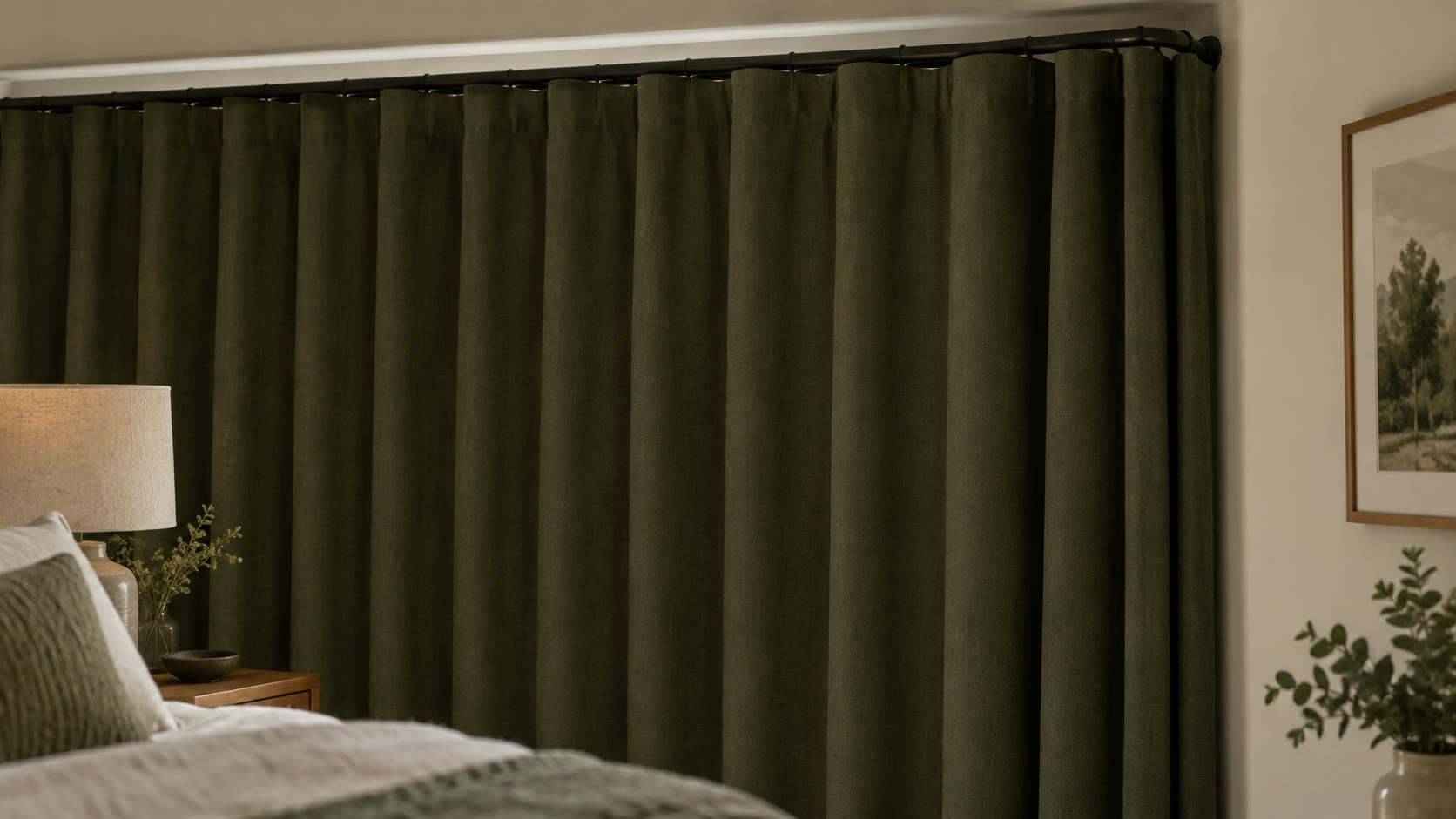
A wraparound pole curves back to the wall. A compatible track may include a return bend. These arrangements reduce the direct view behind the curtain's outer edge, provided there is enough fabric to follow the path. French-return pole guidance illustrates the geometry. Check the exact model's bracket depth and curtain-heading compatibility, rather than assuming the word “wraparound” means a sealed edge.
The Umbra Twilight example below is a return-style pole with a required centre support. Confirm that its adjustable span, diameter and fixings suit the window and fabric. Eyelet curtains may need their final eyelet beyond an outer support; Dunelm's hanging advice explains how that can hold the curtain edge. The setup must still slide freely and be supported for the curtain weight. Do not force stiff eyelets around a bend.
Moving the outer edge toward the wall is different from sticking the fabric to the wall. Daily opening and closing can detach adhesive strips and strain the lining. A properly chosen return or a fuller pair is more repeatable. In a rental, check permission before drilling new brackets; a reversible blind layer may be a more appropriate compromise than an insecure heavy pole.
Layer only where it improves the geometry
A blind behind curtains may intercept light that comes around the outer fabric, especially if its edge does not align with the curtain gap. It may also create a new top or side leak, so view the combined result in daylight. A roller in a recess often has fabric narrower than its complete mechanism; an outside-recess mounting or framed system can give different coverage. Our guide to light leaking around blinds helps compare those possibilities.
If the room is for a child, a blind layer brings specific cord and chain hazards. Use cordless options where suitable, fit supplied safety devices correctly and follow UK product-safety guidance. Secure curtain brackets and keep climbable furniture away from the window. Once the side strip is reduced, close the pair several times and check the centre, hem and top. The aim is dependable daily coverage, not an improvised seal that makes the window difficult to operate.
Products for this job
Return pole and curtain examples
The pole and eyelet pair are separate examples; measure the actual window and confirm their compatible dimensions before buying.
Umbra Twilight wraparound curtain pole, black, 30–84 in
Best for: Bringing eyelet curtain ends closer to the wall
A curved-end steel curtain pole that lets a compatible curtain return towards the wall instead of ending in front of the window edge. It addresses side spill, not the gap above the heading.
What stands out
- Curved ends bring fabric back towards the wall
- Adjusts across the listed span
- Supplied hardware includes a centre support
Keep in mind
- The curtain still needs enough width to form the return
- A centre support and sound wall fixings are essential
- Does not close a bright gap above the pole
- 30–84 in adjustable span
- Black steel
- Single wraparound pole
- Centre support required
Deconovo blackout eyelet curtains, black, 46 × 54 in, pair
Best for: An affordable ready-made eyelet pair
A widely sized pair of soft eyelet curtains made for a standard pole. The dark colour is useful where room darkening matters more than a pale decorative finish.
What stands out
- Many size and colour variants are grouped under the listing
- Pair format suits conventional bedroom windows
- Simple eyelet heading is quick to hang on a compatible pole
Keep in mind
- Darkening depends on pole position, width and centre overlap
- Eyelets can leave a bright band above a low-mounted pole
- The listing's thermal wording is not a measured room-saving guarantee
- 46 × 54 in
- Pair
- Eyelet heading
- Polyester