
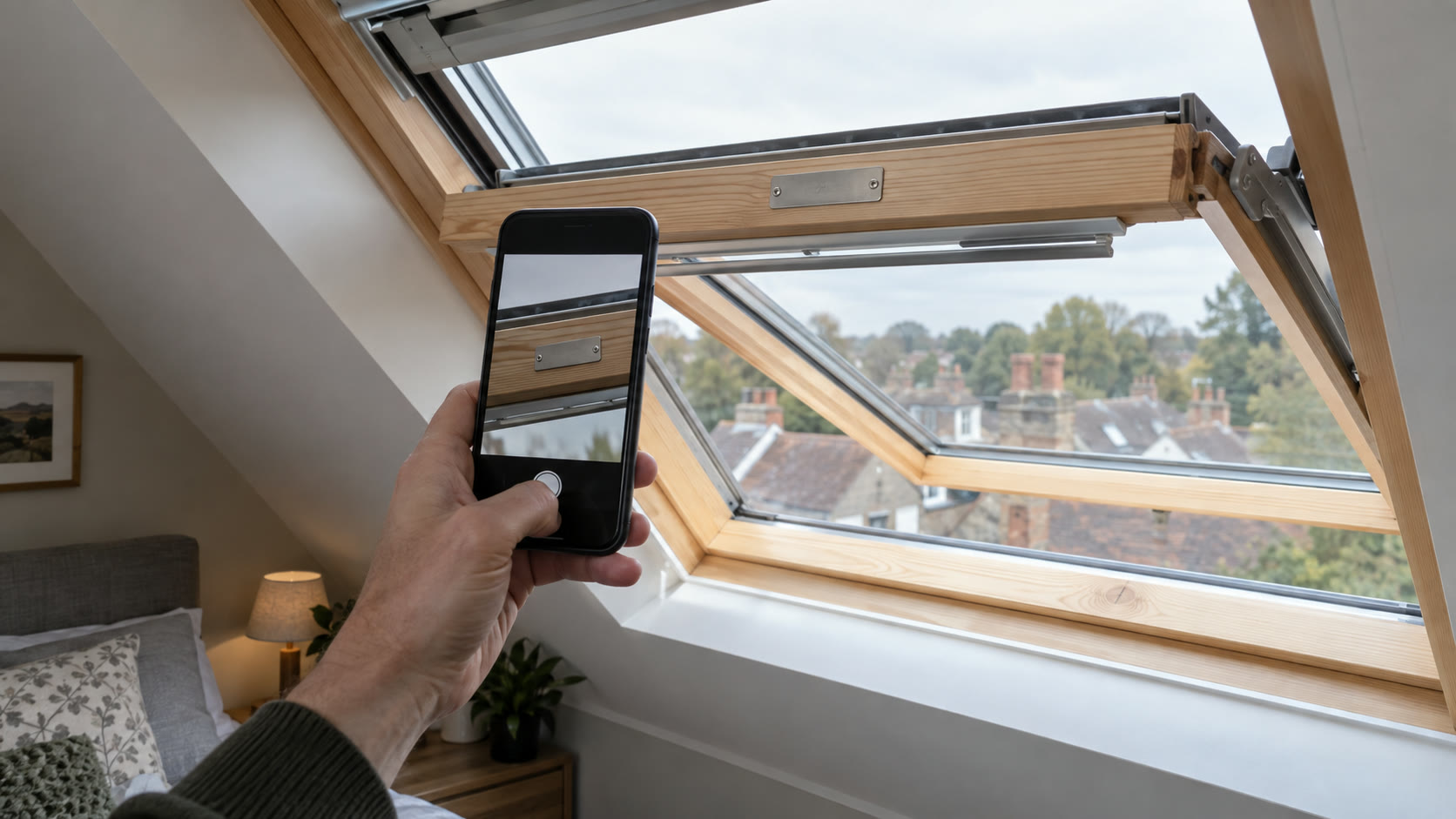
Find the type sign from a safe position indoors
The identification label is the most reliable starting point for a code-matched blackout blind. For many VELUX pitched roof windows, VELUX's type-sign guide shows it on the top of the sash, behind the ventilation flap when the window is opened in the instructed way. Other manufacturers and older generations may place a label elsewhere. Start with the maker's documentation, not an assumption based on a neighbour's window.
Before touching the sash, check that the opening mechanism works normally and the window is reachable from a stable indoor floor. Follow VELUX's safe product-identification advice. Do not stand on a bed, sill or precarious ladder, lean onto a roof, force a stuck sash or operate a damaged hinge just to read a code. If it cannot be accessed safely, use installation paperwork or ask the installer or manufacturer for help. A clear photograph from an existing safe position can be more useful than a hurried transcription.
Photograph both the entire window and the type sign. The wide image shows whether it is a pitched window, flat rooflight, opening roof hatch or lantern. The close image preserves small letters and numbers that can be misread. Avoid flash glare by taking more than one shot. Keep the images with the room's renovation records, because the same code may be needed for future accessories or replacement parts.
Copy the maker, type, size and variant exactly
A type plate can contain several fields: manufacturer, window type, size code, variant and production information. Do not use just the most prominent digits. VELUX's type-sign guide explains the fields on its labels; its size overview shows why letters and numbers together matter. A code such as MK04 is not a decorative colour name or a generic pane width. Small differences in prefix or generation can change the accessory fit.
Write down every line exactly as printed, including spaces, zeros and letters that resemble numbers. If the label is worn, inspect the photograph at higher magnification instead of guessing. An “O” and “0” or an older two-character prefix may be easy to confuse. Compare the photographed label with the manufacturer's code chart. Do not infer the code solely from the outer frame measurement; two windows can have similar visible glass but different accessory rails or installation generations.
If the window belongs to another manufacturer, use that maker's identification instructions. Third-party blinds may advertise compatibility with a named maker, but the product should still state the exact type and size code family. “Fits most VELUX windows” is not enough for an order. Keep the code photograph available when contacting a seller so the selected variant can be confirmed in writing.
| Record from the window | Why it matters for a blind |
|---|---|
| Manufacturer | Accessory and rail systems differ |
| Window type | Opening and frame design affect fit |
| Full size code | Width and length family must match |
| Generation or variant | Older and newer rails may differ |
| Whole-window photo | Confirms pitched versus flat-roof context |
Read the label in fields, not as one number
These original reading diagrams separate the information needed for a blind order. They are schematics, not replicas of a particular label. Field order and label appearance vary by generation; copy your own plate in full.
VELUX: keep type and size together
VELUX’s identification guide names four fields: type, size, variant and production code. Keep the photograph alongside the written record so an uncertain character can be checked rather than guessed.
FAKRO: use the sash plate’s window size
FAKRO’s internal-accessory guidance directs readers to the size on the sash data plate. Its compatibility statement concerns FAKRO’s own internal accessories, excluding insect screens; it is not evidence that a generic third-party blind fits every FAKRO window.
Code checks before choosing a variant
The current VELUX size overview lists MK04 as 78 × 98 cm, MK06 as 78 × 118 cm and PK04 as 94 × 98 cm. These are nominal window sizes, not glass or blind-fabric measurements.
| Plate or listing | Useful cross-check | Before ordering |
|---|---|---|
| MK04 vs MK06 | Same nominal width; different height | Do not replace one size selection with the other |
| MK04 vs PK04 | Same nominal height; different width | Retain the letters as well as the digits |
| M04 vs MK04 | Older and newer codes in the nominal 78 × 98 cm family | Use the exact blind range’s generation and bracket compatibility—not size alone |
| DKL vs GGL | A blind-type code is not a window-type code | Identify the window first, then select the accessory |
| FAKRO size entry | Belongs to that manufacturer’s selection system | Match the model and size within the specified accessory range |
VELUX’s published blind size tables (PDF) group M04/MK04 under the same nominal dimensions, while separating the older-window Basic range. That is a size cross-check, not permission to substitute every blind between generations. For example, the two product cards on this page represent selected M04 and MK04 routes; each still needs its own compatibility confirmation.
For the difference between blind and window codes, see Itzala’s code explanation. Record the selected blind’s full name, supported window type, size and generation before comparing controls or colours. If any field is unresolved, leave the order unresolved too.
Use the complete code against the accessory list
Once the window is identified, choose an accessory designed for that exact window family. A maker's original blind is one route; a third-party blind can be another if its compatibility list names the full code. Check whether the blind includes rails, brackets and controls, and whether the selected listing variant matches the code rather than merely showing it among many options. Verify fabric type if you need blackout: a light-filtering pleated shade and a blackout blind can share a code family but produce different room-darkening results.
The two examples below illustrate why similar-looking codes should not be collapsed. The Bloc example is listed for a VELUX MK04 compatibility route; the VELUX replacement example is listed for an older M04 route. Their shared nominal window-size family does not make them interchangeable recommendations. Read the current seller's exact selected option and the manufacturer's compatibility instructions before purchase. Our VELUX blackout-blind guide explains older and newer code families in more detail. For a general sloping-window comparison, see blackout blinds for roof windows.
Do not confuse pitched roof windows with flat rooflights. VELUX's flat-roof blind range separates accessories for flat or curved glass and dome systems from pitched-window blinds. A horizontal roof lantern is another category again; it may need a tensioned made-to-measure system. Our flat-rooflight guide and roof-lantern guide cover those distinctions.
If the label is missing, unreadable or inaccessible
Check installation invoices, building handover documents, previous blind packaging and any paperwork left by the installer. Look for a product serial or order number that the maker can trace. A safe photograph of the whole window, vent flap, handle and approximate frame dimensions can help a manufacturer narrow down the model, but do not turn a visual guess into a purchase order. Ask the maker or installer to confirm the type and size code before buying a non-returnable custom accessory.
If the window is high, over a stairwell or mechanically damaged, stop at the safe-access boundary. VELUX's identification guidance is explicit that a damaged or hard-to-reach window should not be operated simply to obtain product information. A competent installer can identify and inspect it as part of a fitting visit. If the window cannot be identified, a room-side curtain across the reveal may be an interim light-control option, provided it does not obstruct ordinary opening or ventilation.
After fitting a code-matched blind, test full travel and window operation. Follow the supplied child-safety instructions for any cords or chains; the UK OPSS guidance explains loop hazards. Keep the window and blind codes together for future repairs. Accurate identification is a small task that prevents an expensive wrong-size purchase and, more importantly, avoids improvised fittings on roof glazing.
Products for this job
Why exact code variants matter
These are selected code-specific examples—an MK04-compatible third-party blind and an older M04 VELUX replacement. Similar nominal window sizes do not establish compatibility with either selected blind.
Bloc Skylight blackout blind for VELUX MK04, black
Best for: A code-matched MK04 roof window
A rail-guided roof-window blind made for the MK04 code. It is a third-party alternative that follows the window slope and is selected by the window label rather than room-side glass measurements.
What stands out
- Code-specific roof-window fit
- Side rails guide the blind on a slope
- Manual handle positioning
Keep in mind
- The MK04 variant must not be assumed to fit another code
- Third-party fit should be checked against the entire compatibility statement
- Black fabric is visually strong when open
- MK04
- 603 × 780 mm listed
- Side rails
- Manual
VELUX original replacement blackout blind, M04/M34, black
Best for: An older VELUX M04 or M34 window
An original VELUX replacement blind for older M04 and M34 window codes. It is a precise compatibility purchase: the label on the top sash decides whether this variant belongs on the window.
What stands out
- Made by the window manufacturer
- Cordless manual operation
- Code-matched rail system
Keep in mind
- This replacement range is not the same as every current MK04 product
- Compatibility must be checked before ordering
- A genuine blind may cost more than a third-party alternative
- M04 / M34
- Cordless
- Manual
- Black