
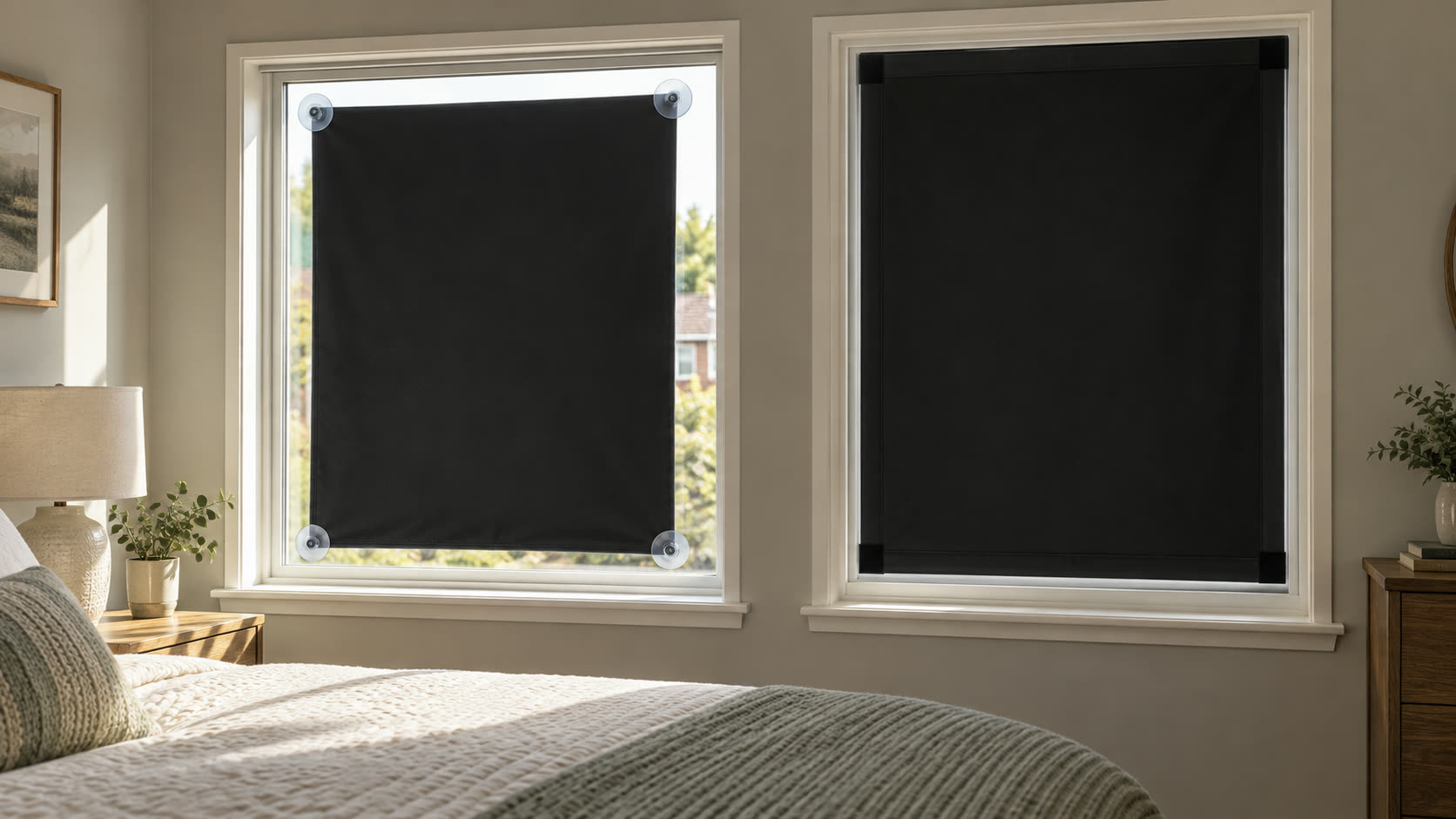
Suction versus adhesive at a glance
Both methods can make a room darker for a visit, rental or decorating period without a conventional drilled blind. They solve different fixing problems. Suction holds a fabric panel against compatible smooth glass. Adhesive may attach a pleated shade directly to a frame or hold hook-and-loop pieces that let a fabric sheet be taken down repeatedly. The fabric can be equally opaque while the room result differs because the panel size, frame overlap and light gaps differ. Choose from the window outward: material, finish, access, dimensions, then fixing method.
| Decision | Suction-cup panel | Adhesive or hook-and-loop cover |
|---|---|---|
| Main fixing surface | Smooth compatible glass | Approved frame or reveal finish |
| Likely strength | Quick attachment with no frame glue | Deliberate positioning and edge overlap |
| Main failure mode | Cups release or lack clear glass area | Adhesive loosens or affects a finish |
| Repeat visits | Pack and refit each time | Fabric may detach while strips remain, if permitted |
| Best first question | Will this exact pane accept the cups? | May this exact surface carry and release the fixing? |
The British Blind and Shutter Association's blind-safety advice also matters if children use the room. A cordless temporary cover does not make an old chain blind behind it safe. Inspect the existing control and keep furniture away from blind cords as the OPSS advises. Do not add loose cups or strips near a cot. Our baby travel guide gives the full room check.
Where a suction panel works well—and where it does not
A suction panel is attractive for a smooth glass guest-room or hotel pane because it does not need adhesive on painted wood or uPVC. The Tommee Tippee example below is one compact format. Its cups need clean, appropriate contact points and the fabric needs enough size to cover the glass. A large window can defeat a small panel even if every cup sticks perfectly. Measure the actual glazing and leave margin for the bright perimeter; do not attach cups partly over a seal or a textured strip just to stretch the fabric.
Suction is not a universal material claim. Patterned glass, film, heavy condensation, acrylic caravan panes and certain coatings can alter compatibility or grip. Ask the window and panel makers before using an unusual surface. A product repeatedly falling down is telling you the fit is wrong. Do not add tape, force the cups or place the panel where falling hardware can reach a child. For an opening sash, check that the fitted cover does not trap a handle, restrictor or ventilation route.
Removal may be straightforward when the product's release tab is used properly, but never yank the fabric against a pane. Dry the cover before packing if moisture has collected. If travelling frequently, count the cups and inspect them for damage; one missing or cracked attachment can change how the whole sheet hangs. See our suction-blind guide for sizing and maintenance in more detail.
What a stick-on or hook-and-loop panel changes
The Easynight example below uses a trim-to-fit fabric sheet and hook-and-loop attachments. That can let the cover sit across more of the frame rather than just the clear glass. It may help where a suction panel would expose the perimeter, provided there is a suitable, approved fixing surface. A pleated adhesive shade is another format, often lighter and quicker to size but not necessarily reusable in the same way. Check whether the chosen product is designed for repeated fabric removal, strip removal, or a one-time installation.
Surface preparation is critical. Paint can lift, wallpaper can tear, and old varnish may react differently from new uPVC. “Renter-friendly” does not override the landlord's rules or the adhesive maker's exclusions. Test only where permitted and in line with instructions; do not attach over a vent or moving gasket. The exact release method depends on the adhesive. 3M Command's removal guidance describes stretching its own designed strips straight down, but that does not apply to ordinary double-sided tape or an unidentified blind. Our stick-on removal guide explains this distinction.
Choose by a four-part window audit
First, identify glass and frame materials; do not assume every clear pane is standard glass. Second, compare the full panel size with the area that needs shading. Third, map handles, vents and opening movement. Fourth, decide how often you need to install and remove the panel and who owns the surface. A permitted suction panel may be best for an occasional hotel stay; a carefully approved frame-fixed sheet may be better for a familiar guest room needing closer overlap. Sometimes a properly fitted curtain is the simpler answer.
Whichever route you choose, expect to assess light leakage separately from fabric opacity. Shine around the sides or above the pane does not necessarily mean the fabric fails; it means the coverage geometry needs work. Do not chase the last millimetre by sealing ventilation or attaching to a fragile finish. Record the chosen size and surface instructions so the next fitting is repeatable, and stop if the panel loosens or the surface shows damage.
Products for this job
One example of each fixing route
These products illustrate suction on compatible glass and a trim-to-fit hook-and-loop sheet on a suitable frame. Check the selected variant, fixing pieces and surface guidance.
Tommee Tippee Sleeptight™ Portable Blackout Blind
Best for: Travel and occasional glass-mounted use
A foldable fabric cover that attaches to glass with suction cups and adjusts to the window. It is the most travel-oriented option here and avoids permanent fixings.
What stands out
- Packs away for travel
- Suction-cup fitting requires no drilling
- Adjustable fabric can accommodate different windows
Keep in mind
- Suction depends on clean, compatible glass
- Taking it down and refitting it adds daily effort
- It is a functional cover rather than a fitted interior blind
- Medium 99 × 130 cm
- Suction cups
- Packable
- Adjustable
Easynight Blackout Blind, regular 150 × 145 cm
Best for: A removable cover with generous edge overlap
A cut-to-size blackout sheet fixed around the window frame with removable hook-and-loop attachments. It can cover the complete opening more closely than an ordinary roller blind and packs into a storage bag between uses.
What stands out
- Can be cut for an unusual window shape
- Hook-and-loop attachment can reduce perimeter gaps
- No drilling and a storage bag is included
Keep in mind
- Adhesive suitability depends on the frame finish
- Less convenient than a blind for frequent daylight access
- The fabric can look utilitarian in a finished bedroom
- 150 × 145 cm
- Cut to size
- Hook-and-loop fixing
- Storage bag