
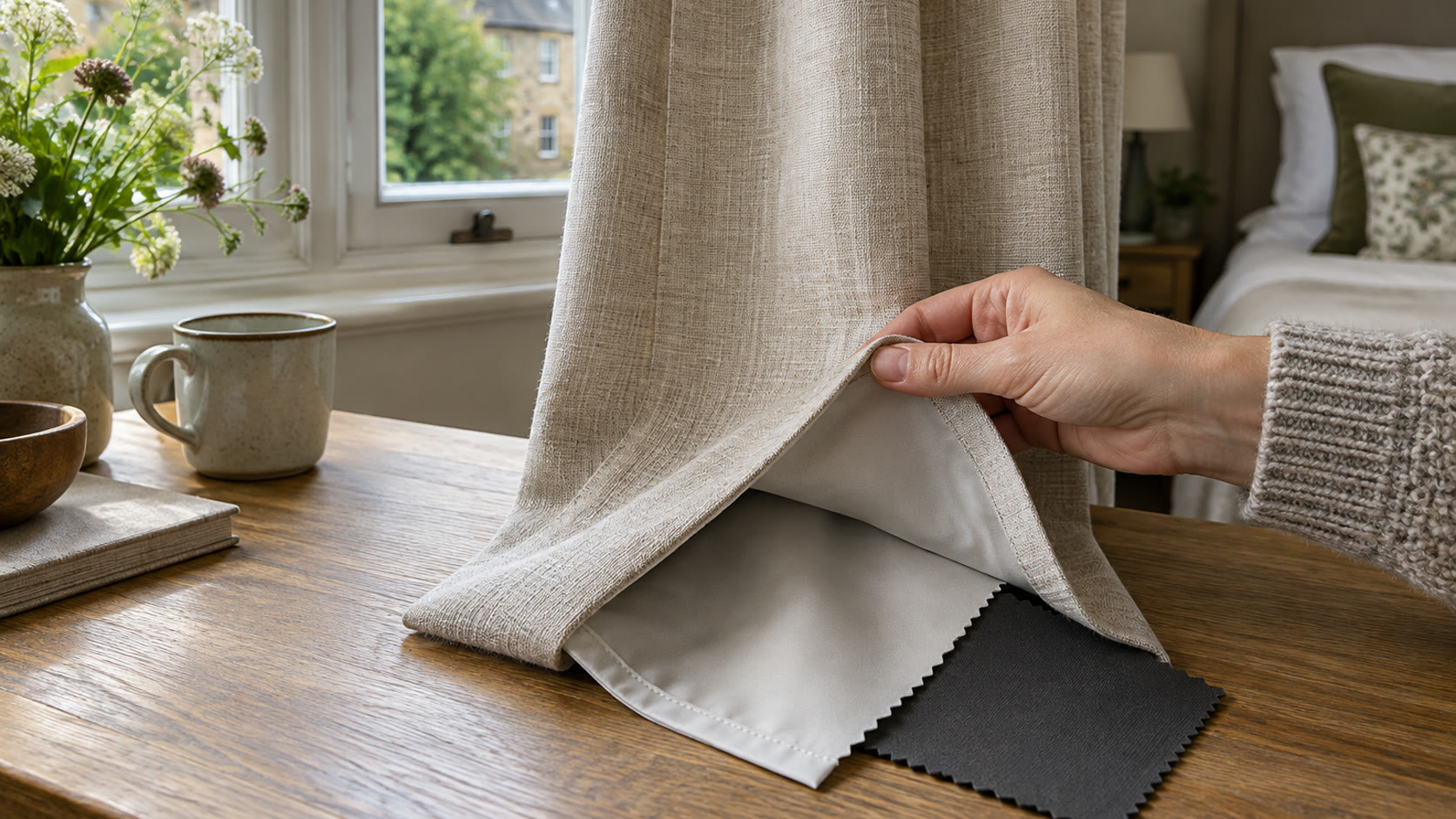
What is a blackout curtain lining?
A curtain lining is the window-facing material behind the decorative face. It can protect the face, add body and change how much light passes through. A blackout lining specifically aims to make the panel opaque. The phrase covers several constructions, and their feel, drape and maintenance can differ markedly.
Some ready-made curtains have a separate layer sewn to the face at the heading and sides. Others have an opaque coating applied to the reverse of the decorative fabric. Some use dense woven layers with dark yarn between lighter faces. A detachable lining can also be hung behind an existing curtain. A product title seldom tells you everything about the construction, so check the fabric description and, ideally, a physical sample.
The Dunelm curtain-care guide distinguishes care for coated blackout or thermal products and directs owners to their labels. That is a practical reminder that lining is not merely decorative: it can determine whether washing or ironing is safe.
Separate sewn-in linings
A separate layer can allow the decorative face to keep more of its natural texture. It may hang with a slight gap between the two fabrics. The lining may be light coloured when seen from outside, which can matter where street-facing windows need a consistent appearance. Check whether it is attached at the bottom or hangs freely; each can move differently when curtains are drawn.
The weight of a separate lining adds to the demands on the pole or track. Wide, long panels may need a centre bracket and secure wall fixings. If you add a lining to an existing pair, ask whether the current heading has enough hooks or eyelets and whether the track supports the combined weight. A lining that finishes too short leaves a visible bright band near the hem.
Bonded coatings
A coated backing can make a relatively thin curtain opaque. It may look smooth or slightly rubbery. Its vulnerability is heat and unsuitable cleaning: agitation, hot water, an iron or prolonged folding can affect the surface or bond. Never assume “polyester” means the whole coated assembly is machine washable.
Inspect a coated backing for cracking, stickiness or flakes, especially on an older pair. Such damage is not a stain to scrub away. If light begins to appear through pinholes, the coating may have failed. A small repaired seam is different from widespread material breakdown; replacement is often more sensible than aggressive treatment.
Woven blackout constructions
Some curtains use yarn arrangement and multiple layers to limit light rather than a separate visible coating. They may feel softer and tolerate different care, though that depends on the actual product. Do not infer machine-washability or complete opacity from the word “woven”. Test the fabric against strong daylight and follow the sewn-in label.
The exact colour can affect how the decorative face looks in the room, but a pale blackout curtain can still contain an opaque inner layer. Conversely, a dark ordinary curtain may allow light through its weave. A light test on the selected sample is more useful than judging from a listing thumbnail.
Choose the lining for the room and routine
For a bedroom used every day, consider how easily the pair opens, closes and can be cleaned. A heavy lined pair that drags on a weak pole will be frustrating. For a nursery or child's room, secure the hardware, keep furniture away from the window and avoid accessible blind cords in any layer behind the curtains. The Office for Product Safety and Standards explains the specific danger of blind-cord loops.
If you want a soft natural-looking face, a separate lining may appeal. If you want a slimmer ready-made panel, examine coated options but read their care requirements. If you need a particular external appearance, inspect the back colour. None of these choices removes the need for adequate window overlap.
Ask whether you can buy a sample or see the curtain unfolded. Hold it against a bright window. Look for pinholes, light at stitched seams and differences where the lining meets the heading. A dark-room promotional photograph may be influenced by camera exposure. The sample shows the actual material more directly.
Thermal language needs care
Some blackout linings are also sold as thermal. A layer over a window can affect comfort, but no fixed heating saving or summer temperature change follows from that label. The Energy Saving Trust's window advice places lined curtains among wider window measures. Glazing, draughts, orientation, ventilation and how you use the curtains all matter.
Do not block a radiator with heavy fabric or trap wet condensation against the lining. Open curtains regularly to inspect and dry the window area. In summer, closing curtains when strong sun reaches a window can help reduce solar gain, but Energy Saving Trust's summer guidance also highlights ventilation when outdoor air is cooler and it is safe to open windows.
Opacity is only one part of coverage
An opaque lining stops light through the panel's central area. It cannot stop light above a low pole, beside a short pole, between panels that barely meet or beneath a short hem. Measure the pole or track and the total panel width. The Dunelm curtain measurement guide explains how heading choice changes fullness and finished drop.
Hang the hardware above and wider than the window where the wall permits. Allow enough fabric for folds without pulling the centre seam apart. A track with centre overlap or wall returns can address specific gaps; a second blind layer can stagger edges. Our curtain fitting guide gives the full sequence.
If you retrofit a lining, make sure the lining is wide and long enough to remain behind the face when closed. A narrow lining can leave bright strips through uncovered decorative fabric at the sides. Check that hooks are evenly spaced so the lining does not sag or bunch at the centre. Make adjustments with the curtains hanging, not just laid flat on the floor.
Care, damage and replacement
Read the label before washing, steaming or ironing. Dust the panel gently first. If a full wash is allowed, follow the specified process and support the wet weight; if dry cleaning is specified, tell the cleaner about the blackout layer. Our washing guide and ironing guide cover these decisions in detail.
Check the lining when you take curtains down. Uneven shrinkage, cracked coating, stretched stitches and weakened heading tape can all affect light coverage. A detachable lining may be replaceable without replacing the decorative curtain. A bonded coating usually cannot be separated cleanly. Ask an alteration specialist whether repair is practical before attempting to cut away material.
For new curtains, choose the construction that matches your maintenance tolerance and window. Then invest equal attention in pole position and fullness. The most opaque lining cannot rescue a pair that never fully covers the opening.
Products for this job
Curtains illustrating different finishes
Compare the actual selected colour and lining description. Product photography alone cannot show how the backing behaves in your room.
Deconovo total-blackout coated curtains, pale khaki, 46 × 72 in, pair
Best for: A lighter face with an opaque backing
A coated-back eyelet pair intended to stop light through the cloth itself. The lighter face gives a softer room look while the backing does the opacity work.
What stands out
- Coated backing rather than relying only on a dark yarn
- Pair format
- Multiple listed colour and size variants
Keep in mind
- Coated fabrics need care-label-led cleaning
- Heavier curtains need a suitable pole and fixings
- Perimeter gaps remain unless the track or pole extends well beyond the window
- 46 × 72 in
- Pair
- Eyelet heading
- Coated back
Deconovo blackout eyelet curtains, black, 46 × 54 in, pair
Best for: An affordable ready-made eyelet pair
A widely sized pair of soft eyelet curtains made for a standard pole. The dark colour is useful where room darkening matters more than a pale decorative finish.
What stands out
- Many size and colour variants are grouped under the listing
- Pair format suits conventional bedroom windows
- Simple eyelet heading is quick to hang on a compatible pole
Keep in mind
- Darkening depends on pole position, width and centre overlap
- Eyelets can leave a bright band above a low-mounted pole
- The listing's thermal wording is not a measured room-saving guarantee
- 46 × 54 in
- Pair
- Eyelet heading
- Polyester
PONY DANCE blackout eyelet curtains, grey, 46 × 54 in, pair
Best for: A grey pair across a standard window
A soft grey two-panel eyelet set with a very broad group of size variants. It is a practical neutral choice when you can create useful overlap beyond the window.
What stands out
- Two-panel set
- Many width and drop combinations are listed
- Neutral colour works with layered blinds
Keep in mind
- Room darkening varies with the selected colour and installation
- A pole close to the recess can expose top and side light
- Exact dimensions must be checked on the selected variant
- 46 × 54 in
- Two panels
- Eyelet heading
- Grey