
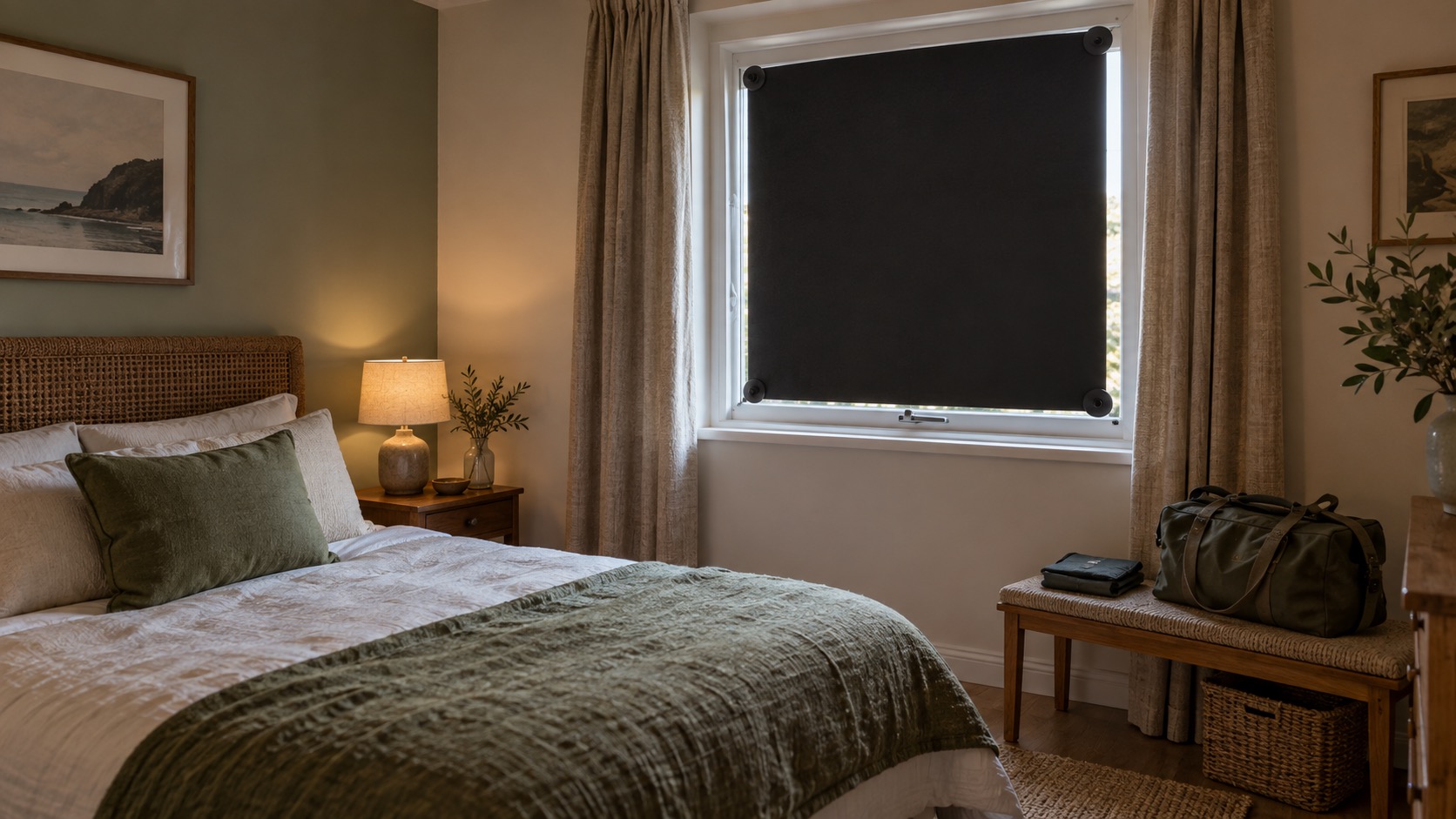
The short answer
Pick the attachment method before the fabric size
Suction cups are packable but need compatible clean glass. Trim-to-fit hook-and-loop sheets can suit a known opening. Top-fixed fabric panels offer another temporary route, but trimming, surface permission and daily removal matter. Compare both dimensions and the fixing layout before choosing.
Measure the complete visible opening and take a photograph before leaving home.
Never cover a required vent, lock, handle or safe escape route.
For a child’s room, remove loose bags, cords, spare fasteners and detached suction cups from reach.
Product shortlist
Four portable formats for different stays
There is no universal travel blind. Choose according to the likely glass, frame surface, daily effort and how small the kit must pack.
Tommee Tippee Sleeptight™ Portable Blackout Blind
Best for: Travel and occasional glass-mounted use
A foldable fabric cover that attaches to glass with suction cups and adjusts to the window. It is the most travel-oriented option here and avoids permanent fixings.
What stands out
- Packs away for travel
- Suction-cup fitting requires no drilling
- Adjustable fabric can accommodate different windows
Keep in mind
- Suction depends on clean, compatible glass
- Taking it down and refitting it adds daily effort
- It is a functional cover rather than a fitted interior blind
- Medium 99 × 130 cm
- Suction cups
- Packable
- Adjustable
Amazon Basics Portable Blackout Curtain, beige, 127 × 198 cm
Best for: A large suction-mounted travel cover
A large polyester blackout cover that attaches to smooth glass with suction cups. Hook-and-loop tabs let the fabric gather to suit smaller windows, and the supplied bag makes it practical to store or pack.
What stands out
- No drilling or adhesive on the frame
- Large 127 × 198 cm panel
- Includes a travel bag and is listed as machine washable
Keep in mind
- Requires clean, smooth glass and careful suction-cup removal
- Needs taking down to restore the full view
- Availability and exact colour can change by retailer variant
- 127 × 198 cm
- Suction cups
- Hook-and-loop adjustment
- Travel bag
Easynight Blackout Blind, regular 150 × 145 cm
Best for: A removable cover with generous edge overlap
A cut-to-size blackout sheet fixed around the window frame with removable hook-and-loop attachments. It can cover the complete opening more closely than an ordinary roller blind and packs into a storage bag between uses.
What stands out
- Can be cut for an unusual window shape
- Hook-and-loop attachment can reduce perimeter gaps
- No drilling and a storage bag is included
Keep in mind
- Adhesive suitability depends on the frame finish
- Less convenient than a blind for frequent daylight access
- The fabric can look utilitarian in a finished bedroom
- 150 × 145 cm
- Cut to size
- Hook-and-loop fixing
- Storage bag
Maritown stick-on temporary blackout blind, 120 × 180 cm
Best for: A broad removable cover without suction cups
A cut-to-size black fabric panel with self-adhesive fixing and adjustable clips. It offers more coverage than many suction products where the frame finish is suitable.
What stands out
- 120 × 180 cm size
- Can be cut down
- No drilled holes
Keep in mind
- Adhesive can mark or lift delicate finishes
- Daily removal is less convenient than a roller
- The panel must be kept securely fitted and out of children's reach
- 120 × 180 cm
- Cut to size
- Self-adhesive fixing
- Adjustable clips
At a glance
Check the exact selected dimensions. Temporary attachments rely on clean compatible surfaces and should be inspected every time they are fitted.
| Option | Attachment | Best for | Packs away | Main trade-off |
|---|---|---|---|---|
| Tommee Tippee Sleeptight | Suction cups | Frequent travel | Yes | Smaller medium coverage |
| Amazon Basics portable curtain | Suction cups | A larger glass area | Yes | Needs smooth clean glass |
| Easynight sheet | Hook-and-loop tabs | Irregular or rental windows | Yes | Frame-surface compatibility |
| Maritown fabric panel | Top adhesive fixing; roll rod and clips | A known temporary opening | Yes, but cut size is permanent | Surface compatibility and daily handling |
What makes a portable blind genuinely useful?
A portable blind has to do more than block light. It must fit windows you have not seen closely, install without specialist tools, come down without damage and pack small enough to be worth carrying. A perfect-looking fitted blind is irrelevant if it cannot travel; a tiny pouch is irrelevant if the fabric leaves half the glass exposed.
Before choosing, think about the trips you actually take. A regular grandparent’s room can support a labelled, pre-cut hook-and-loop panel. A series of hotels may favour suction cups because they touch compatible glass rather than the frame. A short rental may suit a top-fixed fabric panel if the surface and permission are clear.
Compare the two dimensions—not just the panel area
A long narrow sheet can have plenty of area but still leave the sides uncovered. The comparison below uses the exact selected variants and keeps listed size, orientation and attachment suitability separate. All dimensions are width × height; they are nominal size information, not independently established usable blackout coverage.
| Selected variant | Listed rectangle | Turned rectangle | Attachment check |
|---|---|---|---|
| Tommee Tippee Sleeptight regular / medium | 990 × 1,300 mm | 1300 × 990 mm | Suction cups on all four edges; confirm usable cup positions after adjustment. |
| Amazon Basics portable beige, one panel | 1,270 × 1,980 mm | 1980 × 1270 mm | Suction cups and hook-and-loop edge adjustment; confirm the fitted orientation. |
| Easynight regular, frame-fastener kit | 1,500 × 1,450 mm | 1450 × 1500 mm | Listing permits horizontal or vertical use. Allow for edge fabric and handle projection. |
| Maritown black fabric panel, 120 × 180 cm | 1,200 × 1,800 mm | 1800 × 1200 mm | Top adhesive fixing and lower roll rod/clips; do not turn this arrangement sideways. |
The selected Tommee Tippee regular/medium listing specifies 99 cm wide × 130 cm high; do not substitute the larger variant. Use the maker’s portable-blind instructions for glass suitability and temporary use. The selected Amazon Basics listing gives 198 × 127 cm as length × width. Maritown’s selected option is 120 cm wide × 180 cm high and uses coated polyester cloth with a top fixing and lower rod/clips—not a paper pleated blind.
The Easynight listing labels its regular option 150 × 145 cm and permits either orientation, but also describes it as a window-size option. The maker’s home-kit measuring guidance says to add 8 cm to each opening dimension when selecting fabric, including handle projection checks. Do not read a listing’s “windows up to” phrase as evidence that a same-sized opening has enough edge fabric. Confirm the supplied sheet size and instructions for the selected kit.
A worked opening: 1,400 mm wide × 1,100 mm high
For this example only, allow 40 mm on each edge, making the planned rectangle 1,480 × 1,180 mm. This is a chosen planning allowance, not a universal attachment minimum. Subtract that rectangle from each listed size:
| Variant | Listed orientation | Turned 90 degrees |
|---|---|---|
| Tommee Tippee regular | 490 mm short in width | 180 mm short in width and 190 mm short in height |
| Amazon Basics beige | 210 mm short in width | 500 mm spare width; 90 mm spare height—rotation still needs confirmation |
| Easynight regular | 20 mm spare width; 270 mm spare height—confirm supplied fabric and fixing margins | 30 mm short in width |
| Maritown fabric | 280 mm short in width | Arithmetic envelope is large enough, but the top-fixing/roll-rod arrangement is not a sideways fitting option |
“Spare” means the total difference across a dimension, not spare material on every edge. A centred installation would split it between opposite edges, but real cups, folds, handles and frame fasteners may prevent that layout. A geometrically large enough rectangle is only the first check.
Check a different opening
Choose a documented variant and enter the opening plus a chosen allowance on each edge. The tool compares listed rectangles only; it does not approve the mounting, account for fabric draping over a handle, or predict darkness. Entries are not sent or saved by the site.
The static worked example above remains available without JavaScript. Enable JavaScript to compare another opening.
Dimensions changed. Select “Compare sizes” to update the results and diagram.
Nominal rectangle comparison—not a fit approval
Planned rectangle: .
- Listed width × height
- Turned width × height
One common scale for both orientations
Required width = opening width + twice the chosen edge allowance. Required height = opening height + twice the chosen edge allowance. Compare both dimensions in each orientation, then check the manufacturer’s fixing positions, surface rules and window operation. For attachment trade-offs, see suction versus adhesive; for repeat visits, see temporary blackout at grandparents’ homes.
The four options in more detail
Tommee Tippee Sleeptight: focused travel kit
The medium Sleeptight blind is a foldable suction-cup panel designed around travel. Its 99 × 130 cm listed size suits many smaller windows, and the adjustable fabric can gather to the opening. It packs neatly and avoids drilling or frame adhesive.
Read Tommee Tippee’s Sleeptight fitting and safety instructions for the supplied attachment system. The maker specifies temporary use, removal when not in use and keeping both the blind and bag out of children’s reach. Do not position it directly over a child’s bed.
Coverage is the main check. Large modern glazing, patio doors or a broad hotel window may exceed one panel. Do not stretch the fabric so tightly that cups peel away. Fit to clean smooth glass, press every cup and check the perimeter after the room changes temperature.
Amazon Basics portable curtain: larger suction coverage
At 127 × 198 cm, this panel offers more area. Hook-and-loop adjustment helps gather it around a smaller window, and the neutral face is less visually harsh than black in a guest room. It also comes with a bag and is listed as machine washable.
The larger sheet takes more time to align and can be bulky on a small pane. Keep the fabric clear of the handle and do not bridge opening sections in a way that prevents safe use. Remove cups by lifting their tabs rather than pulling the cloth.
Easynight: trim-to-fit coverage
The regular Easynight option is listed as 150 × 145 cm and is designed for trimming and frame-mounted hook-and-loop fixing. Confirm the supplied sheet dimensions and add the maker’s specified edge fabric when selecting a size. A suitably sized sheet can follow an unusual opening more closely than cups limited to positions within the glass.
It is best where you know the frame finish and expect repeated use in the same place. Test the attachment on a hidden area and clean as directed. Cutting is a one-way decision, so mark the room and orientation on the storage bag after fitting.
Maritown: top-fixed cut-to-size fabric panel
The selected 120 × 180 cm blind uses coated polyester fabric, a top adhesive fixing and a lower roll rod with clips. It is designed for trimming to a known opening. This is not the separate Maritown pleated-paper format, and its top/bottom hardware should not be turned sideways simply because the rotated rectangle is wide enough.
A top fixing does not automatically seal the sides, and repeated removal can affect the adhesive and surface. Keep clips, rod pieces and loose parts away from children. Check the supplied fitting directions and surface permission before use; cutting a panel for one room can make it unsuitable for another. For frequent stays in unfamiliar rooms, weigh that loss of flexibility against a reusable suction panel.
A five-minute window check on arrival
First identify the glass, frame and opening method. Look for textured film, condensation, loose paint, trickle vents, locks and handles. Ask permission before applying adhesive in a hotel, rental or someone else’s home.
Clean only the attachment area with a method suitable for the surface, then dry it fully. Lay the panel on a clean bed or floor and decide its orientation. Fit from the top centre outwards so any spare fabric is distributed rather than pulled to one corner.
Close the room door, let your eyes adjust and inspect the edges. Reposition rather than adding improvised tape to walls or wallpaper. Make sure the window can still be opened when needed and that no vent required for the room has been covered.
Planning for unfamiliar windows
Save the maximum panel dimensions in your phone. When booking accommodation, room photographs can reveal whether the bedroom has one small casement, a bay or a glazed door, although photographs are not measurements. If room darkness is essential, ask the host for the approximate opening size.
Carry a small clean cloth for suction cups and a few manufacturer-approved spare parts. Do not bring generic hooks, magnets or strong tape as a workaround: they can damage finishes or create loose hazards. An eye mask is a sensible independent backup when the window is larger than expected.
For repeat family visits, make a paper template and store each pre-cut panel in a labelled breathable bag. This prevents confusion between similar windows and reduces fitting time.
Using portable blackout products around children
Portable does not mean toy-safe. The Office for Product Safety and Standards advises keeping cots, beds, highchairs, playpens and climbable furniture away from window blinds and cords. Apply the same conservative layout to temporary products.
Keep spare suction cups, clips, hook-and-loop tabs, plastic packaging and storage bags out of reach. Check the installation before every sleep period and remove any detached piece. Do not drape excess fabric into the cot area or attach a panel using a cord.
The window must remain safe to access and ventilate. If the product prevents normal use, remove it fully when the room is occupied and awake rather than leaving it half-detached.
Care between trips
Follow the product’s washing instructions; not every coated sheet is machine washable. Make sure the fabric and suction cups are completely dry before packing. Trapped moisture can create odour, mildew or marks.
Store cups flat rather than crushed under luggage. Keep adhesive tabs on their backing sheets when the system is designed for reuse. Before the next trip, inspect seams, attachment points and the fabric for tears that could enlarge under tension.
Bottom line
Consider the Tommee Tippee blind for a compact repeat travel kit and smaller windows. Compare the Amazon Basics panel when you need larger suction-mounted dimensions. Consider Easynight for a known awkward opening where trim-to-fit edge coverage matters. The Maritown fabric panel is another top-fixed option for a known opening and suitable surface; its cut size and hardware layout make it less flexible than a loose sheet.
The best portable blackout blind is the one you can fit securely, remove cleanly and use without blocking the window’s essential functions. For more renter-focused alternatives, see our temporary blackout blind guide.
Clear answers
Frequently asked questions
Short answers to the fitting, use and care questions that most often change the result.
What is the best portable blackout blind for travel?
A suction-cup model is usually the most travel-friendly because it leaves the frame untouched and packs into a bag. It needs clean smooth glass and enough panel area for the specific window.
Do portable blackout blinds work on hotel windows?
They can, but hotel windows vary. Check permission, fire and ventilation arrangements, keep locks and handles usable, and do not attach anything to coated or textured glass unless the product permits it.
Can I cut a portable blackout blind to size?
Only a product expressly designed for trimming. Mark carefully and leave enough overlap. Cutting a suction-cup blind or coated curtain can damage its attachment points and invalidate returns.
Are suction-cup blackout blinds safe for a nursery?
They avoid a blind cord, but loose cups and fabric still need supervision and secure placement. Keep the cot away from the window and remove the storage bag, spare parts and any detached fittings from reach.
Will adhesive blackout material damage a rental window?
It can mark paint, veneer or aged finishes. Check the maker’s surface list, get permission where needed and test a hidden area. Direct-to-glass suction is often lower risk on compatible glass.