
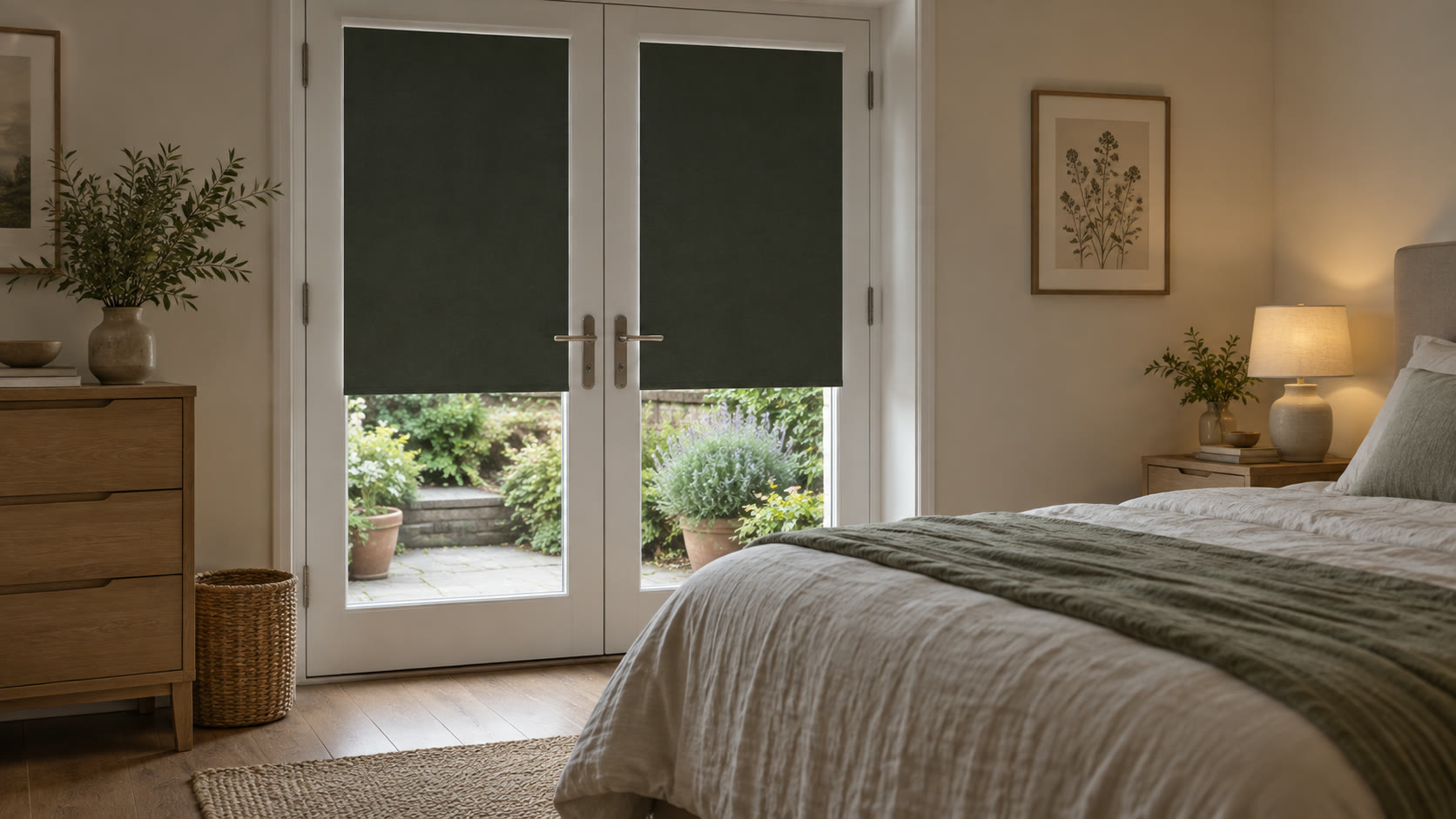
Map the moving panels before choosing fabric
Patio doors may slide one panel behind another, have multiple tracks, or stack several panels at one end. A conventional French-door treatment cannot simply be copied across: sliding leaves need lateral travel and often a usable passage at one side. Identify the active leaf, fixed pane, handle, lock, ventilation positions and the direction in which the panels travel. Stand inside and note where furniture, a radiator or a wall return limits a curtain stack. Photograph the doors fully closed and fully open.
The covering has two states to work in: closed for darkness and parked for access. A curtain that spans the glazing beautifully but piles in front of the active doorway will soon be left half open. If the available wall is narrow, split curtains can stack on both sides, or a panel-track system might move fabric to one end. Each arrangement has different centre joins and edge gaps. Blinds2go's door overview discusses format choices for large glazed doors; use the actual door's measurements to decide, not the label “patio blind”.
Check the top fixing line. A ceiling track can sit close to the frame top, while a wall-mounted pole needs secure brackets above the opening. Do not drill into the door frame, glazing or weather seal for a generic room-side curtain. Keep the path to the door usable when the covering is partly or fully closed; this is particularly important in rooms where the doors are a routine exit to a garden or balcony.
Compare curtains, panel tracks and fitted blinds
Blackout curtains offer broad continuous coverage and are easy to draw to one or both sides. Pencil-pleat panels can hang from suitable rings or gliders, but hooks and a compatible track may need to be purchased separately. The Joydeco example below illustrates a long ready-made pair; its listed black variant should be checked for exact width, drop and stated light blocking. It is not a guarantee of total darkness. A curtain track must support the combined hanging weight plus the force of daily drawing.
Sliding panel tracks use broad fabric panels that travel laterally. They can suit very wide openings, but overlaps between panels and the parked stack take space. A blackout fabric specification is separate from edge coverage, and a panel may still leave top or side light. Ask the supplier for a complete drawing showing track depth, panel overlap, stack width and the location of the active doorway. A narrow vertical blind can also manage privacy across a wide door, but its slats and gaps may be unsuitable where stronger darkening is needed.
Door- or frame-fitted blinds can move with compatible glazing, but each leaf's moving path and handle clearance must be checked. Do not attach a generic adhesive strip to a track or gasket. Blinds2go's fitting-system comparison shows that no-drill methods have different frame and door requirements. In a rented home, a room-side curtain may be more reversible than modifying a sliding door, provided existing secure fixings are available.
| Format | Good reason to consider it | Limitation to check |
|---|---|---|
| Full-width curtains | Continuous coverage across joins | Heavy panels and stack space |
| Sliding fabric panels | Large span with lateral operation | Panel overlap and parked width |
| Door-fitted blinds | Covering moves with suitable pane | Frame and sliding clearance |
Measure the usable span and the parked stack
Record the total outer-frame width and height, then measure the wall or ceiling span available for hardware. Add space at the ends so closed fabric covers the frame, not just the glass. If curtains will stack outside the doorway, measure that parking width too. A curtain's flat packet width does not equal its closed coverage after heading gathers are formed. Use our fullness guide and measuring guide with the selected heading's instructions. Check whether a listing's width is per panel or per pair.
For a pencil-pleat pair, the fabric is gathered before it is hung. A panel that looks generous flat can become too narrow on a long patio span. Conversely, an oversized lined pair may exceed a light track's load. The Speedy bendable track below is a flexible-format example, not an automatic partner for the Joydeco pair. Its suitability depends on the exact weight and fixing schedule; a straight heavy-duty track may be preferable for a wide straight door. Ask the track supplier to confirm both capacity and suitable gliders for the heading.
Measure finished drop from the correct hook or pole point to a hem that clears the floor track. A pool of fabric can catch underfoot or drag grit from the threshold. At the top and sides, plan the heading and returns so daylight does not shine around the fabric. Our side-gap guide and top-gap guide cover those details. Test the centre meeting point with the doors shut and the room lights off during daylight.
Make daily operation part of the specification
Fix the hardware to a suitable substrate. A long, heavy track requires more than a few light-duty plasterboard anchors. Follow the manufacturer's bracket spacing and use a competent installer when the lintel, hidden services or ceiling construction are uncertain. Check that the track does not obstruct the door's top rail, handles, locks or any ventilation unit. Pull the finished curtains their full travel several times and open the active door at each stage.
If the room is used by children, assess any blind controls under the OPSS blind-cord guidance. Curtain tie-backs or dangling cords should also be kept out of reach where the product's instructions require. Avoid attaching blackout material to the glazed door with unapproved tape; damage to seals or finishes can outweigh the benefit. For hinged paired doors rather than sliding panels, see our French-door guide.
The best final test is practical: close the chosen covering in daytime, inspect the outer frame, top and centre, then open the door without moving furniture or wrestling a heavy stack. If the door cannot be used normally, revisit the hardware layout before changing the fabric.
Products for this job
Curtain and track formats to evaluate separately
The pencil-pleat curtain and flexible track are not a pre-matched pair. Check fabric weight, heading compatibility, track load and the usable patio-door span before buying either.
Joydeco black pencil-pleat curtains, 55 × 96 in, pair
Best for: A long, track-compatible curtain pair
A long two-panel black curtain set with a pencil-pleat heading for hooks or a compatible track. The listing describes light reduction rather than a sealed whole-window result.
What stands out
- Two 55-inch-wide panels are listed
- Pencil-pleat heading can use rings or a suitable track
- Long 96-inch drop suits some tall openings
Keep in mind
- Hooks are not included
- Seller describes partial light blocking rather than a room seal
- The large drop may need alteration for a shorter window
- 55 × 96 in each panel
- Two panels
- Pencil-pleat heading
- Hooks not included
Speedy bendable curtain track, white, 5 m
Best for: Planning a close-mounted pencil-pleat track
A cuttable, bendable track supplied with gliders and brackets for pencil-pleat curtains. It can be face- or top-fixed, but its own listing limits use to light- or medium-weight curtains.
What stands out
- Top- or face-fix options are listed
- Can be trimmed or bent for the layout
- Gliders and brackets are included
Keep in mind
- Listed for light- to medium-weight curtains only
- No built-in centre overlap or pelmet is claimed
- Fixings must match the wall or ceiling substrate
- 5 m total track
- White
- 50 gliders and 20 brackets listed
- Light- to medium-weight curtains