
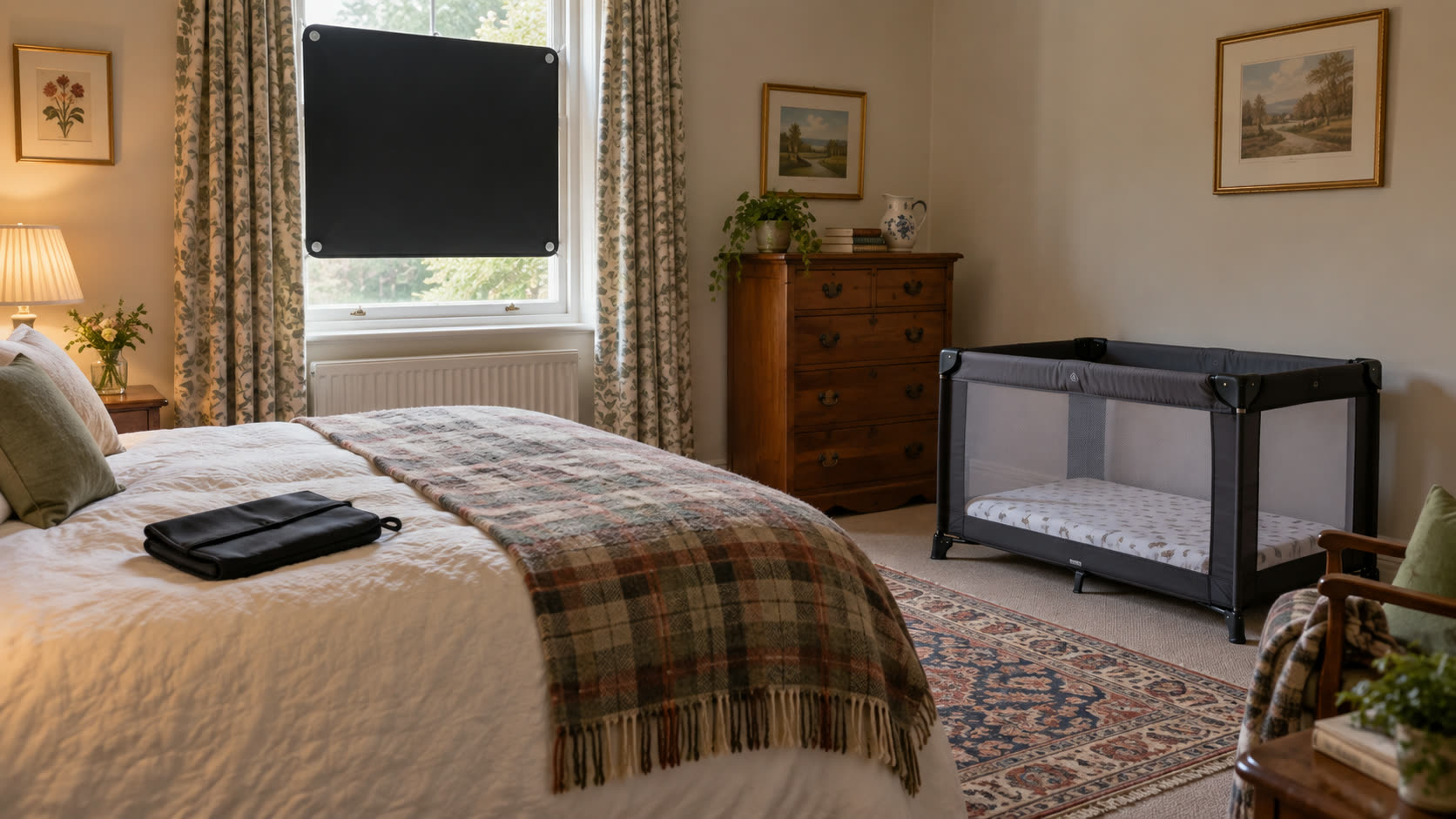
Plan the guest room with the host
A familiar home can still be a new window-fitting problem. Ask for a clear photo of the guest-room window with curtains open and the existing blind raised. Request the clear glass width and height, frame material, any protruding handle and whether the sash opens inward. Also ask whether the frame has painted timber, wallpaper near the reveal, textured glass or a trickle vent. Those details decide whether a portable covering will attach at all. A product bought only from the rough window width may leave bright edges or cover a handle.
Agree the fixing method with the homeowner before arriving. Many people are comfortable with suction cups on smooth glass but not with adhesive on old paint; others have a pane that does not suit suction. Do not assume “removable” means invisible after removal. A hook-and-loop strip can pull a finish; a cup may lose grip on condensation or a textured pane. Our suction versus adhesive guide explains the surface trade-off. If the house has original joinery or delicate decoration, use the existing curtains or a different room rather than experimenting on the finish.
If visits are regular, create a small window record: measurements, permitted attachment, the size of cover that worked and where the cot was placed. That is more useful than buying a larger panel each time. Check whether the window must open at night or during the day and whether a vent would be covered by the proposed fabric. Room darkening should be easy to undo whenever normal window access is needed.
Inspect blind cords before setting up the cot
The Office for Product Safety and Standards (OPSS) says blind cords and loops can pose a danger to young children, and furniture including cots, beds, highchairs and playpens should be kept away from blinds. The BBSA highlights pre-February-2014 blinds as a possible source of hazardous loops and recommends safe-by-design products where children live or visit. A guest-room blind used infrequently may have a long chain with its safety device missing or unfixed. Pull the curtains aside and check it directly.
If a hazardous control is present, ask the host to have the correct device fitted or to use a different room. A suction panel placed in front of it is not a repair. Do not cut the host's blind chain, tie it into a new loop or silently attach a generic clip. The exact blind type determines the approved fix. Our guide to existing blinds explains the process, while the cot-clearance guide shows how to review furniture without inventing a distance rule.
Place the travel cot away from the window and from furniture that a child might climb to reach it. Keep the temporary fabric, straps, cups and spare strips out of reach. Do not drape the cover over a cot or use it as a canopy. Check room comfort and ventilation independently; the NHS hot-weather advice discusses shading alongside other measures, not a guaranteed effect from one fabric panel.
Choose between suction and a frame-fixed sheet
The Tommee Tippee Sleeptight below is a compact suction-cup panel intended for compatible smooth glass. It may be convenient for a quick visit because it needs no adhesive on the frame. Confirm the exact product dimensions, whether the suction points can sit on clear glass and whether the cover leaves enough daylight overlap without obstructing a vent or handle. Test each cup as its maker instructs and do not use the panel if a fitting repeatedly comes loose. A falling panel is especially unacceptable near a cot.
The Easynight fabric sheet below is a larger trim-to-fit format with hook-and-loop attachments. It can cover a broad pane and some edge area, but that benefit depends on where the attachment strips sit. Use it only if the frame is approved by the maker and the homeowner agrees. Painted timber, wallpaper and aged finishes need caution. Check whether the host expects the strips removed after every visit or left in place. A cut sheet cannot be made larger later, so measure carefully before trimming.
| Choice | Main advantage | Main question for this home |
|---|---|---|
| Suction panel | No frame adhesive on suitable glass | Will cups hold on this exact pane? |
| Hook-and-loop sheet | Can be trimmed for more overlap | May strips touch this finish? |
| Existing curtains | No temporary fitting to buy | Are width and top coverage adequate? |
Leave the room easy to use next time
After the visit, remove the cover by its own instructions rather than pulling hard on a cup or peeling an unknown strip from paint. Check that no attachment piece remains loose where a child can reach it. If the fabric is damp from window condensation, dry it before storage. Tell the host if any mark or loose fitting appeared; do not use solvents or heat without knowing the surface and adhesive guidance. Our stick-on removal guide gives method-specific cautions.
Record what actually worked: room orientation, daylight at the edges, whether the window still opened and any change in furniture layout. If the room remains unsuitable because of an unresolved blind cord or inaccessible ventilation, do not treat the blackout panel as the answer. Arrange a safer room for the next stay. A reusable travel setup is valuable precisely when it remains safe, reversible and acceptable to the people who live there.
Products for this job
Two removable covering routes
The suction panel needs suitable smooth glass; the trim-to-fit fabric needs a frame and permission for its attachment strips. Neither is appropriate for every older window.
Tommee Tippee Sleeptight™ Portable Blackout Blind
Best for: Travel and occasional glass-mounted use
A foldable fabric cover that attaches to glass with suction cups and adjusts to the window. It is the most travel-oriented option here and avoids permanent fixings.
What stands out
- Packs away for travel
- Suction-cup fitting requires no drilling
- Adjustable fabric can accommodate different windows
Keep in mind
- Suction depends on clean, compatible glass
- Taking it down and refitting it adds daily effort
- It is a functional cover rather than a fitted interior blind
- Medium 99 × 130 cm
- Suction cups
- Packable
- Adjustable
Easynight Blackout Blind, regular 150 × 145 cm
Best for: A removable cover with generous edge overlap
A cut-to-size blackout sheet fixed around the window frame with removable hook-and-loop attachments. It can cover the complete opening more closely than an ordinary roller blind and packs into a storage bag between uses.
What stands out
- Can be cut for an unusual window shape
- Hook-and-loop attachment can reduce perimeter gaps
- No drilling and a storage bag is included
Keep in mind
- Adhesive suitability depends on the frame finish
- Less convenient than a blind for frequent daylight access
- The fabric can look utilitarian in a finished bedroom
- 150 × 145 cm
- Cut to size
- Hook-and-loop fixing
- Storage bag