
Why a single clearance number would mislead
The Office for Product Safety and Standards (OPSS) tells households to keep furniture away from blinds, naming cots, beds, highchairs and playpens. It does not give a universal number of centimetres between a cot and a window. Reach varies with the position and length of a cord, the blind's operating state, a child's development and what can be climbed. A cot placed just beyond an arbitrary tape-measure line could still be next to a dangling chain or a chair that creates a route to it. Start with the hazard, then design the room around avoiding access.
OPSS does give a number for one different purpose: a cleat should be out of children's reach on an adjacent surface at least 1.5 metres above the floor. Spare cord should be secured on it in a figure of eight after use. That is a device-height instruction, not a cot-clearance rule. Tidies and tensioners must be firmly fixed to an adjoining surface to keep cords or chains tight. Read the actual blind instructions as well. A correctly installed safety device and a safe layout work together; neither justifies placing a cot beside a loop.
The BBSA's window-blind safety guidance recommends safe-by-design controls where young children live or visit. A cordless control removes an operating chain loop, but still examine the mounting, any other coverings and the window itself. Where an existing blind has a cord, identify the specified safety device rather than relying on furniture distance alone. Our blind-cord safety guide explains the control types.
Walk the room from floor to window
Stand where the cot would go and look at the nearest blind control in both fully raised and lowered positions. Notice whether the cord moves as the blind operates. Then check the routes a young child could use: a bed, armchair, storage cube, chest of drawers or lightweight chair can change what is reachable. Move the cot away from the window and keep climbable furniture away too. Reconsider the layout if furniture must sit under the window for everyday access. A dark cover is not a reason to leave an unsafe arrangement in place.
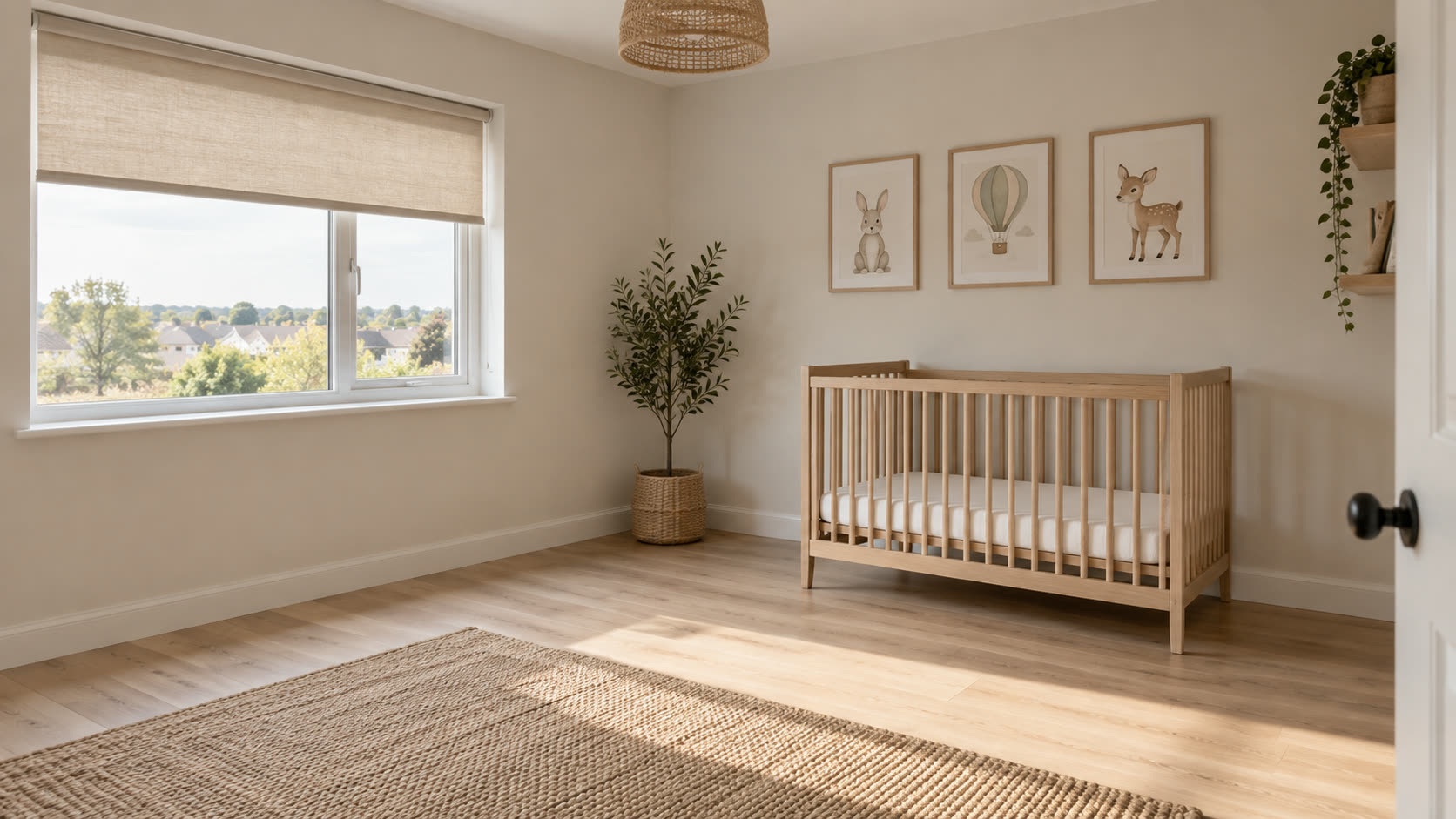
Check what happens when the window is opened, tilted or cleaned. A long curtain tie, decorative loop or blind chain may become visible only when the curtain is pulled back. If a temporary blackout panel is added, its cups, tabs or fixing strips should not sit where a child can pull them from a cot. Do not drape any blackout fabric over the cot or use it as a canopy. The photograph on this page illustrates separation, not a certified safe distance for every room; use the real geometry and the official advice.
| Room feature | Check from the child's position | Change if necessary |
|---|---|---|
| Cot or bed | Can the blind control or fabric be reached? | Move away from window and controls |
| Chair or chest | Could it be climbed to reach a cord? | Relocate it clear of the blind |
| Curtain over old blind | Is a loop hidden behind the fabric? | Resolve the blind itself |
| Temporary panel | Are loose pieces or a falling panel near the cot? | Refit appropriately or choose another room |
Select the covering after the layout works
Where a new blind is needed, start with a control designed to avoid accessible operating loops and a fixing suited to the frame. The BBSA describes cordless, wand, crank and motorised approaches, with different possibilities by blind style. Do not turn the phrase “child-safe” in a listing into a substitute for inspecting the actual product and fitting. A roller may be easy to operate but leave bright side gaps; a framed blind may reduce edge light but require exact glazing compatibility. Choose the safe control first, then compare light coverage and maintenance. Our nursery blind guide separates those decisions.
A curtain can cover light leakage but its pole and fabric need secure mounting, and the curtain should not put reachable fabric or fittings beside the cot. Adding curtains does not make an old chain behind them disappear. A suction travel panel may suit a guest room on compatible glass, but it should not be placed over a window where falling fittings could reach the sleep space. If a landlord or host controls the blind, request a proper correction rather than making an improvised alteration.
Reassess as the room and child change
The first layout is not permanent. A child who could not stand last month may soon climb. A chair moved for feeding or a toy box added below the window can undo a good plan. Review the room whenever furniture moves, a blind is repaired, or a relative's child stays. Check that a tensioner remains firmly fixed and a cleat is actually used after each operation. If you cannot make a cord inaccessible in the current layout, stop using that room for the child until the hazard is addressed.
Keep ventilation and ordinary window access in view too. A cot position that avoids the blind but blocks a door, radiator or safe access route is not a sensible trade. The NHS advice on keeping a baby's room comfortable in hot weather treats shading as one part of room care, not a reason to seal the room. Our nursery ventilation guide helps plan a window covering without obscuring vents or controls.