
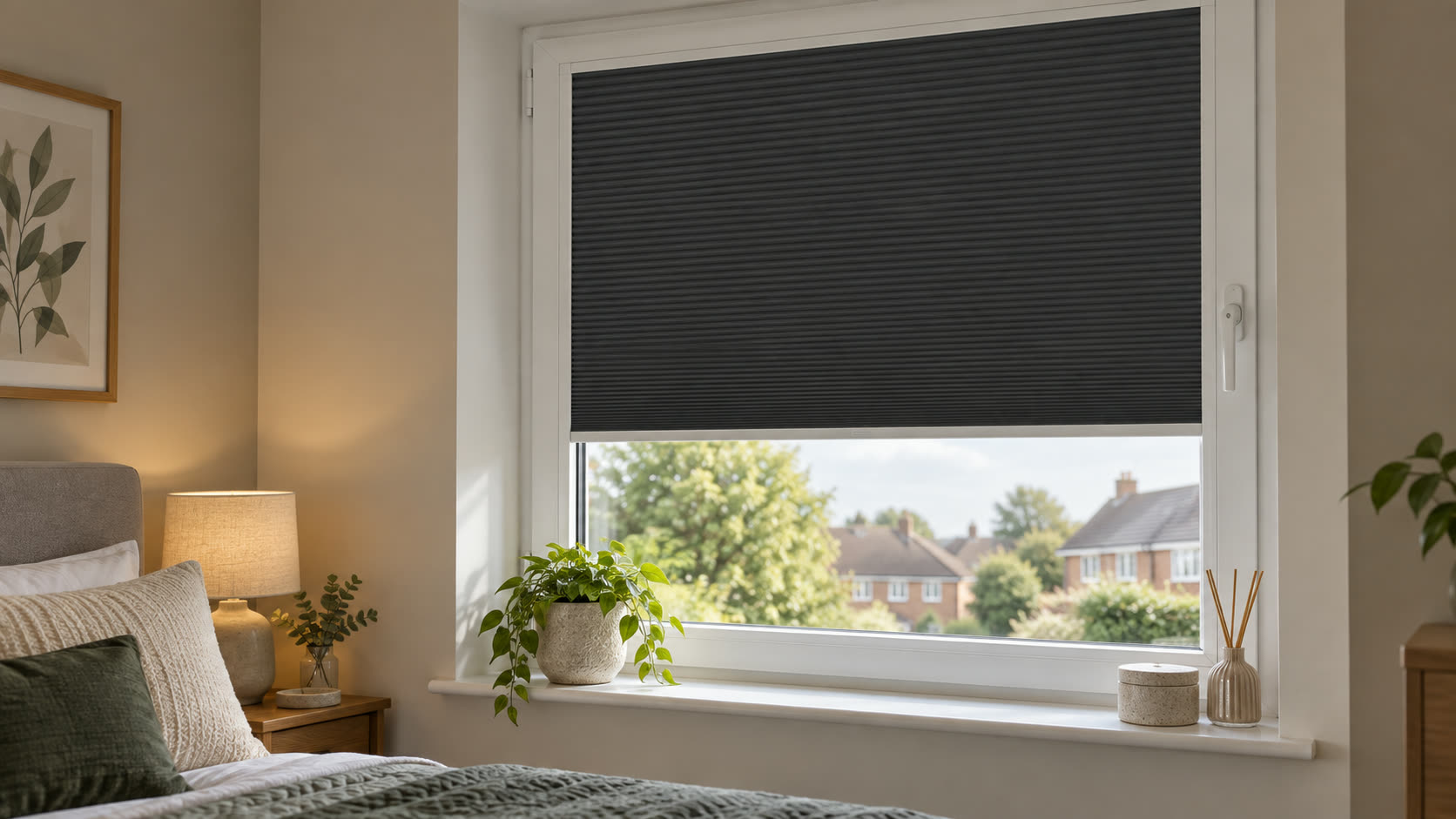
Four ways to fit a blackout blind near uPVC
The simplest answer is that uPVC is a frame material, not a standard bracket. A modern casement can have internally beaded glass, a narrow opening sash, an outward-swinging handle and a trickle vent at the top. Another uPVC window may look similar but have different bead depth or limited clearance beside a wall. Match a fitting to this particular window rather than searching for a single “uPVC blind” size. Older timber sash windows pose a different clearance problem and should not be treated as a uPVC clip-fit case.
| Fitting route | Where it attaches | Decisive check |
|---|---|---|
| Bead-fit frame | Suitable internal glazing bead | Bead type, depth and bracket engagement |
| Clip-on bracket | Compatible opening sash edge | Gasket, sash closing and hinge clearance |
| Adhesive blind | Maker-approved frame or glass surface | Finish, preparation, load and removal |
| Room-side bracket | Wall, ceiling or reveal around frame | Sound substrate and full opening clearance |
A bead-fit system can move with the opening window and avoid drilling into the wall. The Perfect Fit suitability guidance shows how internal beading and clearance affect whether that kind of frame can be fitted. The supplier's bead-depth guidance also illustrates why bracket size is not a guess. The Tipiace framed cellular example below is a different exact product, so use its own compatibility and custom-size instructions; do not transplant Perfect Fit dimensions into it.
An adhesive-mounted shade may avoid a hole entirely. The cordless LazBlinds example below is a spring-operated format, which differs from a clip-in frame. Its mount must still be suitable for the specified surface and load. Wet, dusty or silicone-contaminated uPVC can undermine adhesive. A room-side blind fixed into an appropriate wall or reveal avoids altering the uPVC, but needs sound fixings and may project farther into the room. In a rental, obtain permission before drilling either place.
Survey the sash, seals and space around it
Open the window fully and take photographs of the glazing bead, handle, hinges, rubber gasket and top frame. Locate any trickle vent and operate it. Measure the glass and the intended attachment line separately in millimetres. Then close the sash and record the distance between its edge and the reveal or adjacent wall. A clip can be thin yet still stop a sash closing if it sits over the wrong seal. A framed blind can be correctly sized to glass yet strike a projecting handle.
Do not cover drainage slots or interfere with the glazing gasket. Those are functional parts of a window. If you cannot identify the frame features, ask the window maker or a competent installer. For double doors or tilt-and-turn windows, test every opening mode; the clearance problem can be different from a standard outward casement. Our tilt-and-turn guide addresses this specifically.
Blackout fabric and dark room are not synonyms. A frame-fit blind may leave a small perimeter line, while an ordinary roller fixed farther out can sometimes give more wall overlap. Compare what you see from the room before ordering. If the decisive problem is side light, the side-track guide explains more complete systems. If the room is rented, our no-drill guide sets out removable routes and their surface risks.
Do not let the blind compromise the window
Use the chosen supplier's installation sequence and only its specified brackets or adhesive. The window should still close without pressure, open through its intended range and allow the handle to be gripped. The blind should travel freely without rubbing seals or pulling out of its fixing. If a bracket shifts, stop and resolve the fit rather than using extra tape or forcing the sash shut. For anything that involves drilling into the uPVC, first confirm permission, warranty implications and safe fixing positions with the window maker or installer. Blind instructions alone may not identify reinforcement or hidden glazing details.
Trickle vents need deliberate clearance. England's existing-home ventilation guide advises keeping them open and unblocked. A headrail covering the vent or a fabric panel taped across it can make the room harder to ventilate. Our trickle-vent guide shows how to map that top strip and consider a room-side treatment instead. If the room has persistent condensation, fixing a blind tighter to glass is not a substitute for assessing the moisture source.
If you select a chain-operated blind, follow the OPSS blind-cord guidance, including installation of the supplied safety device and keeping cots and climbable furniture away from controls. A cordless option removes an accessible loop from that product, but its fixing and the rest of the room still require checking. Never hide an older dangling cord behind the new covering.
Choose by use, not by the frame label
For a compatible inward or outward opening sash with suitable beads, a purpose-designed framed system may be tidy and convenient. For an incompatible bead but a suitable approved surface, an adhesive shade may be possible, subject to finish and removal instructions. For a tricky frame or a vent at the top, a separate wall or reveal treatment may be less intrusive. The right route is the one whose bracket, width, control and clearance are documented for your exact window.
Before ordering, record the chosen manufacturer's size convention. A custom framed blind may ask for visible glass dimensions; a roller may ask for recess width or finished unit width. These are not interchangeable. Review the selected colour and control variant as carefully as the dimensions, then check the fitted result from the bed and with the window open. If the treatment makes cleaning, ventilation or ordinary window operation difficult, revise the fitting plan rather than accepting the obstruction.
Products for this job
Two distinct uPVC approaches
One is an adhesive-mounted cordless roller and the other a custom framed cellular option. Neither is universal; verify the selected frame, size and bracket requirements.
LazBlinds cordless no-drill blackout shade, black, 36 × 72 in
Best for: A window where a control loop is best avoided
A spring-operated cordless shade that attaches without conventional drilled brackets. It removes the hanging loop found on many ready-made rollers, but its stick-on installation still needs a compatible, clean surface.
What stands out
- Cordless spring operation
- No conventional drilling
- Opaque black fabric in the featured variant
Keep in mind
- A fixed ready-made width will not suit every recess
- Adhesive or pressure fittings still depend on the surface and instructions
- No-drill does not guarantee mark-free removal
- 36 × 72 in
- Cordless
- No-drill mounting
- Black
TIPIACE framed top-down bottom-up cellular blackout blind, black
Best for: A made-to-size recess with flexible top-down control
A custom-size honeycomb blind inside a full aluminium frame. The fabric cells conceal the internal lift cords, while the frame addresses side leakage more directly than a free-hanging cellular blind.
What stands out
- Full frame manages perimeter light
- Cordless top-down bottom-up operation
- Custom dimensions for non-standard openings
Keep in mind
- Needs a deep, square recess and screw fixing
- Custom products require especially careful measurement
- The configured item may not be returnable if dimensions are wrong
- Custom size
- Honeycomb fabric
- Aluminium frame
- Cordless manual control