
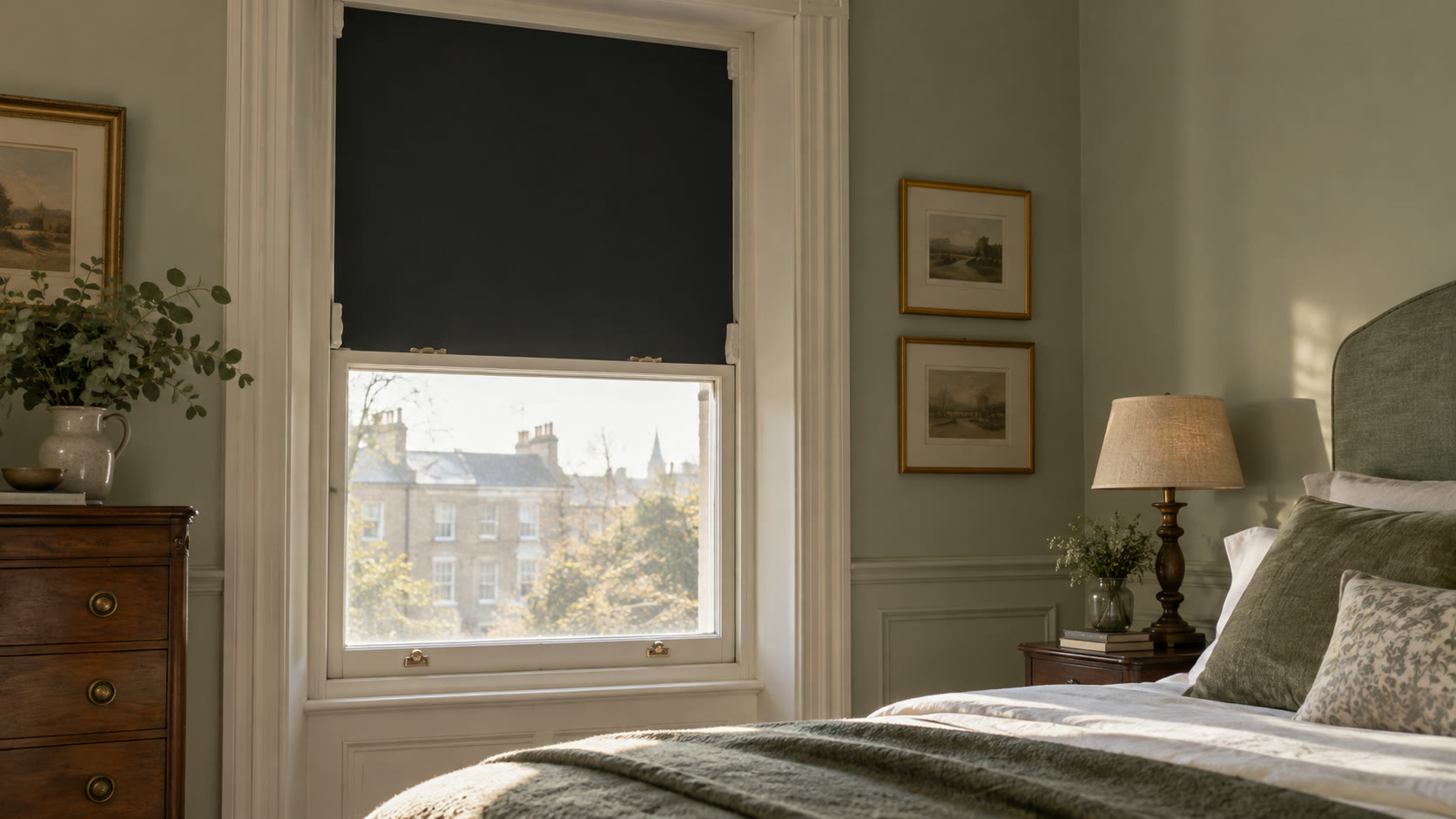
Understand the moving window before the blind
A vertical sliding sash has an upper and lower sash, a meeting rail, catches and usually a frame with channels or cords. Many also have glazing bars, horns, shutters or deep reveals. These features make the window visually attractive but complicate a blind that sits close to the glass. Raise and lower each sash and note everything that moves or projects. Check the position of ventilation openings and locks. A blackout system that prevents ordinary opening is a poor choice even if the dimensions look perfect on a listing.
Measure the clear room-side opening at top, middle and bottom. A period reveal may taper or be out of square. Then measure how far a blind could project without touching the sash handle, meeting rail or shutter. Consider whether it would be attached to the reveal, the wall above, a curtain pole or a temporary fixing surface. Do not take a maker's “recess width” to mean the pane width. For a standard roller, the complete unit is often wider than its fabric; the roller measuring guide explains the distinction.
If the sash is part of a protected or historic property, the physical substrate matters as much as the measurement. Historic England's guidance on modifying historic windows recommends careful assessment of significant fabric and local requirements. Do not assume that a small drilled bracket or adhesive strip is harmless because it is indoors. A landlord may also require consent for fixings in rented accommodation.
Compare three practical blackout routes
A room-side roller can sit above the reveal or within a deep enough recess. It covers the whole sash opening with one panel, though side light may appear where the cloth stops short of the frame. A wider outside mount may improve edge coverage but needs enough wall beside the architrave and must not cover any separate ventilation path. Check the operating chain location: the UK blind-cord safety guidance applies particularly in children's rooms. Cordless controls can remove a hanging loop but still need correct fitting and reachable operation.
A removable blackout panel can be useful for a renter or for an old frame where drilling is undesirable. The Easynight product below is a cut-to-size fabric system with hook-and-loop fixing; the Amazon Basics example uses suction cups. They have different surfaces and removal behaviour. Neither is a sash-specific kit. Check whether the required attachment is to glass, painted timber or plaster, and whether a manufacturer allows that surface. Suction cups can release if glass is dirty or the seal is poor. Adhesive can leave residue or damage old paint. Use a small unobtrusive test area only where the product and property allow it.
A curtain in front of the recess is often the least dependent on the sash geometry. It can cover the frame and meeting rail from the room side. It needs a sound pole or track, adequate fabric fullness and enough wall overlap. Our curtains-versus-blinds guide helps compare access and edge coverage. Existing shutters add another possibility, but check their hinges and catches before layering a blind behind them.
| Route | Keeps sash frame untouched? | Main limitation |
|---|---|---|
| Room-side roller | Often, if mounted to wall or reveal | Mechanism and side gaps need planning |
| Removable fabric or suction | Potentially, with a suitable surface | Adhesion, removal and exact fit vary |
| Curtain outside reveal | Usually avoids the sash itself | Requires secure surrounding fixings and stack space |
Protect glazing, paint and airflow
Old single glazing and its putty may be more fragile than a modern pane. Do not press hard on cracked, loose or valuable glass to attach a suction product. Do not scrape residue from historic paint with a blade. If the finish is uncertain, ask the owner or a specialist about a reversible solution. The Historic England window guidance is a useful starting point for conservation questions, but property-specific decisions need local advice.
Blackout coverings can conceal condensation around a sash frame. Look behind them regularly, especially in a cool room with single glazing. Keep intended trickle vents and ordinary opening available. The GOV.UK existing-home ventilation guide explains why moisture should be managed rather than sealed behind a covering. A fabric panel placed directly on glass is not a substitute for repairing a draughty sash or defective seal.
If the home is rented, photograph the frame condition before fitting anything. Keep the product's removal instructions and test only an approved finish. Consider whether a room-side pole already exists; using sound existing fittings may be better than new adhesive on old wood. Avoid claiming that a particular removable product is “damage free” in every property; the substrate and finish determine the outcome.
Test in daylight and with the window moving
After fitting, operate both sashes fully, close and lock them, and check any shutter or secondary glazing. Then look at the covered window from the bed in daylight. A bright outline at the architrave may call for more room-side overlap rather than another fabric grade. If the sash is part of a bay, each face may need its own approach; see our bay blind guide. If the solution is temporary, rehearse removing and refitting it without pulling on the glass or paint.
Keep the selected product's dimensions and fixing method with your window measurements. The two example cards below show different temporary formats only. Neither guarantees compatibility with old sash glazing, protected joinery or every window size, so treat the exact variant instructions as the final fitting authority.
Products for this job
Removable formats worth sizing carefully
These examples are temporary blackout formats, not sash-specific kits. Check the exact pane or reveal dimensions, fixing surface and removal method before using them on timber.
Easynight Blackout Blind, regular 150 × 145 cm
Best for: A removable cover with generous edge overlap
A cut-to-size blackout sheet fixed around the window frame with removable hook-and-loop attachments. It can cover the complete opening more closely than an ordinary roller blind and packs into a storage bag between uses.
What stands out
- Can be cut for an unusual window shape
- Hook-and-loop attachment can reduce perimeter gaps
- No drilling and a storage bag is included
Keep in mind
- Adhesive suitability depends on the frame finish
- Less convenient than a blind for frequent daylight access
- The fabric can look utilitarian in a finished bedroom
- 150 × 145 cm
- Cut to size
- Hook-and-loop fixing
- Storage bag
Amazon Basics Portable Blackout Curtain, beige, 127 × 198 cm
Best for: A large suction-mounted travel cover
A large polyester blackout cover that attaches to smooth glass with suction cups. Hook-and-loop tabs let the fabric gather to suit smaller windows, and the supplied bag makes it practical to store or pack.
What stands out
- No drilling or adhesive on the frame
- Large 127 × 198 cm panel
- Includes a travel bag and is listed as machine washable
Keep in mind
- Requires clean, smooth glass and careful suction-cup removal
- Needs taking down to restore the full view
- Availability and exact colour can change by retailer variant
- 127 × 198 cm
- Suction cups
- Hook-and-loop adjustment
- Travel bag