
A closed-window measurement is only the start
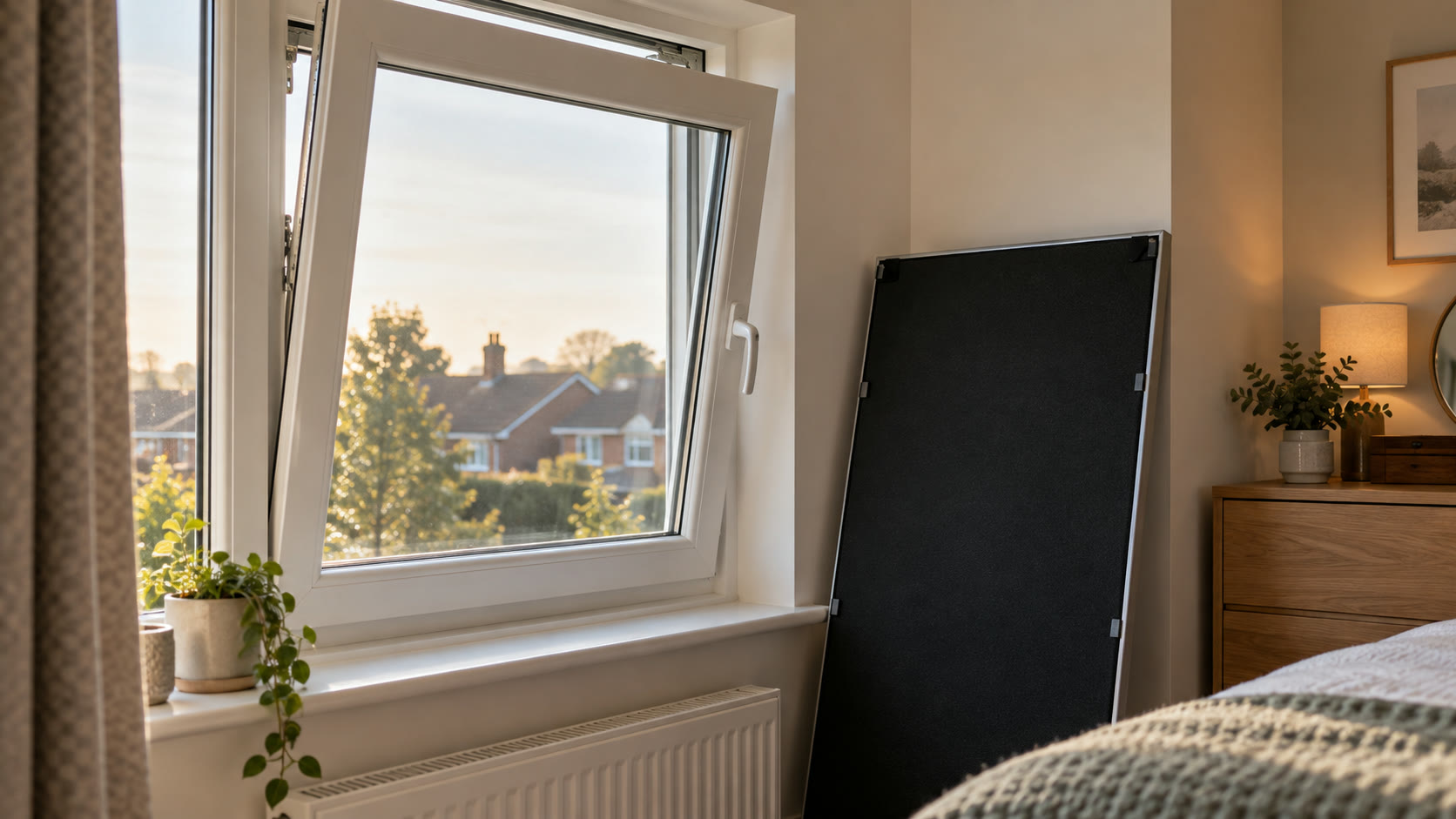
A tilt-and-turn window has two distinct movements. In tilt mode, the top of the sash moves inward while the lower edge stays near its frame. In turn mode, the sash swings inward around a vertical hinge. The handle changes position for each mode. A blind fixed just inside the room-side reveal can clash with the top of the tilting sash, even if it fits the glass perfectly when shut. A side bracket can be struck by the turning sash. Map both movements with the covering's full projected depth in mind.
Make a simple paper or cardboard profile of the proposed headrail or panel thickness. Hold it at the likely mounting line, then operate the window slowly through the intended ranges. Check handles, trickle vents, insect screens, secondary glazing and nearby furniture. Do not force a sash past a template. The goal is to keep normal operation available without bending hardware or rubbing the window seal. Blinds2go's fitting-system comparison demonstrates that frame-fit approaches are profile-specific; a product labelled “no drill” is not automatically compatible with every uPVC frame.
Where the sash opens very far into the room, a covering attached to the moving sash may be more convenient than a recess blind. But a large fabric panel can also hit the reveal as the sash turns. Record the maximum opening you actually use and any cleaning access needed. Never sacrifice a required opening or ventilation route for a small improvement in darkness.
Choose the attachment route that suits the frame
A glass-mounted removable panel can move with the sash. The Amazon Basics portable example below attaches by suction to suitable glass. The Easynight format uses cut-to-size fabric and hook-and-loop attachment. They are different solutions and neither is a tilt-and-turn kit. Check the exact selected size, cups or adhesive positions, glass condition and any need to fold fabric around a handle. A suction cup that works on a clean pane may not suit textured glass; an adhesive strip may affect paint or a rented frame. Follow the maker's surface and removal instructions.
A frame-compatible blind may clip, clamp or fit around glazing beads, depending on the design. It can preserve a clean room-side view and travel with the sash, but even a slim headrail needs room for tilt and handle motion. Do not wedge fixings into weather seals or drainage channels. A generic compression blind spanning the reveal may avoid drilling but can obstruct the sash when it tilts. Our no-drill fitting guide explains the different mechanisms behind that one label.
A room-side curtain or outside-mounted roller stays on the wall or ceiling rather than the moving sash. It can provide broader frame coverage when closed. Stack or raise it before opening the window, and check the top projection against the turning sash. This is sometimes the more realistic answer if the frame profile cannot take a compatible clip-in blind. Our renter-friendly options compare reversible routes, but any new wall fixing still needs landlord permission where applicable.
| Mounting route | What moves? | Critical test |
|---|---|---|
| Glass or sash panel | Covering and sash together | Does fabric clear the reveal during turn? |
| Frame-fit blind | Blind stays on compatible sash | Do clips and headrail clear tilt and seals? |
| Room-side curtain or roller | Window moves behind covering | Is fabric fully parked before opening? |
Record dimensions and opening arcs
Measure the clear glass width and height, the outer sash dimensions and the room-side reveal separately. Note the handle's position from the pane edges and how far it protrudes. Measure the available headroom above the frame and the distance from the closed sash to any proposed room-side blind. If choosing a frame-fit product, obtain its exact bead-profile and glass-measurement instructions. Do not use a recess measurement for a pane-attached item or vice versa.
Take photographs with the window closed, tilted and turned. Show the hinge side, top seal, ventilation slot and wall clearance. These images help a supplier confirm whether a blind's brackets will interfere. For a removable fabric, check whether its permitted trimming method preserves the specified fastener positions. A cuttable shade may cover irregular glass, but cutting into a seam or attachment strip can change how it works. Before buying, confirm the listing's selected size and whether it describes fabric or the whole mechanism.
Darkness depends on edge coverage. Glass-mounted shades can leave a glowing frame outline; a room-side curtain can cover the outline but may leave a top gap. Use our light-gap guide to identify which line matters. Do not respond to a bright edge by taping over a working seal or intended ventilation opening. The GOV.UK ventilation guide for England explains why room ventilation remains important.
Fit for safe daily use, not a static photograph
Follow the selected product's instructions. If it has an operating chain, assess reach and supplied safety devices using the UK OPSS blind-cord advice. A cordless or removable option may simplify controls but still needs correct installation. If a panel uses suction, check it regularly and keep detached parts away from young children as directed. Avoid putting adhesive on a window seal, freshly painted frame or protected finish.
Once fitted, practise the exact routine: remove, raise or stack the covering; set the handle; tilt; close; then turn. If the blind catches, change its location rather than forcing the sash. Check the result in daylight while the window is fully closed. Remember that leaving the window tilted for air will naturally admit light; no covering should be presented as a way to preserve a fully open ventilation gap and complete blackout simultaneously.
Products for this job
Temporary formats for suitable surfaces
These examples use suction and hook-and-loop attachment. Neither is a guaranteed tilt-and-turn fit; test the selected sash's glass, frame and opening arcs before ordering.
Amazon Basics Portable Blackout Curtain, beige, 127 × 198 cm
Best for: A large suction-mounted travel cover
A large polyester blackout cover that attaches to smooth glass with suction cups. Hook-and-loop tabs let the fabric gather to suit smaller windows, and the supplied bag makes it practical to store or pack.
What stands out
- No drilling or adhesive on the frame
- Large 127 × 198 cm panel
- Includes a travel bag and is listed as machine washable
Keep in mind
- Requires clean, smooth glass and careful suction-cup removal
- Needs taking down to restore the full view
- Availability and exact colour can change by retailer variant
- 127 × 198 cm
- Suction cups
- Hook-and-loop adjustment
- Travel bag
Easynight Blackout Blind, regular 150 × 145 cm
Best for: A removable cover with generous edge overlap
A cut-to-size blackout sheet fixed around the window frame with removable hook-and-loop attachments. It can cover the complete opening more closely than an ordinary roller blind and packs into a storage bag between uses.
What stands out
- Can be cut for an unusual window shape
- Hook-and-loop attachment can reduce perimeter gaps
- No drilling and a storage bag is included
Keep in mind
- Adhesive suitability depends on the frame finish
- Less convenient than a blind for frequent daylight access
- The fabric can look utilitarian in a finished bedroom
- 150 × 145 cm
- Cut to size
- Hook-and-loop fixing
- Storage bag