Choose a system that crosses the opening under tension
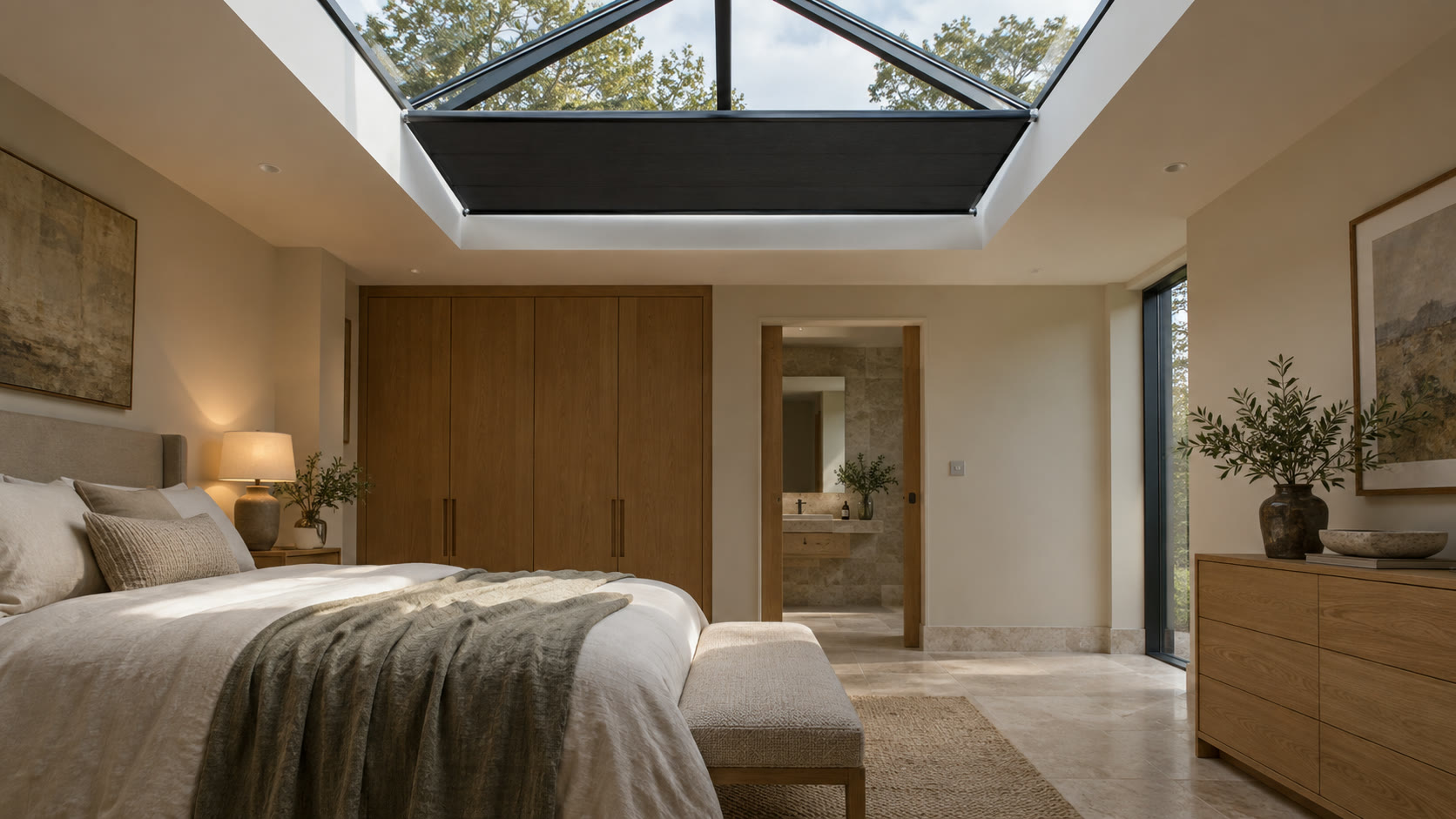
A roof lantern differs from a single sloping roof window. It may have several glazed facets around a ridge, or one broad horizontal glazed area with a deep internal reveal. In either case, the blind must travel across or beneath an overhead opening without relying on gravity to keep the fabric straight. Somfy's overview of skylight blinds describes guided and motorised approaches, while Apollo's lantern-roof range illustrates a purpose-made tensioned system. These are format examples, not interchangeable kits.
Ask where the blind sits: immediately under each pane, beneath the whole lantern within the ceiling reveal, or across a separate mounting frame. A blind covering the whole opening can make the room appear simpler when closed, but its cassette and side guides need space and structural fixing points. Individual facet blinds may preserve the shape of the lantern, yet junctions between panels remain possible light paths. A supplier's drawing should show the fabric travel direction, guides, stack position and service access. The phrase “rooflight blind” by itself does not establish compatibility.
For a room where darkness matters, request the actual blackout fabric option and ask how light is controlled at the perimeter. The weave can be opaque while a bright line still appears beside a guide or at the cassette. Some products primarily reduce glare or solar exposure rather than aiming for blackout. Their labels should not be treated as equivalent. Nor should any fabric choice be turned into a promised room-temperature or energy-saving figure: roof glazing, ventilation, orientation and the rest of the room all matter.
| Design question | What to establish before ordering | Why it matters |
|---|---|---|
| Direction of travel | Does a tensioned panel span the whole opening or each facet? | Junctions and stack locations differ |
| Perimeter | Are guides and cassette included in the quote? | Opaque fabric alone cannot cover side gaps |
| Control | Manual, battery, solar or wired motor? | High openings can be awkward to reach |
| Maintenance | Can the blind be removed or serviced from inside? | Access can dominate long-term practicality |
Measure the lantern as an assembly, not a patch of glass
Make a sketch from inside the room. Record the visible glass sizes, the full frame's outside dimensions, the clear internal reveal and its depth. Include crossbars, ridge position, sloping sides, ceiling trim and any roof-window opening mechanism. Take several measurements along each direction; a reveal can be out of square. Photograph the lantern from each side, showing the whole ceiling area and the locations where a cassette might sit. If you have installation paperwork, note the manufacturer and model; this may lead to a dedicated accessory.
Do not decide the order width by adding the individual glass measurements. Frames and mullions consume space, and suppliers may require the finished blind dimensions rather than the daylight opening. Give the maker your sketch and ask which measurement line their system uses. For a substantial opening, confirm whether a single panel is within the product's maximum dimensions or whether more than one is required. Also ask how far the blind projects below the ceiling when open, especially near pendant lights or a tall door.
The important dimensions are not all horizontal. A deep reveal may allow concealed mounting but may also make operation harder to reach. An angled reveal can change the fixing surface. Check that brackets would attach to a suitable structural substrate rather than glazing beads, seals or waterproofing. If an installer needs a ladder over stairs or furniture, plan safe access before accepting a quote. Measuring from outside on the roof is rarely necessary for an interior blind and should not be attempted simply to read a hidden label.
Specify operation and fitting together
Motorisation can be convenient where the lantern is beyond reach, but it is not a generic upgrade. Establish the compatible motor, how it is powered, the location of any cable or battery and how the blind is operated if a control is misplaced. Ask whether the motorised system needs a dedicated electrician, whether the blind can be removed for cleaning and what happens during a fault. A battery-powered option still needs occasional access. Wireless controls should be kept with the house documentation.
If the lantern opens for ventilation, the shade must not block its opening path or controls. Preserve any intended ventilation and inspect for condensation; a permanently closed blind should not conceal a damp frame. The GOV.UK home ventilation guide for England explains why moisture removal remains important. For children's rooms, avoid reachable loose cords and check any control arrangement against the UK product-safety advice on blind cords.
Before fitting, obtain the maker's drawings and warranty instructions. Do not drill into the glazing unit, lantern seals or roof weatherproofing. Ask a competent installer to handle high-access, structural or electrical work. Once fitted, operate the blind fully several times and look at the edges from the position in the room where daylight is troublesome. A small perimeter glow is a different problem from a misaligned track, and the remedy depends on the actual hardware.
When another route is more sensible
If the lantern is not an integrated kit-friendly model, a specialist made-to-measure supplier may be more realistic than a ready-made shade. An ordinary pitched-roof blind is not a lantern product: its rails, code and slope assumptions would be misleading here. For a single window set into a sloping roof, use our roof-window guide. For a flat manufactured rooflight, start with our flat-rooflight compatibility guide.
Sometimes the lantern is only one of several sources of light. Before paying for a complex overhead system, look at the room in early daylight and identify whether a conventional side window, a glazed door or a hall light is the stronger intrusion. The light-gap guide can help map these paths. A good solution is the smallest correctly specified combination, not necessarily the most elaborate roof blind.