The short answer
A pleated shape does not guarantee darkness
Single pleats, cellular pockets and temporary adhesive shades can all be called pleated. Inspect the exact blackout fabric, any visible cord holes and the perimeter fit. A framed cellular unit deals with edge light differently from a free-hanging or stick-on shade.
Check whether the material is single pleat or honeycomb cellular.
Ask whether cord holes are visible through the chosen blackout fabric.
Plan the fitting, control and edge gaps before comparing colours.
Product shortlist
Three pleated constructions
These examples cover a custom cellular shade, a simple adhesive pleated panel and a framed cellular system. They suit different levels of permanence and edge control.
Luxevoir Panoramix cordless cellular blackout blind, light grey, custom size
Best for: A custom-sized honeycomb blind without a hanging chain
A handle-operated honeycomb blind supplied to a chosen size. Its pleated cells offer a softer appearance than a roller, while the advertised no-drill fitting needs a compatible frame and careful measurement.
What stands out
- Handle-operated cordless control
- Custom-size ordering
- No conventional drilling advertised for compatible frames
Keep in mind
- Fitting compatibility and grip must be checked on the actual frame
- A free-hanging cellular blind can still admit light at the edges
- Custom dimensions need careful confirmation before ordering
- Custom size
- Honeycomb fabric
- Cordless handle
- No-drill fitting
Maritown adhesive pleated blackout shade, black, 90 × 150 cm
Best for: A low-cost temporary shade on a compatible frame
A temporary pleated non-woven shade with a self-adhesive header. It can be trimmed to width and held at different heights with the supplied clips, making it useful for short-term room darkening.
What stands out
- No drilling or hanging chain
- Can be trimmed to a narrower width
- Two clips allow a basic raised position
Keep in mind
- Adhesive may mark paint or leave residue
- Pleats need extra drop to cover the full window
- Clips and lightweight material suit temporary use better than heavy daily handling
- 90 × 150 cm
- Non-woven pleated material
- Self-adhesive header
- Cordless clips
TIPIACE framed top-down bottom-up cellular blackout blind, black
Best for: A made-to-size recess with flexible top-down control
A custom-size honeycomb blind inside a full aluminium frame. The fabric cells conceal the internal lift cords, while the frame addresses side leakage more directly than a free-hanging cellular blind.
What stands out
- Full frame manages perimeter light
- Cordless top-down bottom-up operation
- Custom dimensions for non-standard openings
Keep in mind
- Needs a deep, square recess and screw fixing
- Custom products require especially careful measurement
- The configured item may not be returnable if dimensions are wrong
- Custom size
- Honeycomb fabric
- Aluminium frame
- Cordless manual control
Pleated formats at a glance
Check the selected variant's fabric, full width and fixing instructions; a pleated appearance alone is not a performance measure.
| Format | Fabric structure | Mounting | Typical trade-off |
|---|---|---|---|
| Custom cellular | Honeycomb pockets | No-drill custom fit | Free side edges can glow |
| Adhesive pleated | Single folded panel | Stick-on strip | Shorter-lived finish and surface dependence |
| Framed cellular | Honeycomb within frame | Custom frame fit | More exacting measurements |
First, work out which “pleated” blind you are looking at
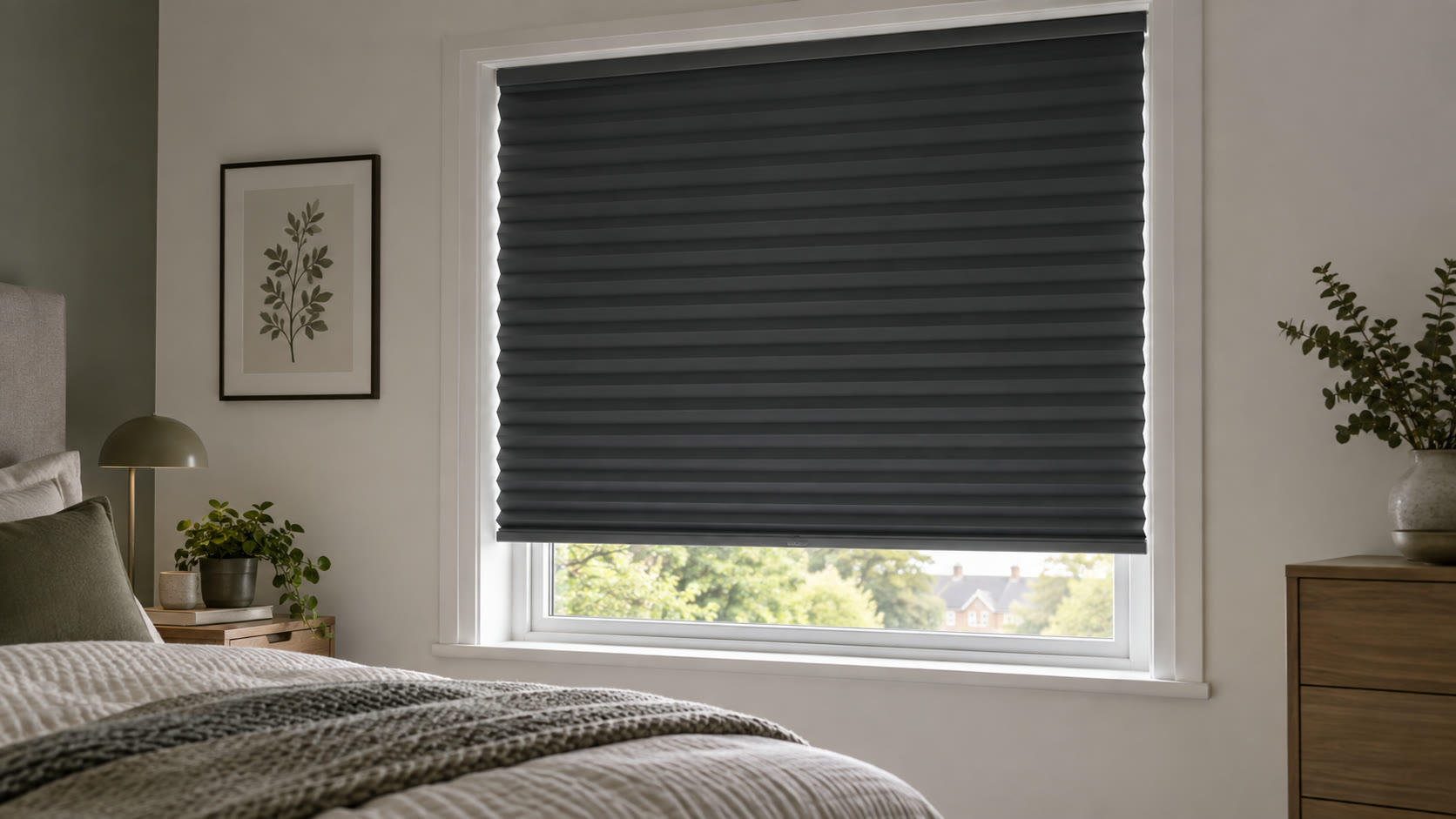
Pleated blinds are named for their concertina folds. That visual family includes a single sheet folded into regular pleats, a honeycomb or cellular fabric made from connected pockets, and inexpensive stick-on panels sold as temporary shades. They are not interchangeable. The control, stiffness, cord route and ability to manage the window edge vary. Before buying a “blackout pleated blind”, inspect the exact fabric and a real fitting diagram for the chosen size.
The BBSA's pleated and cellular characteristics guide is particularly helpful here. It explains that pleated and honeycomb blinds may use blackout fabrics, but light can still enter around the extremities unless framing or channels reduce it. It also notes that single pleated fabrics can show light through operating-cord holes, whereas cords in a honeycomb construction run within the cells. These are construction differences, not small print.
Custom cellular: softer than a roller, but not sealed
The Luxevoir Panoramix is a custom-sized cordless cellular shade. Its handle control avoids a hanging operating chain. The folded material stacks at the top when raised and offers a softer appearance than a flat roller. This can suit a bedroom where a rigid cassette would feel too technical. Its free side edges can still admit daylight, particularly in a pale reveal. Select the correct opaque variant and check whether the headrail and bottom bar sit squarely in the opening.
Custom sizing needs careful measuring. Take widths at several heights, note protruding handles and inspect the depth available for the headrail. Read whether the seller wants the raw recess or final finished width. A blind manufactured to the wrong dimension may be costly to replace. Our recess measuring guide deals with a roller rather than cellular hardware, but the principle of recording the opening at several points remains useful; use the cellular seller's own deduction instructions for the order.
Stick-on pleated: a temporary route
The Maritown adhesive pleated panel is an inexpensive way to cover a window without brackets. It is most attractive when speed, low commitment and a close fit to a simple opening matter more than a durable daily mechanism. The folded panel may be cut or adjusted only as its maker permits. Adhesive attachment depends on a clean, sound, compatible surface; old paint, textured plaster and damp uPVC are not equivalent.
This format often looks and wears differently from a fabric blind with a rigid headrail. Frequent raising can crease the folds or weaken the attachment. It may not seal the sides, and “temporary” does not mean removal will leave no trace. If your tenancy has strict decoration rules, test the proposed surface and review the rental terms before fitting. See best stick-on blackout blinds for a wider look at adhesive routes.
Framed cellular: when side light matters
The TIPIACE example puts cellular fabric in a surrounding frame. This is relevant where the window geometry allows a precise fit and free side edges are the main source of unwanted light. Its cordless control and frame solve different problems: one concerns the operating loop, the other concerns perimeter coverage. Neither should be described as guaranteeing a perfectly dark room.
Check how its frame sits relative to the sash, gasket and handle. A nearby hinge may prevent the blind reaching the advertised position. A window that opens inward can also collide with a frame that looked unobtrusive when closed. Ask for a mounting diagram and measure the actual fixing plane, not simply the glazing. A framed system may be harder to remove or clean than a simple shade.
Fabric, control and safety checks
Inspect the backing in strong light. “Blackout” may refer to an opaque internal layer, a coated face or a dark-looking fabric with more transmission than expected. A swatch can answer the through-fabric question, but not the edge-light question. View the window from the bed or work position at the time the sunlight is most troublesome. Consider a side channel or an overlapping curtain if the perimeter remains bright.
Control matters in a household with children. Some pleated systems use accessible loops or cords even when the front looks clean. The Office for Product Safety and Standards warns about looped blind cords and the need to install supplied safety devices. Prefer a safe-by-design control where appropriate, keep climbable furniture away and secure the whole blind correctly. “Cordless” in a listing must be checked against the actual variant.
Pleats need gentle maintenance. Dust according to the maker's instructions and avoid saturating coated fabric or its internal cells. The BBSA notes that retracting pleated and honeycomb blinds periodically helps preserve their shape. If condensation collects behind the blind, open it to inspect the frame and manage moisture. The mould guide explains why a covering should not hide a recurring damp problem.
For a normal vertical window, choose by attachment first: temporary adhesive for a short-term need, a custom cellular shade for everyday soft folds, or a framed system for stronger edge control where the opening permits it. For a pitched roof window or flat rooflight, use a code-matched product instead of adapting a vertical-window pleated shade. Our roof-window guide explains the code check.
Clear answers
Frequently asked questions
Short answers to the fitting, use and care questions that most often change the result.
Are pleated blinds fully blackout?
Some use opaque fabric, but single pleats may have cord holes and any free-hanging blind can admit light at its edges. Verify the exact selected model.
What is the difference between pleated and honeycomb blinds?
Single pleats fold as one layer; honeycomb or cellular fabric forms pockets. The latter can route cords inside the cells, avoiding visible holes in the fabric face.
Are stick-on pleated blinds reusable?
It depends on the product and adhesive. Many inexpensive panels are intended as temporary coverings; moving them can weaken the strip or damage a delicate finish.
Can pleated blinds be fitted in a roof window?
Only if the exact blind is designed for that window and fitted with the required guides or tensioning. A free vertical shade should not be assumed to work overhead or on a slope.
How should I maintain the folds?
Follow the maker's care instructions and retract the blind periodically. Avoid crushing, soaking or forcing a pleat that has become misaligned.