
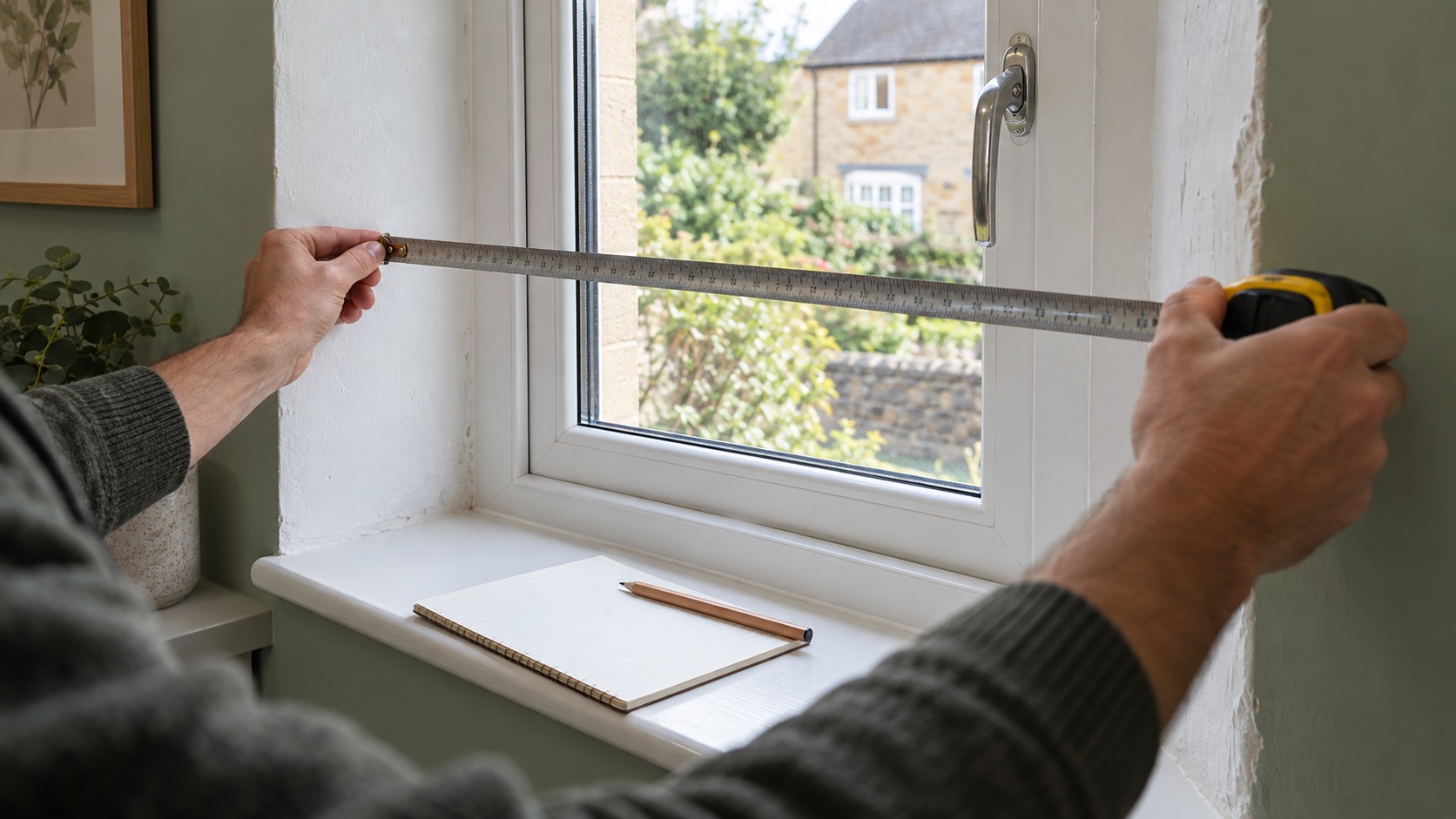
Before you put a tape to the window
Decide what “recess fit” means for the chosen product. A conventional roller puts brackets near the top side walls or ceiling of the reveal. A clip-on model may attach to the opening sash instead. A tension-fit product bears against the recess walls. The same glass can therefore produce different order dimensions.
Download or open the exact measuring diagram before recording a number. Note whether the retailer asks for finished-blind width, recess width or fabric width, and whether it makes an automatic deduction. Save a copy because product pages can change.
Use a rigid metal tape, pencil, labelled sheet and small spirit level. A fabric tape can stretch and a phone-measuring app is not accurate enough for a made-to-measure blind. Work from a stable platform rather than leaning across furniture.
Make a simple measurement sheet
Draw a rectangle for the recess. Add spaces for top, middle and bottom width; left, centre and right drop; depth at both top corners; handle projection; and notes about vents, tiles or seals. Label units prominently.
Record each number as soon as it is taken. Do not rely on memory or write three figures without locations. Photograph the finished sheet beside the window number or room name.
If measuring several similar windows, label them individually. Small construction differences can matter, and swapping two order sizes is an expensive mistake.
Measure the recess width in three places
Measure horizontally from the left reveal to the right reveal near the top, through the middle and near the sill. Keep the tape level and pull it straight without bowing. Record each figure separately to the nearest unit requested.
The top measurement deserves special attention because the complete mechanism sits there. Check the precise intended bracket line, not a convenient point lower down. Sealant, picture rails or a bowed corner can reduce the usable width.
The middle and bottom figures still matter. The fabric and bottom bar must pass through the full drop. A recess that narrows over tiles can accept the roller at the top but snag the blind lower down. Report that geometry to the supplier rather than assuming flexible cloth will solve it.
Check whether the recess is square
Compare the three widths and drops. A small variation is common in plastered openings, but a large difference affects side gaps and operation. If the supplier requests diagonal measurements, take corner-to-corner readings and label their direction.
Do not average an out-of-square opening. The blind still has to fit the tightest constraint, and the resulting gap on the wider side may be visible. A face-fitted roller with overlap, or a professionally measured cassette, can be more appropriate.
Use a spirit level at the proposed bracket line. Level brackets help the fabric roll squarely. Do not plan to deliberately slope the tube to follow an uneven sill; that can make the cloth telescope sideways.
Measure drop, usable depth and obstructions
Measure the vertical distance at the left, centre and right from the proposed top fixing line to the sill or finishing point. A made-to-measure blind needs enough cloth to reach the bottom without an excessive roll. A ready-made blind needs a listed drop at least as long as the usable distance.
Depth is not simply the distance from wall face to glass. Measure the clear space available to the roll after allowing for the window handle, vents, frame bevels and the opening path of the sash. A thick blackout cloth builds a larger roll at long drops.
Open the window fully and watch how the handle and top edge move. A blind that fits while the window is closed may prevent it opening. Do not cover trickle vents or emergency egress hardware.
Part-tiled recesses need two sets of widths: the bracket area above the tiles and the narrow point between them. Deep silicone beads can also interfere with clip-on brackets or side channels.
Complete mechanism versus fabric coverage
Roller cloth is narrower than the bracket-to-bracket width because the control and pin ends occupy space. The difference varies. One product in our catalogue states about 4.5 cm; another maker may use a different figure.
In a recess, that difference becomes a strip of uncovered opening. Before ordering, ask for the exact fabric width at the configured blind width. Mark it on the recess with removable tape and inspect whether the predicted side light is acceptable.
If darkness is more important than keeping the blind inside the reveal, consider a face fit. Our broader blackout blind measuring guide covers outside overlap and roof windows.
Apply deductions exactly once
Many made-to-measure retailers ask for the raw recess size and then manufacture the blind slightly smaller. Others ask for an exact finished-blind dimension. These instructions are not interchangeable.
For example, the Blinds2go roller measuring guide (PDF) says it makes the fitting allowances for recess orders. Its exact-fit instructions instead ask for the finished size. That is an example of one supplier’s order options, not a deduction rule for every roller blind.
Never automatically remove 5 mm, 10 mm or a memorised trade allowance. If the seller already deducts and you subtract too, the resulting gap doubles. If the seller expects a finished size and you submit the raw recess, the blind may be too wide.
Keep written confirmation if a customer-service adviser gives a special instruction. Save the configured order screen showing units, fitting type, width, drop, control side, colour and quantity.
Control side and safe access
Choose the control side after looking at furniture, handles and the route into the room. A chain needs its supplied tensioning device fixed to a sound adjacent surface. The Office for Product Safety and Standards says blind loops can endanger children and advises keeping furniture away from windows.
Where children live or visit, prefer a safe-by-design cordless option. Measurement is part of safety: a control that lands behind a cot, shelf or radiator is not a usable installation.
Final checklist before ordering
- Exact product and fitting type chosen.
- Top, middle and bottom widths labelled.
- Left, centre and right drops labelled.
- Usable depth checked at both ends.
- Handles, vents, tiles, seals and opening path recorded.
- Complete blind width and fabric width understood.
- Retailer deduction rule applied once.
- Units, control side and selected variant rechecked.
- Photographs and configured order saved.
Measure again on a different day before buying. If the numbers disagree, find the reason rather than choosing the preferred figure. A careful ten minutes at the window prevents most fit problems and gives a much better chance of useful room darkening.
Products for this job
Roller formats with different width questions
A drilled chain roller, clip-and-adhesive roller and cordless shade each define the fitting area differently. Use the chosen model’s exact diagram.
FURNISHED blackout roller blind, black, 60 × 165 cm
Best for: A familiar daily blind in a standard bedroom
A conventional coated roller blind with a broad size range and several fitting positions. It is useful when you want an everyday blind rather than a panel that must be removed each morning.
What stands out
- Many width and drop options are listed
- Can be fixed inside or outside the recess
- A trim-to-width route for awkward standard sizes
Keep in mind
- The fabric is about 4.5 cm narrower than the complete mechanism
- The looped chain and supplied safety device must be fitted correctly
- An ordinary roller does not seal the sides
- 60 × 165 cm
- Coated polycotton
- Bracket mounted
- Chain controlled
Amazon Basics blackout roller blind, dark grey, 56 × 150 cm
Best for: A compact adhesive-and-clip installation
A compact roller blind whose clip-and-adhesive mounting avoids drilling into the frame. The listed fabric is opaque, but the roller mechanism still leaves perimeter routes for daylight.
What stands out
- Mounting clips are listed as requiring no drilling
- Available in several compact widths
- Raises and lowers like a normal roller blind
Keep in mind
- Adhesive removal can affect delicate surfaces
- The cord tensioning device is safety-critical
- The 150 cm drop will not suit every window
- 56 × 150 cm
- Polyester
- No-drill clips
- Cord controlled
LazBlinds cordless no-drill blackout shade, black, 36 × 72 in
Best for: A window where a control loop is best avoided
A spring-operated cordless shade that attaches without conventional drilled brackets. It removes the hanging loop found on many ready-made rollers, but its stick-on installation still needs a compatible, clean surface.
What stands out
- Cordless spring operation
- No conventional drilling
- Opaque black fabric in the featured variant
Keep in mind
- A fixed ready-made width will not suit every recess
- Adhesive or pressure fittings still depend on the surface and instructions
- No-drill does not guarantee mark-free removal
- 36 × 72 in
- Cordless
- No-drill mounting
- Black