
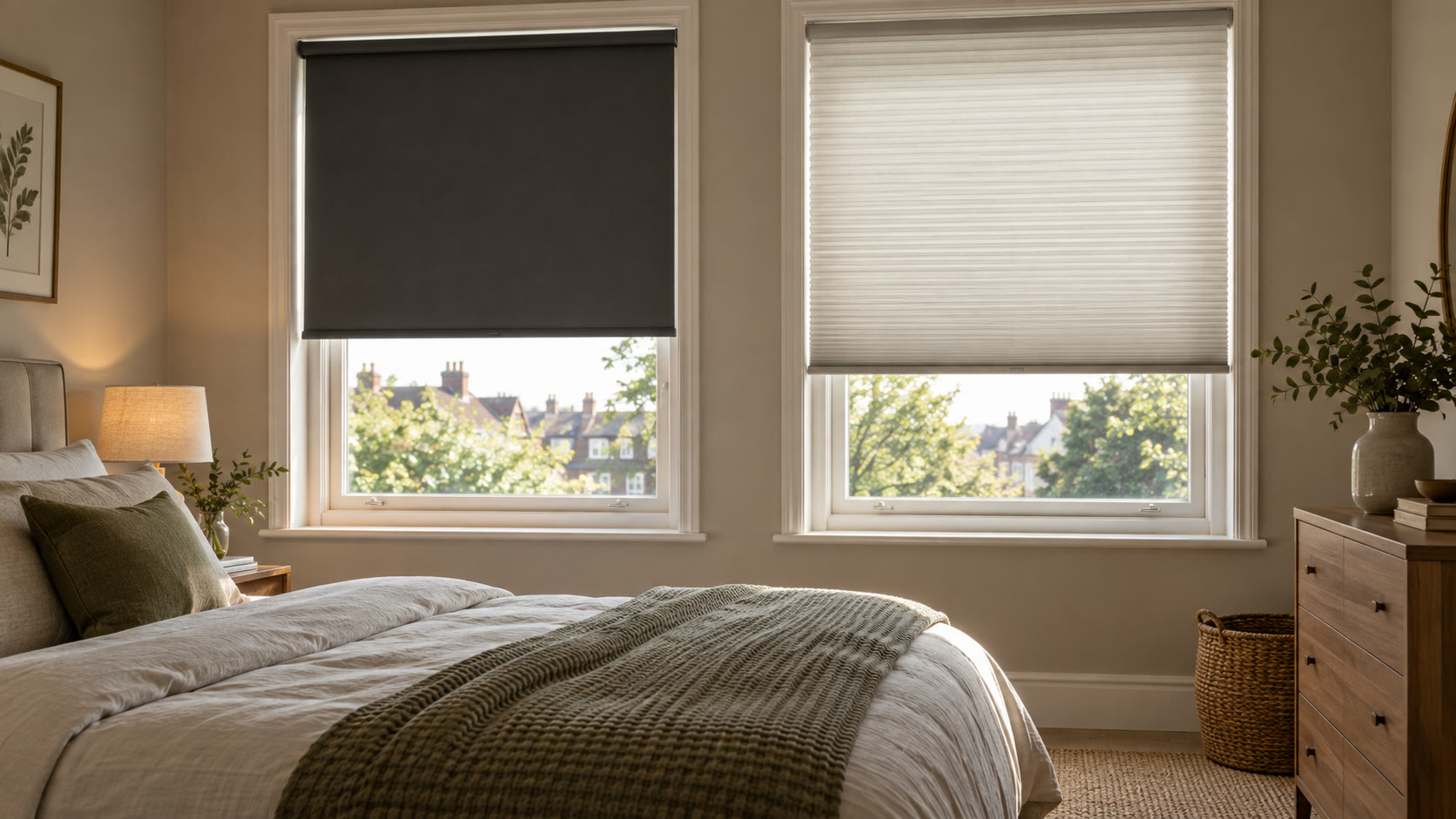
Two labels, two different questions
“Blackout” asks how much visible light passes through the blind material. “Thermal” signals that a material or design is intended to affect heat transfer at the window. They can overlap, but neither term alone describes the finished room. An opaque roller may still leave bright side strips. A cellular shade may create an insulating air layer but use a light-filtering fabric that does not darken a room enough for a daytime sleeper.
For blackout performance, inspect the actual fabric in strong light. Coated rollers and curtains may block light through the central panel. Cellular blinds may include a blackout lining inside their pleated cells. The British Blind and Shutter Association's cellular guidance notes that blackout fabric can be used in honeycomb blinds while light may still enter at the extremities without additional framing or channels.
Thermal performance is more complicated. Heat moves through glazing and frames and by air movement. A blind changes part of that system, depending on its material, distance from glass and how closely its edges meet the reveal. A marketing claim about fabric does not tell you what will happen in a specific room with a particular window.
Thermal and blackout features at a glance
| Feature | Blackout focus | Thermal focus | What to verify |
|---|---|---|---|
| Main purpose | Limit visible light through material | Influence heat transfer at a window | Whether the whole assembly addresses your actual problem |
| Typical construction | Opaque coating or dense blackout layer | Cellular pockets, lining or reflective layer | Exact selected fabric and independent specification |
| Edge gaps | Can leave strong visible strips | Can allow air movement around a blind | Recess fit, overlaps, channels and sill |
| Room result | Depends on perimeter light and other openings | Depends on glazing, orientation and use | Real window conditions rather than a generic label |
The same blind may have a blackout cloth and a cellular structure, but it can still be the wrong fit for a shallow, tapered recess. Start with the room problem, then evaluate the construction that addresses it.
How fabric and fit interact
A standard roller is a simple everyday light control. Its cloth usually runs narrower than the complete mechanism so it can clear the brackets. That deliberate clearance can leave side strips even when the cloth is opaque. Outside mounting adds overlap; side tracks or a cassette can manage the perimeter more directly.
Cellular blinds form pleated pockets. Some place internal cords within the cells, avoiding visible cord holes through the fabric. Their soft texture suits bedrooms, and some are available with blackout lining. However, a free-hanging cellular panel can still admit daylight around its sides. A full frame, such as the TIPIACE example, tackles that fit problem with more precise installation.
A reflective backing is sometimes promoted as a thermal shortcut. Its actual contribution depends on orientation, cavity, distance to glazing and the rest of the window. Avoid translating a quoted material property into a promise that the room will be a certain number of degrees cooler or that a household will save a stated percentage on heating.
Winter and summer need different behaviour
In winter, a window covering may help reduce the feeling of cold near glazing, particularly when closed in the evening. But the Energy Saving Trust's windows and doors guidance puts treatments in the context of the whole window, including glazing and draughts. A blind is not a substitute for repairing poor seals, condensation or inadequate glazing.
Keep radiators and required ventilation clear. A blind trapped tightly against a cold, damp pane can hide condensation, so open it regularly to inspect and dry the window area. If moisture recurs, address ventilation and the underlying cause rather than sealing it behind a product.
In summer, timing matters. The Energy Saving Trust's summer guidance advises closing curtains or blinds when sun shines on the window and ventilating when outside air is cooler and it is safe to do so. A darker blind may reduce glare, but that does not mean it will necessarily lower room temperature more than another suitable treatment. Glazing type, external shading and orientation have major effects.
Choose by the problem you can observe
If strong daylight comes directly through the fabric, choose a genuine opaque construction. If light mainly enters at the edges, change the fit. Our guide to side tracks explains when a cassette or channel is worth considering. If the room feels uncomfortable beside a cold window, inspect seals and draughts before spending on a fabric upgrade.
For a south-facing bedroom that becomes bright and warm in afternoon sun, a close-fitting blind can serve both light control and a shading role. Compare product specifications carefully, but do not rely on an advertised energy-saving number unless the test conditions match your window. An exterior shading option or a different ventilation routine may have a larger effect than swapping one interior blind for another.
For a rented home, a no-drill cellular shade may be attractive, but measure the frame and confirm the mounting method is compatible. An adhesive claim of “damage free” is not a guarantee for old paint or varnish. For a child's room, choose a safe-by-design cordless control where possible and keep beds and furniture away from the window; the UK child-safety guidance is relevant regardless of fabric type.
A sensible shortlist
Choose an opaque roller if your priority is simple daily operation and you can provide enough overlap. Choose a cellular blind if you value its layered construction and softer finish, then specify blackout fabric if darkness also matters. Choose a framed or channelled system if perimeter light is the dominant complaint and the reveal can accept accurate fitting.
The deciding questions are concrete: what light path do you see, what space is available, which controls are safe for the household, how will the window open, and can the product be fitted correctly? The answer may be a layered combination rather than one supposedly universal “thermal blackout” label. See our blackout cellular guide for a closer look at that construction and do blackout blinds keep a room cool? for the summer evidence.
Products for this job
Construction examples
These products illustrate an opaque roller, a honeycomb blind and a framed cellular system; none has a universal energy-saving outcome.
FURNISHED blackout roller blind, black, 60 × 165 cm
Best for: A familiar daily blind in a standard bedroom
A conventional coated roller blind with a broad size range and several fitting positions. It is useful when you want an everyday blind rather than a panel that must be removed each morning.
What stands out
- Many width and drop options are listed
- Can be fixed inside or outside the recess
- A trim-to-width route for awkward standard sizes
Keep in mind
- The fabric is about 4.5 cm narrower than the complete mechanism
- The looped chain and supplied safety device must be fitted correctly
- An ordinary roller does not seal the sides
- 60 × 165 cm
- Coated polycotton
- Bracket mounted
- Chain controlled
Luxevoir Panoramix cordless cellular blackout blind, light grey, custom size
Best for: A custom-sized honeycomb blind without a hanging chain
A handle-operated honeycomb blind supplied to a chosen size. Its pleated cells offer a softer appearance than a roller, while the advertised no-drill fitting needs a compatible frame and careful measurement.
What stands out
- Handle-operated cordless control
- Custom-size ordering
- No conventional drilling advertised for compatible frames
Keep in mind
- Fitting compatibility and grip must be checked on the actual frame
- A free-hanging cellular blind can still admit light at the edges
- Custom dimensions need careful confirmation before ordering
- Custom size
- Honeycomb fabric
- Cordless handle
- No-drill fitting
TIPIACE framed top-down bottom-up cellular blackout blind, black
Best for: A made-to-size recess with flexible top-down control
A custom-size honeycomb blind inside a full aluminium frame. The fabric cells conceal the internal lift cords, while the frame addresses side leakage more directly than a free-hanging cellular blind.
What stands out
- Full frame manages perimeter light
- Cordless top-down bottom-up operation
- Custom dimensions for non-standard openings
Keep in mind
- Needs a deep, square recess and screw fixing
- Custom products require especially careful measurement
- The configured item may not be returnable if dimensions are wrong
- Custom size
- Honeycomb fabric
- Aluminium frame
- Cordless manual control