
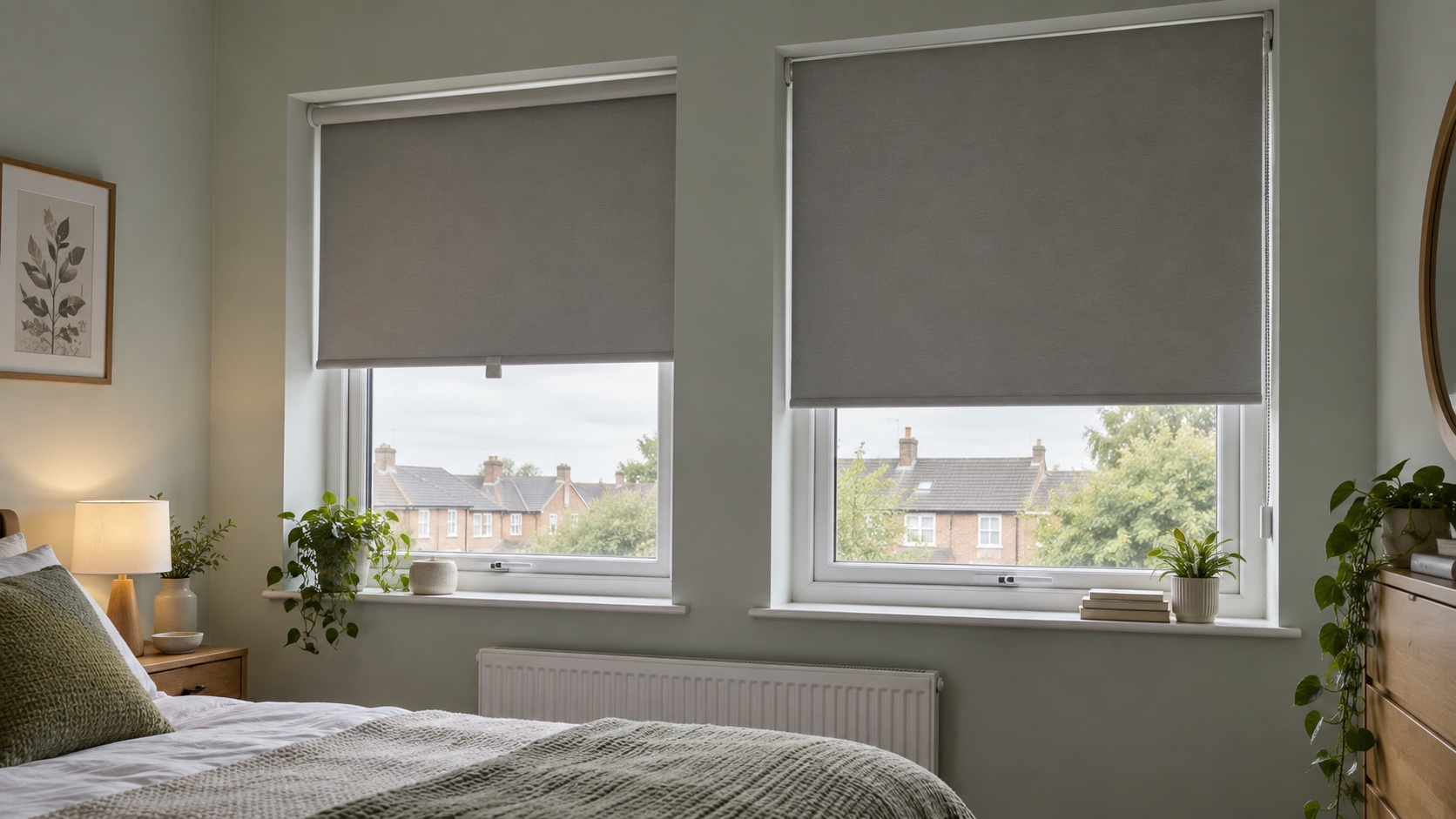
How each control feels in daily use
A spring-operated roller is moved by its lower bar or pull tab. The spring helps retract the cloth and a catch or controlled mechanism holds its position. It avoids the visual clutter of a side chain and can be convenient on a reachable bedroom window. The trade-off is that the user must comfortably reach the lower bar and operate the product as instructed; some mechanisms are less forgiving of a rushed pull.
A chain roller uses a continuous loop at one side. It can be easy to make small height adjustments and may suit a tall window if the chain is specified and secured correctly. It also introduces an accessible loop hazard in homes where children live or visit. The OPSS blind-cord guidance says supplied safety devices must be fitted, and the BBSA safety guide recommends safe-by-design options where suitable. A chain simply tied up or left behind furniture is not an equivalent installation.
| Issue | Spring-operated roller | Chain-operated roller |
|---|---|---|
| Daily control | Pull or guide the lower bar | Operate a secured side loop |
| Reach | Lower bar must be accessible | Control position can be selected |
| Child-safety focus | Secure full blind and avoid other loose parts | Correctly install the supplied chain safety device |
| Darkness | Set by cloth and fit | Set by cloth and fit |
Look beyond the control label
“Cordless” addresses the hanging operating loop, not every risk. Check that the blind is firmly mounted, that a child cannot pull it down from nearby furniture, and that the window remains accessible. A no-drill spring blind relies on the surface or frame fit specified by the maker. A chain blind may be entirely appropriate in a room when its safety device is installed and maintained correctly, but the extra fitting step is non-negotiable. Do not improvise a replacement chain or remove the tensioner for convenience.
The LazBlinds example below combines spring operation with a no-drill fitting; its surface and stock width therefore deserve attention. The FURNISHED roller is a familiar bracket-and-chain format with a different width family. Compare the control method and fitting requirements separately from the fabric coverage. For a child-used room, use our cordless blind guide alongside the official safety information.
Match the control to the window
Choose a spring roller when the lower bar is easy to reach, you want no side loop and the maker's fitting is sound for your window. Choose a chain roller when precise positioning or a particular compatible blind range makes it more practical, and you can install its safety device in the required position. Our cordless blind shortlist includes more than spring rollers. On a high window, neither manual control may be ideal; an appropriate motorised or wand-operated system could be worth comparing.
For either format, measure the complete mechanism width and the cloth width separately. A dark fabric with narrow cloth can leave side glow regardless of the control. The BBSA roller product guidance explains this characteristic. If side leakage is the main problem, consider outside overlap or a side-tracked blind before paying for a different control alone.
Try the movement, not just the label
If possible, operate the same type of mechanism in a showroom. Raise it from the height a shorter household member would reach and consider whether a bed, desk or radiator will stand in the way. On a spring blind, watch whether the lower bar stops evenly and whether repeated pulls disturb the fitting. On a chain blind, identify the exact adjacent wall area where the tensioner can be fixed firmly without being reachable by a child. A mock-up with tape at the proposed headrail and control positions is often enough to reveal a practical conflict. The decision is about repeatable, safe operation every day, not simply the appearance of the blind when it is closed.
Products for this job
Two control types to compare
These catalogue examples show a cordless spring shade and a conventional chain roller. Their fit and size are different, so compare controls without assuming identical coverage.
LazBlinds cordless no-drill blackout shade, black, 36 × 72 in
Best for: A window where a control loop is best avoided
A spring-operated cordless shade that attaches without conventional drilled brackets. It removes the hanging loop found on many ready-made rollers, but its stick-on installation still needs a compatible, clean surface.
What stands out
- Cordless spring operation
- No conventional drilling
- Opaque black fabric in the featured variant
Keep in mind
- A fixed ready-made width will not suit every recess
- Adhesive or pressure fittings still depend on the surface and instructions
- No-drill does not guarantee mark-free removal
- 36 × 72 in
- Cordless
- No-drill mounting
- Black
FURNISHED blackout roller blind, black, 60 × 165 cm
Best for: A familiar daily blind in a standard bedroom
A conventional coated roller blind with a broad size range and several fitting positions. It is useful when you want an everyday blind rather than a panel that must be removed each morning.
What stands out
- Many width and drop options are listed
- Can be fixed inside or outside the recess
- A trim-to-width route for awkward standard sizes
Keep in mind
- The fabric is about 4.5 cm narrower than the complete mechanism
- The looped chain and supplied safety device must be fitted correctly
- An ordinary roller does not seal the sides
- 60 × 165 cm
- Coated polycotton
- Bracket mounted
- Chain controlled