
The short answer
Choose a safe-by-design control and secure complete fitting
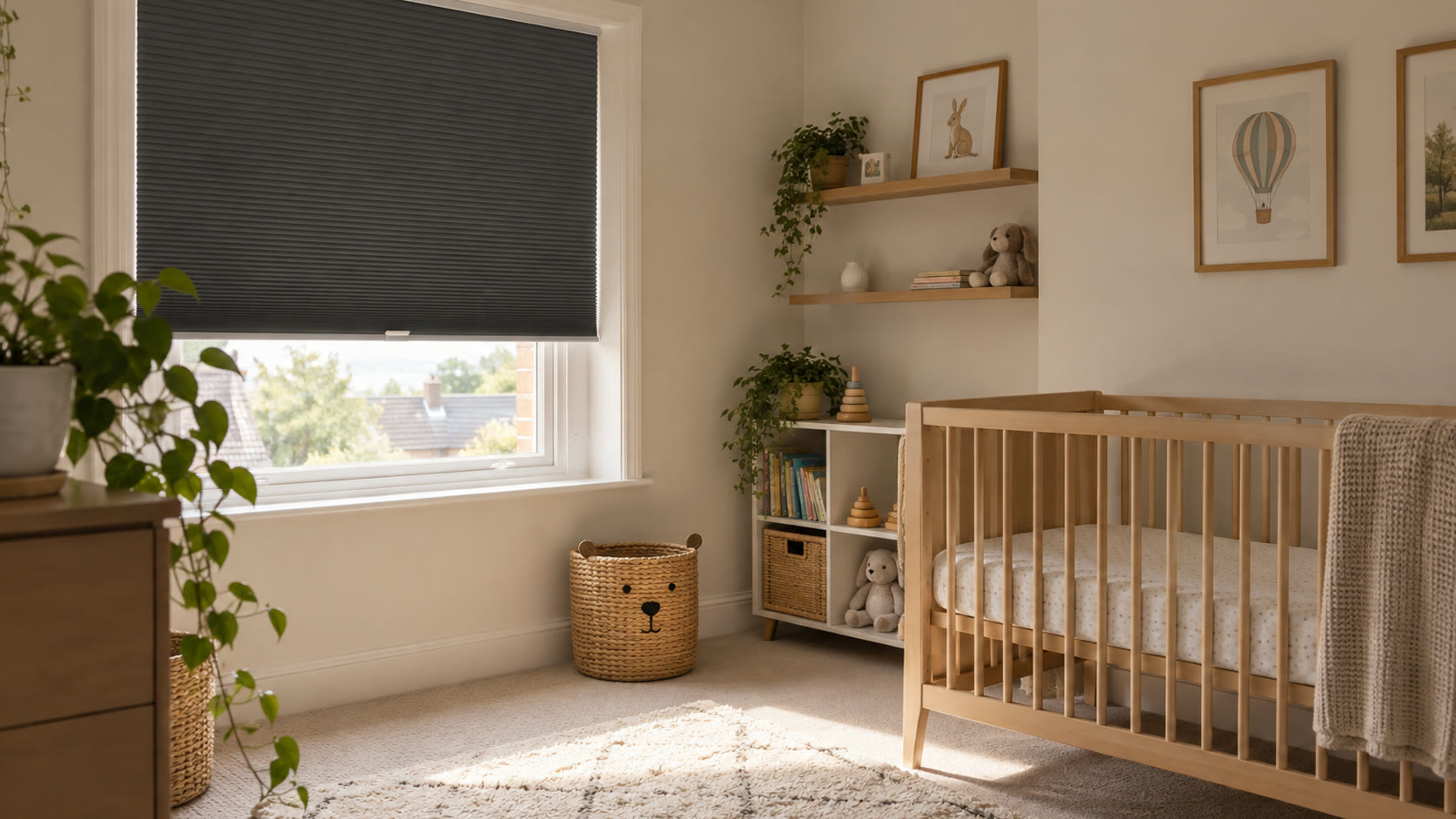
A blind without an accessible operating cord or chain is the preferred starting point for a young child's room. Then check that its brackets, frame, handles and any accessories are secure and that furniture remains away from the window. Darkness is useful only within a safe, practical room setup.
Follow current UK child-safety guidance and the exact product installation instructions.
Keep cots, beds and climbable furniture away from the window and blind.
Choose between a simple roller, free-hanging cellular and full-frame cellular by fit and edge coverage.
Product shortlist
Cordless blind formats to consider
These examples avoid a hanging operating chain, but use different mounting systems. Inspect the complete product, selected variant and installation before placing any blind in a child's room.
LazBlinds cordless no-drill blackout shade, black, 36 × 72 in
Best for: A window where a control loop is best avoided
A spring-operated cordless shade that attaches without conventional drilled brackets. It removes the hanging loop found on many ready-made rollers, but its stick-on installation still needs a compatible, clean surface.
What stands out
- Cordless spring operation
- No conventional drilling
- Opaque black fabric in the featured variant
Keep in mind
- A fixed ready-made width will not suit every recess
- Adhesive or pressure fittings still depend on the surface and instructions
- No-drill does not guarantee mark-free removal
- 36 × 72 in
- Cordless
- No-drill mounting
- Black
Luxevoir Panoramix cordless cellular blackout blind, light grey, custom size
Best for: A custom-sized honeycomb blind without a hanging chain
A handle-operated honeycomb blind supplied to a chosen size. Its pleated cells offer a softer appearance than a roller, while the advertised no-drill fitting needs a compatible frame and careful measurement.
What stands out
- Handle-operated cordless control
- Custom-size ordering
- No conventional drilling advertised for compatible frames
Keep in mind
- Fitting compatibility and grip must be checked on the actual frame
- A free-hanging cellular blind can still admit light at the edges
- Custom dimensions need careful confirmation before ordering
- Custom size
- Honeycomb fabric
- Cordless handle
- No-drill fitting
TIPIACE framed top-down bottom-up cellular blackout blind, black
Best for: A made-to-size recess with flexible top-down control
A custom-size honeycomb blind inside a full aluminium frame. The fabric cells conceal the internal lift cords, while the frame addresses side leakage more directly than a free-hanging cellular blind.
What stands out
- Full frame manages perimeter light
- Cordless top-down bottom-up operation
- Custom dimensions for non-standard openings
Keep in mind
- Needs a deep, square recess and screw fixing
- Custom products require especially careful measurement
- The configured item may not be returnable if dimensions are wrong
- Custom size
- Honeycomb fabric
- Aluminium frame
- Cordless manual control
Cordless options at a glance
A cordless control reduces one specific hazard; it does not certify the whole room or make an insecure mount acceptable.
| Format | Control | Fitting | Light-gap approach | Main check |
|---|---|---|---|---|
| LazBlinds roller | Cordless spring | Stick-on no-drill fit | Ordinary roller clearance | Secure surface grip and size |
| Luxevoir cellular | Cordless handle | Custom no-drill fit | Free-hanging cellular edges | Custom measurements and mount |
| TIPIACE framed cellular | Cordless top-down bottom-up | Screw-fixed full frame | Frame manages perimeter | Sound fixing and accurate deep recess |
Start with the safety standard, then the light gap
The main reason to consider a cordless blind in a child's room is the risk from accessible looped controls. The Office for Product Safety and Standards' UK guidance explains that blind cords and chains can be dangerous to young children and that supplied safety devices must be installed. The British Blind and Shutter Association recommends safe-by-design products without accessible cords or chains where possible and explains the relevant installation responsibilities.
“Cordless” is useful wording, but inspect what it means for the selected variant. Some blinds have an internal cord concealed within a closed mechanism and a bottom handle to operate the panel. Others use a spring roller. Ensure there is no accessible loop in the complete product, including accessories or a second window treatment behind it. A blind can have a cordless control and still be a poor choice if its mount can fall, its lower handle breaks off or it blocks the window's safe use.
Place cots, beds, changing furniture, shelves and climbable objects away from the window. Children grow and move furniture is often rearranged, so revisit the room layout regularly. Never use a dangling chain or improvised tie-up as a temporary workaround. If an existing blind has a loop, fit its supplied tensioner or safety device according to the maker's instructions and seek a suitable replacement if the arrangement cannot be made safe.
Which blackout format suits the window?
A standard cordless roller is compact and familiar. It can be a sensible choice for a straightforward window where some edge light is acceptable. A free-hanging cellular blind has a softer pleated appearance and may be made to a custom size, but its sides can still admit light. A framed cellular system addresses the perimeter more thoroughly while requiring a deeper, precisely measured and securely fixed recess.
The BBSA's cellular product guidance notes that blackout material can still allow light at the extremities. That is why a promise of “blackout fabric” should not be confused with an installed room result. It is reasonable to accept a little edge light if doing so keeps the fit simple and secure.
The shortlisted products in detail
LazBlinds: cordless spring roller
The listed black 36 × 72 inch LazBlinds blind is operated by pulling the bottom rail, without a hanging side chain. Its no-drill fitting can appeal where permanent holes are undesirable, provided the window matches the specified mounting range. Check the full width, attachment grip and surface strength before fitting. The cloth remains a normal roller, so daylight may appear at the sides.
Do not assume a pressure or clip mount is safe merely because it does not use screws. Follow the maker's exact fitting method, test the blind gently through its full travel and inspect for movement. If it slips, remove it from use until the cause is corrected. Keep the child's sleeping area away from the window regardless of the mounting method.
Luxevoir Panoramix: custom cordless cellular
This handle-operated cellular option is offered in a light-grey blackout variant and a custom size. Its pleated finish may suit a calm bedroom where a flat dark roller feels too stark. It is advertised as a no-drill fit on compatible windows. Ask what frame profile it needs and whether the fixing is appropriate for your actual opening before entering custom dimensions.
A custom order requires careful measurement at several points. The blind should travel freely without catching a handle or sash. Free-hanging edges can still show a halo in strong daylight. If that is unacceptable, a frame or curtain layer may be more suitable, but adding layers also adds hardware that must be secured and kept safe.
TIPIACE: framed cordless cellular
The TIPIACE system puts blackout honeycomb fabric inside an aluminium surround and uses manual top-down bottom-up operation. The frame can address side light more directly than a free-hanging panel. Its flexibility can allow upper daylight while preserving lower privacy, although the setting you use will determine the actual light entering the room.
It needs a deep, square recess and screw-fixed installation. Carefully verify the custom dimensions and fixing substrate. A frame that is forced into a tapered opening may bind or leave uneven gaps. Because the assembly is heavier and more permanent, competent fitting may be appropriate if the wall or frame is uncertain. Ensure every fixing is secure before the room is used.
Mounting and room checks
Measure the opening according to the selected maker's instructions. Record width in several places, drop, clear depth, handle projection and how the window opens. Do not guess a deduction for a custom blind. Check the order summary for the exact fabric, colour, operation and fixing method. Related retailer variants can have different controls.
Before installation, identify a sound surface. Adhesive needs an approved clean, dry, flat substrate; screw fixings need the right wall or frame and must avoid hidden services and window components. No-drill clips or pressure fittings must be within the stated size and load range. Do not attach any blind over a required vent, drainage path or escape opening.
After installation, run the blind through its full travel several times. Watch the top fixing, side clearance and lower rail. A blind that moves at the head, binds or drops unexpectedly needs correction. Recheck periodically, particularly after cleaning, window maintenance or seasonal expansion and contraction of the frame.
Darkness without sleep or medical promises
A darker room may be a preference for naps, early summer mornings or shared bedrooms. It does not guarantee better sleep, alter a child's medical needs or replace a safe sleep environment. Be cautious with claims that a product will make a baby sleep through the night. Choose a window treatment for practical light management and safe everyday use.
Do not seal over ventilation to chase the last strip of daylight. A child room still needs appropriate airflow and a usable window. The Energy Saving Trust's summer guidance discusses managing sun at windows and ventilating when outside conditions are suitable. A blackout blind is not an air-conditioning or temperature-control device.
If a curtain is added in front of the blind, secure its pole and keep its fabric and any tiebacks out of the cot area. An overlapping curtain can hide edge glow but also introduces another object near the window. Check the complete arrangement rather than each item in isolation.
When to choose each format
Choose the spring roller where it fits securely and ordinary edge clearance is acceptable. Choose the custom cellular shade for a softer look and cordless handle where the frame suits its no-drill mount. Choose the framed cellular blind where perimeter light is the real issue and a permanent, accurate fixing is possible.
If the window is awkward or the room is rented, do not force an unsuitable product into place. Compare child-safe blind principles, nursery blind choices and our cellular guide. The deciding test is whether the whole window remains secure, usable and appropriate for the child who lives in the room.
Clear answers
Frequently asked questions
Short answers to the fitting, use and care questions that most often change the result.
Are cordless blackout blinds child-safe?
Removing an accessible operating loop addresses a major hazard, but the complete product must still meet applicable safety requirements and be installed securely. Keep cots and furniture away from the window and follow the maker's instructions.
Can I use a no-drill blind in a nursery?
Only if the exact product and window are compatible and the mount is secure under normal use. Inspect pressure, clips or adhesive regularly; do not place a cot beneath a blind that could loosen.
Do blackout blinds help children sleep?
They reduce visible daylight when fitted well, which some families find useful for the room environment. They are not a sleep treatment or a guarantee of sleep duration or quality.
What if my current blind has a chain?
Fit every supplied safety device exactly as instructed and keep the loop inaccessible to children. Do not tie the chain up as a substitute. Consider replacing an unsuitable blind with a safe-by-design option.
Is a framed cellular blind worth the extra fitting?
It can help when edge light is a significant problem and the recess is deep and accurately measurable. A simple cordless roller may be sufficient if some perimeter light is acceptable and the installation is easier to secure.