
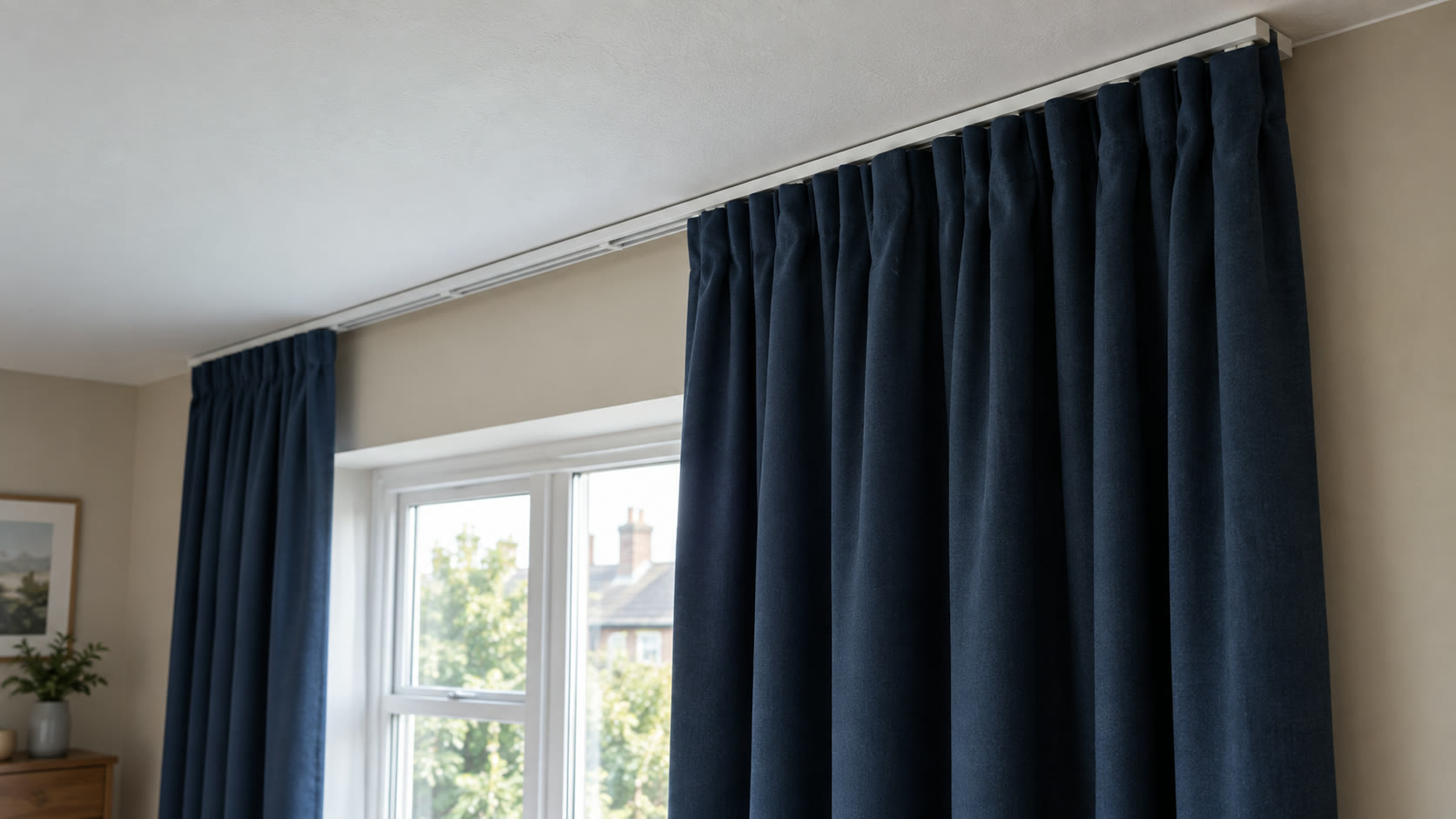
Work out where the light enters
Close the curtains at the brightest time for that window. From the bed or desk, look above the heading. Is there a visible strip of glazing because the pole is too low? Can you see light behind the pole or through the folds around eyelets? Does the ceiling glow even though the top of the window is covered? These are different problems. A darker fabric will not close a geometric gap.
Use a piece of removable card to cover the suspected route briefly, without fixing it permanently or obstructing the window. If the room noticeably darkens, you have identified the path. If light persists elsewhere, repeat at the sides and centre. Our curtain overlap guide maps all four edges. A camera can exaggerate or suppress a small glow, so judge the room from the position where you use it.
Check whether the fabric itself is translucent by holding a section against a bright pane. If light passes through the central area, a pelmet or raised pole will not solve that material problem. See blackout curtain linings for construction and care considerations.
Can the pole or track sit higher?
John Lewis's curtain buying guide suggests mounting hardware roughly 10–15 cm above many windows as a starting point. That is not a mandatory dimension; coving, ceiling height, curtain heading and wall structure decide what is possible. Mark a proposed higher line with tape and hold the existing curtain in that position. Confirm that the hem still covers the lower opening and does not drag or expose a sill.
If new holes are needed, identify hidden services and substrate first. Use fittings rated for the curtain weight; heavy blackout lining can make a previously adequate pole insecure. Avoid drilling into a window frame or lintel without understanding the product and structure. In a rental, obtain permission where required. A non-drill stopgap may be a temporary blind behind existing curtains, but check window operation and child safety.
An eyelet curtain sits around a visible pole. Raising the pole can help the fabric mask the top edge, but some light may still pass around the pole and between folds. A pencil-pleat heading on a high track creates a different top geometry. Dunelm's hanging guide shows why the drop must be measured differently for each heading. Changing the heading usually means changing the curtains, so test cheaper adjustments first.
Cover a persistent top route
A fitted pelmet or rigid top cover can hide the view over the hardware when its width and depth match the installed arrangement. It must be secure and must not jam the moving curtains, hide necessary ventilation or block window access. The pelmet explainer sets out where it helps and where it cannot. A ceiling track can also bring the heading close to the top, but do not assume every rail has side returns or a centre-overlap arm.
The Speedy track below is a long bendable example listed for light-to-medium curtains. It should not be treated as suitable for every heavy lined pair. The Joydeco pencil-pleat curtains are a separate heading example with hooks not included. Check actual load, gliders, hooks, drop and fixings before pairing products. If the track cannot safely carry the pair, choose a correctly rated system rather than sacrificing structural safety for a smaller light gap.
A second close-fitting blind behind the curtain can interrupt some top light before it reaches the heading. Its benefit depends on its own headrail and side gaps. If it uses a chain or cord, fit the supplied safety device and keep loops inaccessible to children, following UK product-safety guidance. Do not improvise a corded layer above a cot.
Check the whole window after the fix
Open and close the curtains repeatedly. Look for snagging at the new top position and for a centre join pulled apart by a changed pole height. Check the lower hem, handles and ventilation. Revisit the room when the sun reaches the window; a good evening result can conceal a morning problem. If the top is now controlled but side glow dominates, the side-gap guide is the next step. Stop once the room is comfortably darker without making the window awkward or unsafe to use.
Products for this job
Heading and track examples
These examples show a track and pencil-pleat heading. The track is light-to-medium duty; check fabric weight and compatibility before combining products.
Speedy bendable curtain track, white, 5 m
Best for: Planning a close-mounted pencil-pleat track
A cuttable, bendable track supplied with gliders and brackets for pencil-pleat curtains. It can be face- or top-fixed, but its own listing limits use to light- or medium-weight curtains.
What stands out
- Top- or face-fix options are listed
- Can be trimmed or bent for the layout
- Gliders and brackets are included
Keep in mind
- Listed for light- to medium-weight curtains only
- No built-in centre overlap or pelmet is claimed
- Fixings must match the wall or ceiling substrate
- 5 m total track
- White
- 50 gliders and 20 brackets listed
- Light- to medium-weight curtains
Joydeco black pencil-pleat curtains, 55 × 96 in, pair
Best for: A long, track-compatible curtain pair
A long two-panel black curtain set with a pencil-pleat heading for hooks or a compatible track. The listing describes light reduction rather than a sealed whole-window result.
What stands out
- Two 55-inch-wide panels are listed
- Pencil-pleat heading can use rings or a suitable track
- Long 96-inch drop suits some tall openings
Keep in mind
- Hooks are not included
- Seller describes partial light blocking rather than a room seal
- The large drop may need alteration for a shorter window
- 55 × 96 in each panel
- Two panels
- Pencil-pleat heading
- Hooks not included