
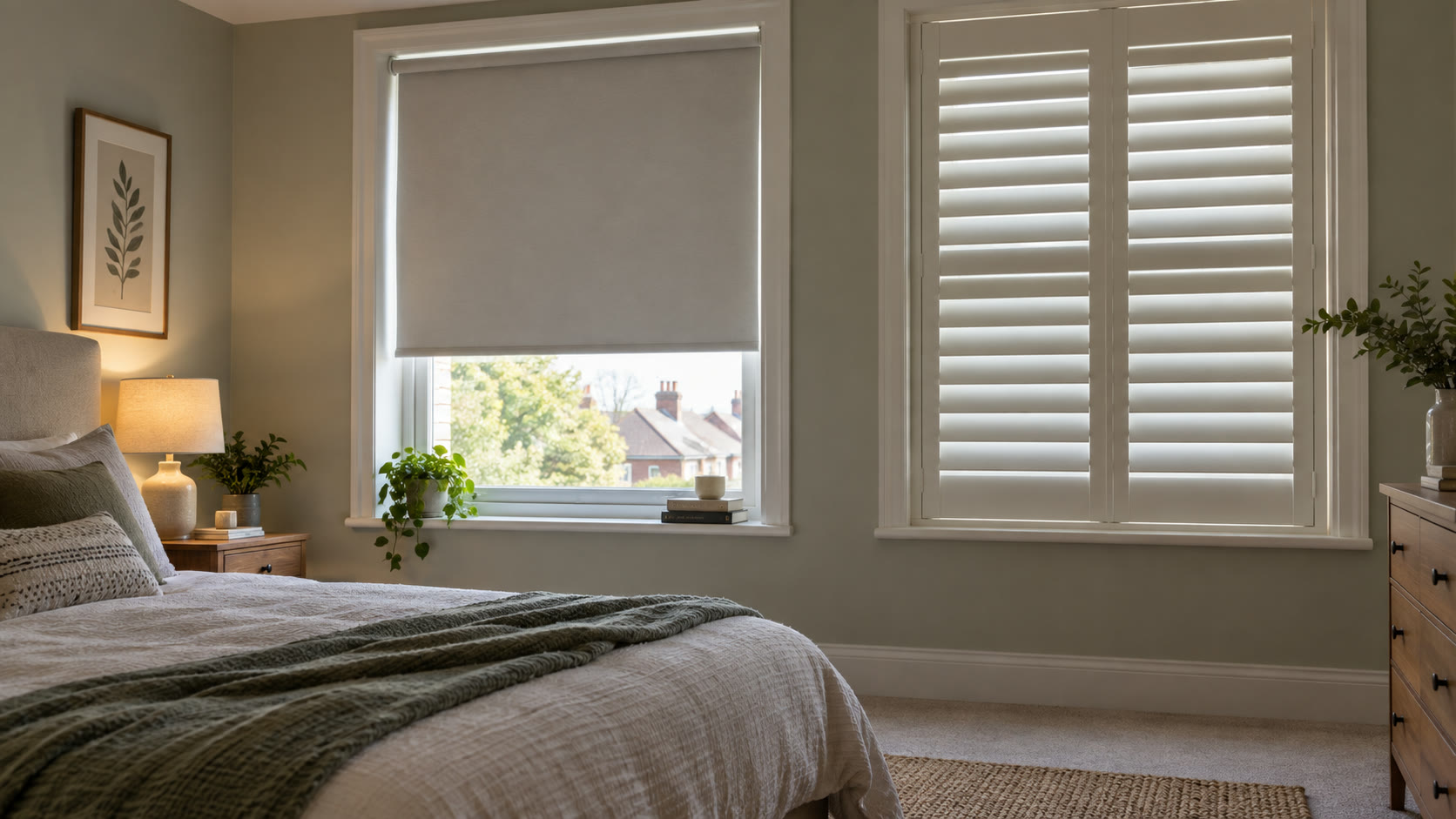
Compare the openings each system leaves
Shutters and blackout blinds solve different design problems. Interior shutters are a visible part of the room and offer adjustable daylight and privacy through their louvres. A blackout blind is usually chosen to cover the glass with opaque fabric. The first mistake is assuming that a closed shutter must create a black room. Light can pass between slats, around the frame, at the centre meeting line and around hinges. The second mistake is assuming an opaque roller has no gaps. It normally has clearance beside the cloth and may leave a bright top or bottom line.
The BBSA product-characteristic guidance includes separate documents for internal shutters and roller blinds. It is a useful reminder to compare the finished assemblies rather than only a swatch or a photograph. Stand at the position where light bothers you—often the bed rather than the doorway—and identify the direction of the bright lines. A west-facing window may expose a different weakness from a streetlight outside at night.
An ordinary roller, represented here by the FURNISHED model, is a practical daily covering. It is easier to change than custom shutters, and an outside mount can overlap the opening. But its fabric is narrower than the full mechanism. The Sol Royal cassette adds a housing and side rails, addressing some of the perimeter that an ordinary roller leaves exposed. Neither format blocks light through another opening or guarantees a fully dark room.
| Issue | Standard shutters | Ordinary blackout roller | Tracked blackout cassette |
|---|---|---|---|
| Light through the middle | Slat and panel joints may show | Opaque cloth can block direct transmission | Opaque cloth can block direct transmission |
| Perimeter | Depends on shutter frame and wall | Side and top clearance common | Rails and housing manage some edge light |
| Daylight adjustment | Tilt slats without opening panels | Raise or lower fabric | Raise or lower fabric |
| Installation | Usually measured to the window | Brackets inside or outside reveal | Accurate cassette and rail mounting |
| Reversibility | Often a substantial fixed installation | Brackets leave smaller fixings | Adhesive or fixings may alter the surface |
Some shutter suppliers offer a blackout insert behind the panels. If so, ask for the exact mechanism and where its edges sit. A dark-coloured shutter is not, by itself, an opaque insert. For a strong darkness requirement, a separate blind behind shutters may be effective where the reveal has enough depth, but the two systems must not obstruct each other.
How they feel to use every day
Shutters remain visible when open and closed. They can suit a room where appearance, privacy and directional daylight are as important as darkening. You can tilt louvres for partial light without raising the entire treatment. That is less convenient when the goal is to remove narrow slivers of bright sunlight: the slat edges may be the most noticeable part. Shutter panels also need swing space if you want the window fully clear.
Blinds occupy less room in front of the window, though a cassette and its rails are more visible than a bare roller. A roller is quick to raise for cleaning the sill or opening the sash. A tracked system may need its rails wiped and checked for debris. Shutters have multiple slats and hinges to dust, especially in a room where condensation forms on the glazing. Regular access to the window matters whichever you choose; a beautiful covering that hides persistent moisture is a poor fit.
Controls affect household safety. The selected blind examples use looped chains, so any installation around children must include the supplied safety device. The UK OPSS blind-cord advice also recommends keeping furniture away from windows. Shutters may avoid a blind chain but still have moving hinges and panels; follow the shutter maker's safety instructions. A cordless blind may be a better alternative where accessible loops are unacceptable.
Choose by window shape and commitment
For a shallow recess or an inward-opening sash, shutters can take up more useful space than expected. Check handles, vents and panel swing. A roller can sometimes go above the reveal to preserve sash movement, although that can leave reflected edge light. A tracked cassette needs a suitable straight route for its rails. Bay and irregular windows add joints to either solution. Measure each section individually rather than assuming one covering will bridge all angles.
If you own the property and want an architectural finish throughout the day, shutters may justify their more permanent, measured installation. If the main need is darkness and you may move, a well-specified blind is usually simpler to change. In a rental, read the tenancy terms before fixing either system and consider renter-friendly blackout solutions. If you already have shutters, diagnose their light paths before removing them; a discreet blind or curtain layer may solve the practical complaint.
Neither product category should be sold as a guaranteed thermal upgrade. Glazing, draughts, wall conditions, ventilation and how the covering is used influence comfort. If heat transfer is the deciding factor, read our thermal versus blackout blinds guide and ask suppliers for comparable, applicable performance data rather than a generic saving percentage. For light control, see total-blackout systems and how to stop light leaking around blinds before committing to an expensive custom treatment.
Products for this job
Blind systems for comparison
These illustrate a basic opaque roller and a more enclosed cassette; neither should be treated as a direct substitute for a made-to-measure shutter.
FURNISHED blackout roller blind, black, 60 × 165 cm
Best for: A familiar daily blind in a standard bedroom
A conventional coated roller blind with a broad size range and several fitting positions. It is useful when you want an everyday blind rather than a panel that must be removed each morning.
What stands out
- Many width and drop options are listed
- Can be fixed inside or outside the recess
- A trim-to-width route for awkward standard sizes
Keep in mind
- The fabric is about 4.5 cm narrower than the complete mechanism
- The looped chain and supplied safety device must be fitted correctly
- An ordinary roller does not seal the sides
- 60 × 165 cm
- Coated polycotton
- Bracket mounted
- Chain controlled
Sol Royal K24 cassette blackout blind with side rails, black, 90 × 175 cm
Best for: A framed no-drill installation on a smooth window
A no-drill cassette roller supplied with adhesive side rails. The frame manages the routes around the fabric more directly than an open roller, provided the window surface is flat, smooth and carefully prepared.
What stands out
- Top cassette and side rails are supplied as one system
- Adhesive installation avoids conventional drilling
- Several listed widths and three neutral colours
Keep in mind
- Surface preparation and flatness are critical
- The cloth is narrower than the complete mechanism
- The looped chain and safety device need careful positioning
- 90 × 175 cm variant
- Polyester
- Adhesive side rails
- Chain controlled