
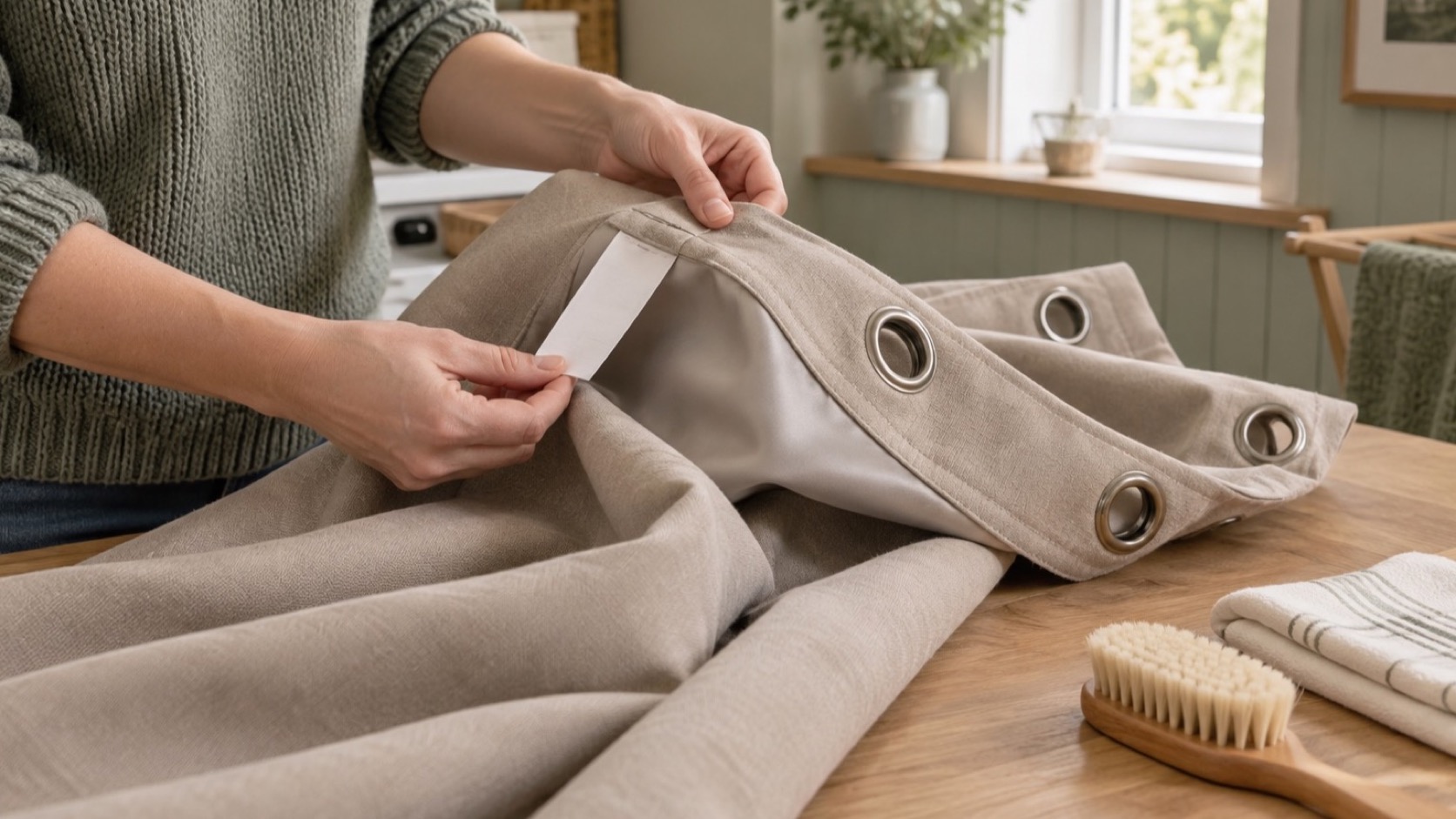
Identify the curtain before adding water
Blackout curtains can look similar from the room while being very different at the back. One panel may be woven from dense yarn, another may have a bonded acrylic or foam-like coating, and a third may use a removable or sewn-in lining. Water, heat and movement affect these constructions differently.
Find the sewn-in care label on every panel. Curtains in the same room may have been altered or replaced at different times, so do not assume a matching appearance means identical care. Note the fibre content, permitted process, temperature, drying and ironing symbols. If the label is missing, contact the manufacturer with the exact product details or use a professional cleaner who can inspect the construction.
Dunelm’s curtain-care guidance advises reading the care label and recommends dry cleaning for blackout or thermal coated curtains and linings where the label shows the relevant symbol. That conservative approach reflects the risk of coating damage and uneven shrinkage.
Before taking curtains down, photograph the heading, hooks and overlap arrangement. Count hooks, mark left and right panels discreetly, and keep small parts in a labelled container. Support the full weight while unhooking; pulling a heavy panel from one corner can strain the heading tape.
Check for problems that cleaning will not fix
Inspect the window-facing side in good light. A dusty grey surface may clean well. Cracked, flaking, sticky or powdering coating is material deterioration, not ordinary dirt. Aggressive washing is likely to make it worse. Mould or recurring damp also needs the moisture source addressed; simply washing the textile and rehanging it against a wet reveal repeats the problem.
Check hems, seams and eyelets. Repair loose stitching before cleaning. Remove detachable hooks and weights if the instructions require it, but do not prise out eyelets or fixed hardware. Measure the panel before treatment if shrinkage would prevent it reaching the sill.
Routine cleaning without a full wash
Regular low-impact care delays the need for immersion. Close the curtains and use a clean upholstery attachment on the lowest practical suction. Work from top to bottom while supporting the fabric with the other hand. Pay attention to headings, folds and the upper surface of the hem, where dust collects.
For coated backs, avoid scraping with a stiff brush. A clean, dry microfibre cloth may lift loose dust if the maker allows it. Keep coated faces from sticking together while the curtains are down. Lay each panel on a clean sheet rather than directly on a floor or outside surface.
If the label permits spot cleaning, test a hidden corner with the recommended solution. Blot rather than rub. Work from the edge of a mark towards the centre and avoid soaking through to the backing. Feathering a large wet ring across coated fabric can leave a more visible mark than the original spot.
Vacuum the pole, track and top of the window before rehanging. Cleaning the fabric but leaving construction dust on the hardware leads to immediate re-soiling.
If the care label allows machine washing
Use the exact permitted cycle and temperature. Close any hook-and-loop tabs, remove detachable hooks and protect eyelets if the instructions specify it. Do not overload the drum: a large wet panel is heavy and needs space to move without hard creasing. Wash panels separately when capacity is marginal, but keep conditions identical so colour and size remain matched.
Choose the detergent type and quantity recommended for the fabric. Avoid bleach, stain removers, fabric softener or fragrance additives unless specifically allowed. Products that are harmless to ordinary cotton can affect coatings or leave residues. A cool or delicate cycle is not automatically safe if the label says dry clean only.
Reduce spin speed if instructed. Remove the curtain promptly at the end of the cycle and support its weight; do not pull wet fabric by the heading. Smooth folds with clean hands and check that layers have not shifted.
Hand washing is not automatically gentler
A bath gives more space, but a waterlogged curtain is difficult to lift evenly. Wringing, twisting and dragging can stretch the face or separate a bonded backing. Only hand wash when the care instructions allow it. Use a clean vessel, correct temperature and gentle pressing motion, then drain thoroughly without twisting.
If the curtain is too large to support safely, professional cleaning is more sensible. Tell the cleaner that it is blackout material and identify any coating or lining. Ask how they will manage colour matching across the pair.
Drying and reshaping
Follow the label. Where air drying is permitted, spread the panel over a clean, strong rail or several lines so its weight is distributed. Keep coated surfaces separate and away from direct high heat. Peg marks, sharp folds and prolonged strong sun can leave visible changes.
Do not return a damp curtain to a cold window. Moisture can become trapped against the coating or reveal. Wait until all layers, hems and headings are dry. Rehang while supporting the weight, restore the recorded hook positions and let the fabric settle before judging the final drop.
Heat, ironing and common damage
Blackout coatings are especially vulnerable to inappropriate heat. Do not tumble-dry, steam or iron merely because creases are visible. If the label permits a cool iron, use the approved side, a clean pressing cloth and a concealed test area. Keep the iron moving and avoid the coated surface.
Some travel folds relax after the curtain hangs in a warm room. Gentle hand smoothing is safer than directing steam at an unknown backing. Persistent creases may be part of the material or packaging history rather than a defect that should be forced flat.
Never use solvent spot removers casually. They can change colour, dissolve a coating or create a tide mark. Do not scrub mould without addressing why the window remains wet, and do not mix household cleaning chemicals.
Care after rehanging
Open curtains daily enough to inspect and dry the window area. Wipe condensation from the glass and frame, keep required ventilation working and avoid pressing fabric against wet panes. In kitchens or smoky rooms, airborne residue builds faster; a blind or washable voile layer may protect the main curtains.
Check the pole and brackets while the panels are down. Lined curtains are heavy, and a loose wall fixing is a safety issue. Make sure curtains travel freely without snagging on radiator valves, handles or furniture.
The safest decision rule
Use the least intensive method that solves the problem. Dust first, spot-clean only when permitted, wash only when the label explicitly allows it, and use a suitable professional cleaner when construction or symbols are uncertain. The goal is not simply to remove dirt; it is to preserve the opaque layer, dimensions and hang that make the curtains useful.
For choosing a replacement with manageable care requirements, see our blackout curtain buying guide. For routine room-darkening maintenance, our roller blind cleaning guide explains a different fabric system.
Products for this job
Curtain types with different care needs
The coated, dark and neutral examples below illustrate why the selected variant’s label matters more than a generic washing rule.
Deconovo total-blackout coated curtains, pale khaki, 46 × 72 in, pair
Best for: A lighter face with an opaque backing
A coated-back eyelet pair intended to stop light through the cloth itself. The lighter face gives a softer room look while the backing does the opacity work.
What stands out
- Coated backing rather than relying only on a dark yarn
- Pair format
- Multiple listed colour and size variants
Keep in mind
- Coated fabrics need care-label-led cleaning
- Heavier curtains need a suitable pole and fixings
- Perimeter gaps remain unless the track or pole extends well beyond the window
- 46 × 72 in
- Pair
- Eyelet heading
- Coated back
Deconovo blackout eyelet curtains, black, 46 × 54 in, pair
Best for: An affordable ready-made eyelet pair
A widely sized pair of soft eyelet curtains made for a standard pole. The dark colour is useful where room darkening matters more than a pale decorative finish.
What stands out
- Many size and colour variants are grouped under the listing
- Pair format suits conventional bedroom windows
- Simple eyelet heading is quick to hang on a compatible pole
Keep in mind
- Darkening depends on pole position, width and centre overlap
- Eyelets can leave a bright band above a low-mounted pole
- The listing's thermal wording is not a measured room-saving guarantee
- 46 × 54 in
- Pair
- Eyelet heading
- Polyester
PONY DANCE blackout eyelet curtains, grey, 46 × 54 in, pair
Best for: A grey pair across a standard window
A soft grey two-panel eyelet set with a very broad group of size variants. It is a practical neutral choice when you can create useful overlap beyond the window.
What stands out
- Two-panel set
- Many width and drop combinations are listed
- Neutral colour works with layered blinds
Keep in mind
- Room darkening varies with the selected colour and installation
- A pole close to the recess can expose top and side light
- Exact dimensions must be checked on the selected variant
- 46 × 54 in
- Two panels
- Eyelet heading
- Grey