
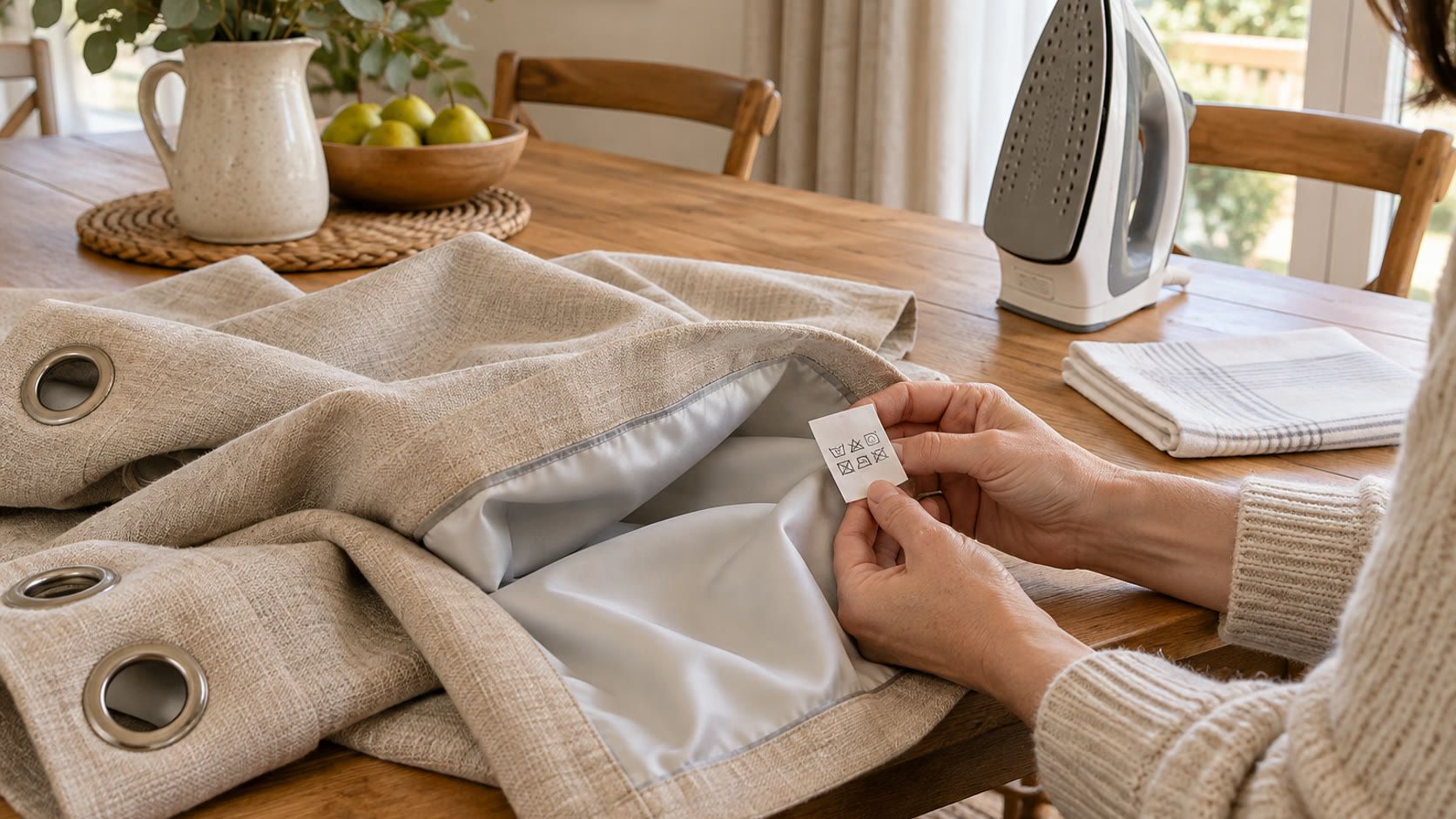
The answer depends on the curtain you own
Blackout curtains are built in several ways. A densely woven face may be relatively tolerant of low-temperature pressing. Another pair may have a separate blackout lining. A third may carry an acrylic or foam-like coating bonded to the back. Those constructions can look much the same when hanging, yet heat can affect them very differently. There is no safe universal temperature for “blackout curtains”.
Find the sewn-in care label on each panel. Read the ironing symbol and any written instructions. A crossed-out iron means do not iron. A permitted iron symbol may specify low heat and a particular face or pressing cloth. Do not infer permission from the face fabric alone: a polyester face can be attached to a vulnerable coating.
Dunelm's curtain-care guidance tells owners to follow the care label and notes that blackout and thermal coated curtains or linings may need specialist care. That is a useful conservative rule when the backing is unfamiliar. If the label is missing, contact the manufacturer with the exact product name and variant, or consult a professional curtain cleaner before applying heat.
Inspect before treating creases
Take a panel down only if you can support its weight without pulling on one eyelet or hook. Lay it on a clean, dry surface in good light. Check whether the lining is separate, stitched at the sides or bonded to the face. Look for cracking, stickiness, powder, flaking and areas where the backing has lifted. These are signs of deterioration, not ordinary fold marks, and heat may make them worse.
Feel the crease from both sides. A superficial fold in the decorative face is different from a sharp permanent line in a coated layer. A deep crease that has cracked the coating cannot be repaired by pressing the face smooth. If the room-darkening layer has failed, consider a replacement lining or curtains rather than trying to melt it flat.
Why some blackout backings dislike heat
Coated backings can soften, stick to an iron or transfer to a pressing cloth. Bonded layers can separate if heat and steam weaken the adhesive. Different fabrics can shrink at different rates, leaving a wavy hem or puckered face. The risk grows with a hot soleplate, pressure, prolonged contact and repeated passes.
A separate woven lining may have its own care instructions and fibre mix. Treat the entire assembled curtain according to the most restrictive component. Decorative trims, headings, eyelet rings and sewn-in weights can also make flat pressing difficult. An iron held close to a metal eyelet may leave a shine mark or distort nearby fabric.
Do not use a generic online temperature chart in place of the manufacturer's label. The label accounts for the whole product, not just the named fibre. If one panel has a different label from the other, follow each panel's own instruction and ask why they differ before treating the pair.
If the care label allows ironing
Set up a clean ironing board or a broad padded table with a heatproof cover. Check that the iron plate is clean and the water reservoir is free of deposits. Start at the lowest permitted setting and let the appliance stabilise. If a pressing cloth is required, use a clean light-coloured cotton cloth so that dye cannot transfer.
Test a hidden area near the lower side hem, provided the label permits pressing. Work from the approved face only. Use light pressure and short contact; lift and reposition the iron rather than dragging it across the curtain. Let the test area cool fully before deciding whether the finish changed. Shine, puckering, sticking, an unusual smell or a change in opacity means stop.
Support the panel so its weight does not pull the warm fabric off the board. Press a small section at a time and avoid seams, headings, eyelets and coated backings unless the maker gives explicit instructions. A low setting is not permission to hold the iron in one place. Never leave a hot iron unattended near fabric.
If the label specifies no steam, empty or disable the steam function. Moisture can penetrate between layers and affect bonding. If steam is expressly allowed, use only the maker's stated method and test first. Do not press a damp curtain against a cold window afterwards.
Common mistakes to avoid
Turning a curtain over and ironing the “plain” back can be the most damaging move, because a smooth pale backing may actually be the blackout coating. Placing a towel over it does not automatically make high heat safe; heat still travels through the towel. Nor does a low temperature make a crossed-out iron symbol optional.
Another mistake is to work on curtains straight from a washing machine without checking whether washing itself was permitted. A wet coated panel is heavy and may stretch while being moved. Our guide to washing blackout curtains explains why cleaning and drying rules need to be checked first.
Avoid aggressive crease-release sprays unless the manufacturer approves them. Solvents, fragrances and water can mark the face or affect coatings. Test any permitted product discreetly and allow full drying before rehanging.
Gentler ways to deal with fold lines
Hang a new pair correctly and let it settle for several days. Gravity and normal movement may soften light packing creases, particularly in woven fabric. Close and open the curtains gently to allow folds to fall naturally. Do not add heavy objects to the hem or pull on eyelets to force a line out.
If steaming is allowed by the label, work from the recommended side with the steamer at the distance and temperature the maker specifies. Keep it moving and avoid wetting any coated backing. If the care instructions prohibit steaming or are missing, skip this method. A professional curtain cleaner or alteration specialist can assess whether controlled pressing is appropriate.
For a badly creased detachable lining, ask whether the lining can be treated separately. Do not unpick a sewn assembly simply to iron it unless you can restore the original fit and light coverage. Altering a curtain can change its finished drop and the way it closes.
Check the result after rehanging
Allow treated fabric to cool and dry completely. Rehang the pair using the original hook positions, then close it in daylight. Check for new pinholes, glossy patches, ripples and gaps at the centre or hem. A visually flatter curtain is not an improvement if the blackout layer has become damaged.
Future folds are easier to prevent than to press out. Store panels loosely, avoid compressing coated surfaces together, and follow the care label when cleaning. For a replacement pair, compare lining construction and maintenance needs in our blackout curtain buying guide before choosing by colour alone.
Products for this job
Curtains with different backings
The selected variant's sewn-in label is more reliable than a general rule about polyester or blackout fabric.
Deconovo total-blackout coated curtains, pale khaki, 46 × 72 in, pair
Best for: A lighter face with an opaque backing
A coated-back eyelet pair intended to stop light through the cloth itself. The lighter face gives a softer room look while the backing does the opacity work.
What stands out
- Coated backing rather than relying only on a dark yarn
- Pair format
- Multiple listed colour and size variants
Keep in mind
- Coated fabrics need care-label-led cleaning
- Heavier curtains need a suitable pole and fixings
- Perimeter gaps remain unless the track or pole extends well beyond the window
- 46 × 72 in
- Pair
- Eyelet heading
- Coated back
PONY DANCE blackout eyelet curtains, grey, 46 × 54 in, pair
Best for: A grey pair across a standard window
A soft grey two-panel eyelet set with a very broad group of size variants. It is a practical neutral choice when you can create useful overlap beyond the window.
What stands out
- Two-panel set
- Many width and drop combinations are listed
- Neutral colour works with layered blinds
Keep in mind
- Room darkening varies with the selected colour and installation
- A pole close to the recess can expose top and side light
- Exact dimensions must be checked on the selected variant
- 46 × 54 in
- Two panels
- Eyelet heading
- Grey