
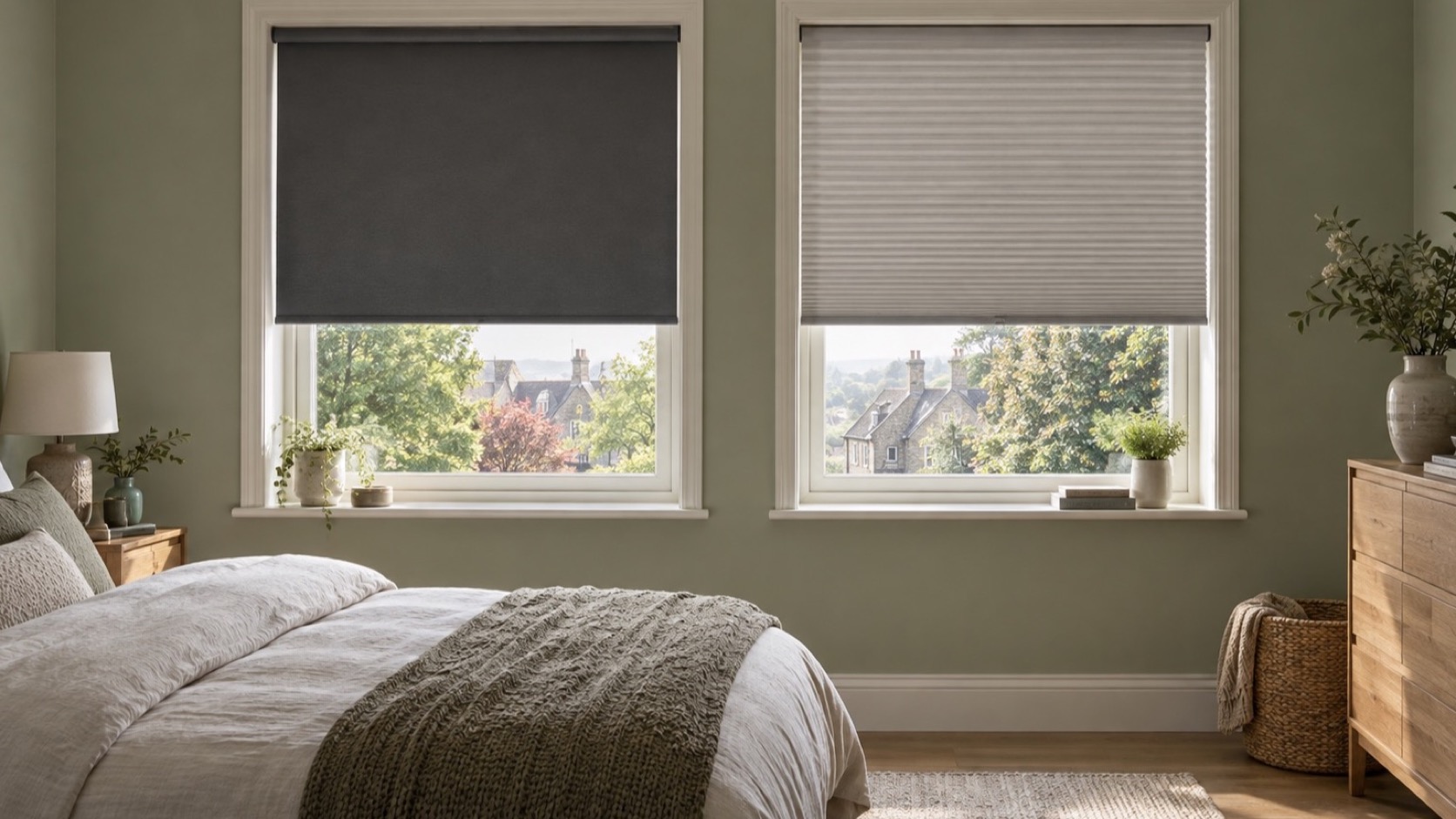
Roller versus cellular blinds at a glance
| Question | Blackout roller blind | Blackout cellular blind |
|---|---|---|
| Fabric form | One flat sheet around a tube | Pleated material forming honeycomb cells |
| Raised profile | Compact roll at the top | Stacked folds below a headrail |
| Common controls | Chain, spring, motor or handle | Cordless handle, cord, motor or top-down bottom-up |
| Cleaning | Flat face is relatively simple | Pleats need gentle, detailed dusting |
| Edge light | Visible on an open system | Visible on a free-hanging system; reduced by a frame |
| Best reason to choose | Simplicity and broad availability | Soft texture, flexible opening and framed options |
The meaningful comparison is not just roller versus honeycomb cloth. It is open roller versus cassette roller, or free-hanging cellular versus framed cellular. The frame and control system can change the result more than the folded fabric itself.
How each blind works
A roller uses a single panel wound around a tube. The mechanism is wider than the cloth, so a recess-fitted blind normally leaves a narrow uncovered strip on both sides. Reverse rolling, outside mounting and side channels alter those clearances, but every choice affects handles, depth and appearance.
A cellular blind consists of joined layers that form pockets when viewed from the side. The pleats compress into a stack when raised. In true honeycomb blackout fabric, lift cords can travel within the cells rather than through visible holes. The British Blind and Shutter Association’s product guidance notes that blackout fabrics are available but light still enters around their extremities unless a frame or side channels reduce it.
Which gives the darker room?
On basic models, neither wins automatically. An opaque roller and opaque honeycomb material both stop the main field of light. Bright lines then appear where the moving part cannot touch the surrounding structure.
A face-fitted roller can overlap the opening generously. This is often effective on a plain wall, although the roll may sit away from the surface at the top. A recess roller looks integrated but must clear brackets, controls and an imperfectly square reveal.
A free-hanging cellular blind has similar perimeter realities. A framed cellular system guides the fabric within an aluminium surround and can substantially reduce the routes at the sides. The trade-off is a larger, more exact installation with deeper-recess and squareness requirements.
For demanding daytime darkness, compare a roller cassette with side channels against a fully framed cellular system. Inspect corners, sill junctions and the headrail, not only the centre fabric. Even specialist systems may show a faint halo at joins; “total blackout” is a product category, not a guarantee of laboratory darkness in every room.
Top-down bottom-up control
Some cellular blinds lower from the top while remaining covered at the bottom. This can admit daylight above eye level while maintaining lower-window privacy. It is useful on street-facing bedrooms, but adds moving parts and a larger headrail or frame.
Standard rollers usually expose the window from the bottom upward as they rise. That is simpler but offers less flexible privacy. Day-and-night striped rollers are a different category and do not provide the same opaque field as a dedicated blackout cloth.
Thermal expectations
Honeycomb pockets create enclosed air layers, which is a rational construction difference. However, the installed result depends on perimeter gaps, distance from the glass, window condition and use. A poorly fitted cellular blind may not outperform a well-overlapped roller plus curtains.
Avoid transferring a manufacturer’s test result to a whole room or promising a bill saving. For winter comfort, close the blind when useful daylight has gone, keep ventilation functioning and do not conceal condensation. For summer, shade sunlit windows early and ventilate when outdoor air is cooler and it is safe.
Recess depth, measurement and operation
Rollers are usually the more forgiving option in a shallow opening. Even so, the bracket and roll diameter must clear handles and vents. Check whether the quoted width is cloth width, pin-to-pin width or complete bracket width. Follow the selected maker’s measuring rules rather than applying an arbitrary deduction.
Cellular blinds require attention to headrail depth and stack size. A framed product may need a minimum flat depth around the entire reveal. Measure width and drop in at least three places, check diagonals and note tiles, trim, handles and sloping sills. If a custom item is non-returnable, confirm every number and unit before ordering.
Operate a sample if possible. Spring rollers need controlled, even movement. Cellular handles should be reachable without dragging the blind sideways. Top-down systems should remain level through their travel. Motorised options add charging, wiring or battery access questions.
Child safety
Either format may use an accessible chain or cord, so do not infer safety from appearance. The UK blind-cord safety guidance says looped controls can pose a strangulation risk and supplied safety devices must be installed. The strongest default in a child’s room is an inherently safe cordless or concealed-control design.
Keep cots, beds, highchairs and climbable furniture away from the window. Never remove a tensioner for convenience, and check controls after furniture is rearranged.
Cleaning, durability and value
A roller presents one flat surface. Dust with a clean cloth or low-suction attachment and spot-clean only as directed. Keep the lower bar level; fabric that telescopes sideways can rub and fray.
Cellular folds need a softer approach. Dust along the pleats, support the material and avoid crushing cells. Debris can enter open ends, while aggressive vacuuming may distort the structure. Framed systems also need clean tracks so the handle moves without resistance.
Ready-made rollers generally offer the lowest entry cost and are easier to replace. Cellular blinds are more often made to measure, and framed or top-down options add cost. Compare the full configured price, warranty, installation and return terms. A custom blind measured incorrectly is not good value, however advanced its construction.
Which should you choose?
Choose a roller for compact stacking, simple care, predictable daily operation and a broad range of sizes. Add outside overlap, curtains or a channel system when side light is the main weakness.
Choose a cellular blind for a softer pleated appearance, top-down privacy or a purpose-made framed system. Confirm depth and squareness before committing.
Choose neither in isolation if the room has multiple light routes. Door gaps, fanlights and a second window can dominate the result. Map the room in daylight, then spend on the route that matters most. Our total-blackout systems guide compares more perimeter-controlled options.
Products for this job
A standard roller and a framed cellular alternative
These products illustrate the difference between a conventional free-hanging roller and a custom framed honeycomb system. They are not like-for-like on cost or fitting.
FURNISHED blackout roller blind, black, 60 × 165 cm
Best for: A familiar daily blind in a standard bedroom
A conventional coated roller blind with a broad size range and several fitting positions. It is useful when you want an everyday blind rather than a panel that must be removed each morning.
What stands out
- Many width and drop options are listed
- Can be fixed inside or outside the recess
- A trim-to-width route for awkward standard sizes
Keep in mind
- The fabric is about 4.5 cm narrower than the complete mechanism
- The looped chain and supplied safety device must be fitted correctly
- An ordinary roller does not seal the sides
- 60 × 165 cm
- Coated polycotton
- Bracket mounted
- Chain controlled
TIPIACE framed top-down bottom-up cellular blackout blind, black
Best for: A made-to-size recess with flexible top-down control
A custom-size honeycomb blind inside a full aluminium frame. The fabric cells conceal the internal lift cords, while the frame addresses side leakage more directly than a free-hanging cellular blind.
What stands out
- Full frame manages perimeter light
- Cordless top-down bottom-up operation
- Custom dimensions for non-standard openings
Keep in mind
- Needs a deep, square recess and screw fixing
- Custom products require especially careful measurement
- The configured item may not be returnable if dimensions are wrong
- Custom size
- Honeycomb fabric
- Aluminium frame
- Cordless manual control