
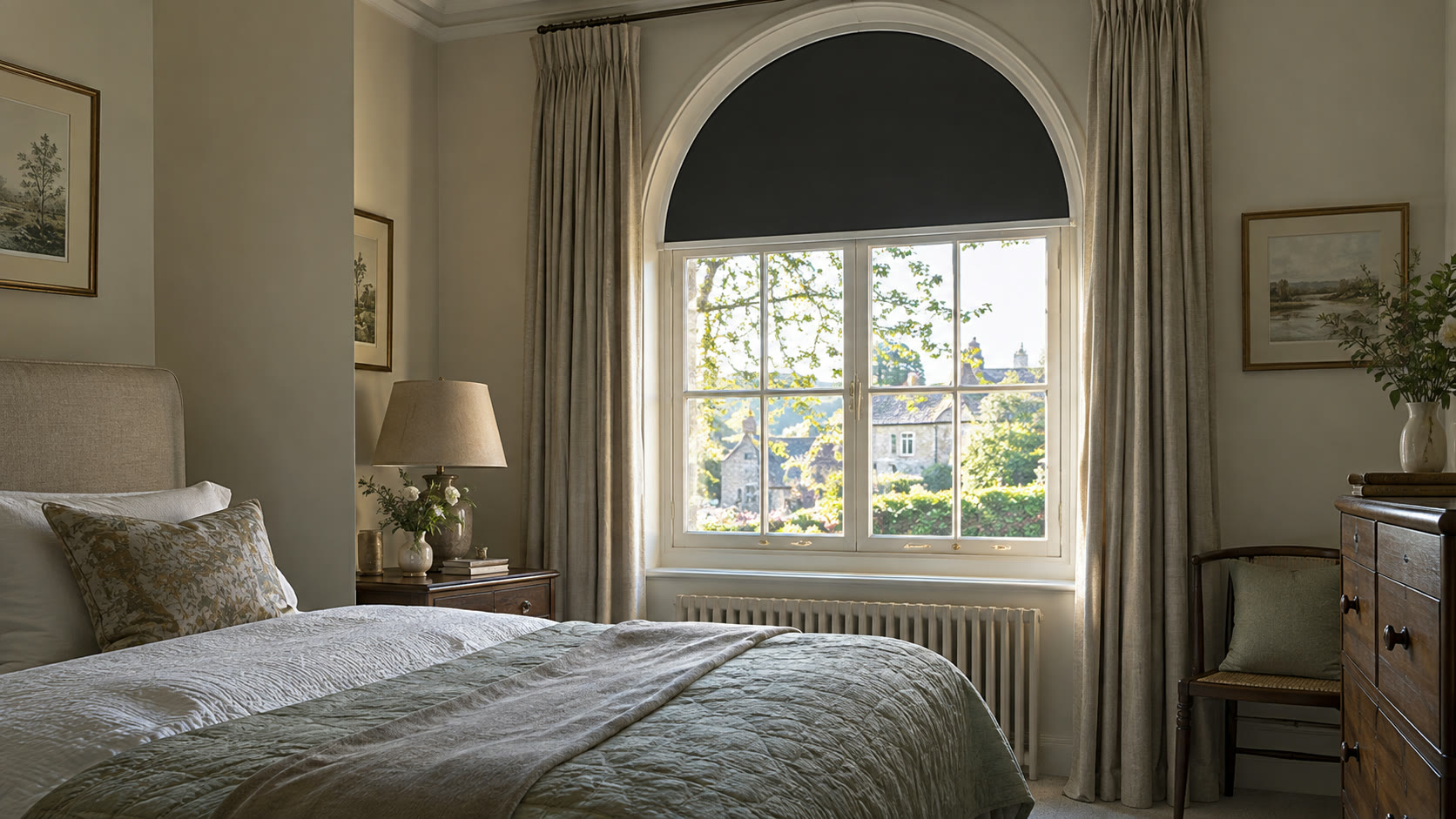
Identify the arch and the moving parts
“Arched window” covers several different openings. A semicircular fanlight may sit above a rectangular sash; a segmental arch may be shallow; a pointed arch can have two curved sides; and some windows have a curved frame but mostly rectangular glass. The top portion may be fixed while the lower window opens. Sketch the outline and mark every moving sash, handle and hinge. This determines whether one shaped panel is possible or whether the curve and lower area should be treated separately.
The first decision is visual and practical: preserve the arch's appearance when the blind is open, or cover the whole opening with a room-side rectangular treatment? A custom shaped shade can follow the curve neatly but may be difficult to operate, clean or replace. A curtain on a straight track above the opening is usually simpler to source and can cover the arched top, though the hardware must extend far enough beyond the sides. A rectangular roller above the arch may also work if there is enough wall, but it hides the architectural outline when down and can require a long drop.
Do not confuse cuttable blackout fabric with a conventional roller blind. A roller has a straight tube and controlled rectangular travel; trimming its cloth into a curve would not create a shaped mechanism. The Easynight and Maritown examples below are temporary fabric formats with different attachment methods. They may be cut for some openings within their stated limits, but they do not provide tracks or a guaranteed seal around an irregular arch.
Choose by access, reversibility and desired appearance
A custom shaped blind may be made for the arch alone or for the whole window. Ask the maker whether it is fixed, manually moved, or driven by a special mechanism. Request a drawing that shows fabric stack, rails, guides and the remaining light paths. A product marketed for a round-top fanlight might not suit a shallow segmental arch. The exact template method matters more than a generic “arch” label. If you need daily opening and closing, confirm how the curved portion operates rather than assuming it works like a normal vertical blind.
A removable fabric insert can be a lower-commitment approach for a guest room or rented home. Cut only as the manufacturer permits, leave the instructed allowance for fasteners, and make a paper template before cutting the final fabric. Adhesive can mark paint; hook-and-loop and other fasteners need a suitable flat surface. If the curve meets a textured masonry reveal, there may be too little continuous fixing area for a neat seal. Our temporary blackout guide compares attachment formats in more detail.
A room-side curtain can cover the entire curve and some wall around it. It needs a pole or track above the arch's highest point, sufficient side overlap, fabric fullness and a drop that covers the lower opening. If the wall above the arch is narrow, a ceiling track may be possible, subject to sound fixings. Our curtain measuring guide explains the usable hardware width and finished drop. For a protected historic window, a reversible treatment supported away from original joinery may be preferable; Historic England's window guidance explains why significant fabric requires care.
| Approach | Keeps arch visible when open? | Main challenge |
|---|---|---|
| Custom shaped blind | Often | Exact template and specialist mechanism |
| Cut-to-shape removable panel | Yes when removed | Attachment and accurate edge cut |
| Straight curtain across opening | Usually covers arch when closed | Wall space, heading and side returns |
Measure the curve without assuming a perfect semicircle
Record the overall width at the spring line, where the straight sides begin to curve. Record the height of each straight side, the height to the apex and the arch rise from spring line to apex. Measure several horizontal chords at known heights if the supplier requests them. A cardboard template can capture an irregular curve better than a single radius, but follow the maker's template rules and note which face of the opening the template represents. A reveal's room-side arch can differ from its glass-side arch because of depth and trim.
Check the opening at more than one location and look for asymmetry. Period frames often look symmetrical from a distance but vary by a few millimetres. Write down whether each measurement is of glass, frame, recess or planned finished covering. Include any central glazing bar or fanlight division. The maker may need depth for a cassette or guides as well as the two-dimensional outline. Do not round a measured curve into a standard semicircle just to fit a listing photograph.
If using a room-side rectangular treatment, measure the full outer frame and available wall above and beside it. Plan enough coverage to hide the apex and sides after the heading forms its folds. Use the selected curtain or roller manufacturer's own deductions. If the lower window opens inward, test that the covering can move completely clear for ventilation and cleaning. A fixed arch above an operable lower sash can sometimes be covered with two coordinated pieces, but their meeting line needs thought.
Inspect the curved edge in daylight
Small fitting errors are more visible around a dark arch than around a straight rectangle: a crescent of daylight can remain at the top. Check the paper template in daylight from the bed or usual seat before cutting permanent material. Leave the attachment method accessible for cleaning, and inspect behind a closely fitted panel for condensation. The GOV.UK home ventilation guidance is a reminder to keep intended airflow available. Do not tape over working vents to darken the room.
For children's rooms, any chain or cord in a custom blind must be assessed against the OPSS blind-cord safety advice. A removable fabric panel may avoid an operating loop, but loose fasteners and detached material must still be managed according to its instructions. If the shaped-window quote is disproportionately complex, consider whether a simple outer curtain plus side-gap improvements gives the better practical result for the room.
Products for this job
Cut-to-shape temporary formats
These two removable fabrics can be cut for some shapes, but they are not custom arched blind mechanisms. Check their selected dimensions, fastener layout, trimming rules and surface suitability.
Easynight Blackout Blind, regular 150 × 145 cm
Best for: A removable cover with generous edge overlap
A cut-to-size blackout sheet fixed around the window frame with removable hook-and-loop attachments. It can cover the complete opening more closely than an ordinary roller blind and packs into a storage bag between uses.
What stands out
- Can be cut for an unusual window shape
- Hook-and-loop attachment can reduce perimeter gaps
- No drilling and a storage bag is included
Keep in mind
- Adhesive suitability depends on the frame finish
- Less convenient than a blind for frequent daylight access
- The fabric can look utilitarian in a finished bedroom
- 150 × 145 cm
- Cut to size
- Hook-and-loop fixing
- Storage bag
Maritown stick-on temporary blackout blind, 120 × 180 cm
Best for: A broad removable cover without suction cups
A cut-to-size black fabric panel with self-adhesive fixing and adjustable clips. It offers more coverage than many suction products where the frame finish is suitable.
What stands out
- 120 × 180 cm size
- Can be cut down
- No drilled holes
Keep in mind
- Adhesive can mark or lift delicate finishes
- Daily removal is less convenient than a roller
- The panel must be kept securely fitted and out of children's reach
- 120 × 180 cm
- Cut to size
- Self-adhesive fixing
- Adjustable clips