
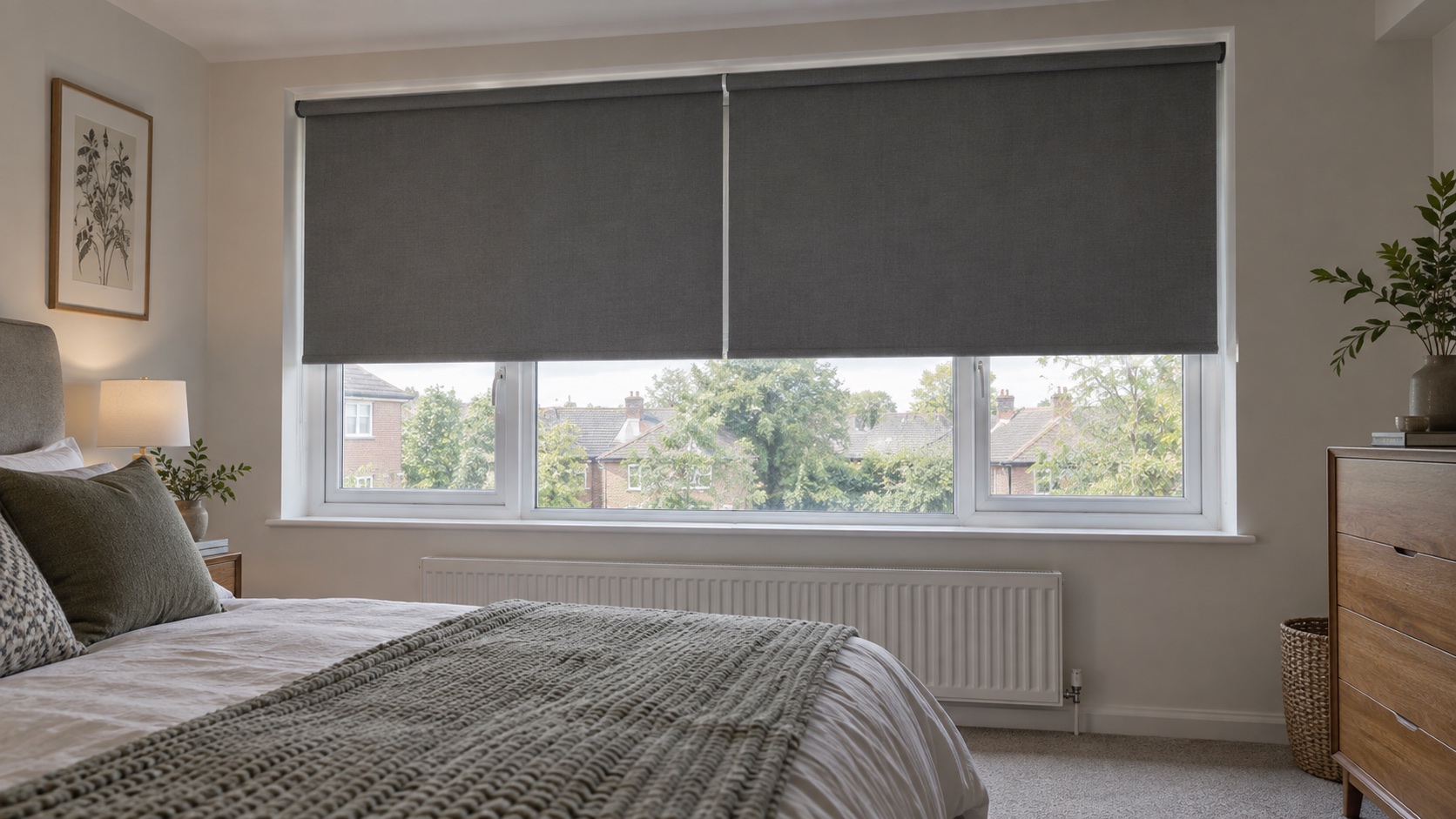
The short answer
A wide window is a fitting problem first
One large blind avoids a centre join but needs a system rated for the full span. Two smaller blinds can be easier to operate and replace, yet their mechanisms leave a visible line between fabrics. Choose the arrangement from the window divisions and where light matters in the room.
Measure the complete span and each opening sash separately.
Check the maker's maximum supported width and fabric-versus-mechanism dimensions.
Decide whether a centre join or wider outside overlap is less intrusive.
Product shortlist
Formats to compare for a broad opening
These are different ways to plan a wide window, not a claim that either featured variant alone spans every large opening.
FURNISHED blackout roller blind, black, 60 × 165 cm
Best for: A familiar daily blind in a standard bedroom
A conventional coated roller blind with a broad size range and several fitting positions. It is useful when you want an everyday blind rather than a panel that must be removed each morning.
What stands out
- Many width and drop options are listed
- Can be fixed inside or outside the recess
- A trim-to-width route for awkward standard sizes
Keep in mind
- The fabric is about 4.5 cm narrower than the complete mechanism
- The looped chain and supplied safety device must be fitted correctly
- An ordinary roller does not seal the sides
- 60 × 165 cm
- Coated polycotton
- Bracket mounted
- Chain controlled
TIPIACE framed top-down bottom-up cellular blackout blind, black
Best for: A made-to-size recess with flexible top-down control
A custom-size honeycomb blind inside a full aluminium frame. The fabric cells conceal the internal lift cords, while the frame addresses side leakage more directly than a free-hanging cellular blind.
What stands out
- Full frame manages perimeter light
- Cordless top-down bottom-up operation
- Custom dimensions for non-standard openings
Keep in mind
- Needs a deep, square recess and screw fixing
- Custom products require especially careful measurement
- The configured item may not be returnable if dimensions are wrong
- Custom size
- Honeycomb fabric
- Aluminium frame
- Cordless manual control
Wide-window options at a glance
Confirm the maximum dimensions and exact ordering method for the selected variant before buying.
| Approach | Main advantage | Main limitation | First measurement |
|---|---|---|---|
| Two standard rollers | Separate control of window sections | Centre light seam | Width of each bay and mechanism |
| One custom framed blind | One continuous covering if supported | Size and depth limits | Full opening and frame depth |
| Blind plus curtains | Curtains can cover the join and edges | More hardware and stack space | Pole span and side returns |
Let the window divisions guide the layout
A wide window may be one uninterrupted glazed span or several opening sections with mullions between them. That distinction matters more than a generic “extra wide” label. If the glass is divided, two or three blinds can align with the frames and allow one section to be opened without uncovering the whole wall. If it is one clear span, every join becomes a potential bright line. Sketch the window elevation and mark where the bed, television or desk sees the daylight before choosing a system.
The BBSA roller-blind characteristics explain why a roller's cloth is narrower than its overall width. When two rollers meet, both mechanisms contribute to the centre gap. The FURNISHED product below is a standard-size example for a divided window; the featured 60 cm variant is not presented as a single-blind answer for a broad opening. Check the range and each exact variant before planning multiples.
Work out the two-blind centre seam
The featured FURNISHED listing states that the cloth is about 45 mm narrower than the complete blind. It does not establish an equal deduction at both ends. The example below deliberately assumes equal 22.5 mm offsets on two identical 600 mm-overall blinds, installed with their mechanisms touching. It is a planning illustration, not a promised installed gap.
Two mechanisms meeting over a centre line
| Measure or source | Illustration | Your installation |
|---|---|---|
| Left blind: mechanism width − cloth width | 600 − 555 = 45 mm total | _____ mm total |
| Left blind: cloth offset at centre-facing end | 22.5 mm assumed | _____ mm, from maker |
| Right blind: cloth offset at centre-facing end | 22.5 mm assumed | _____ mm, from maker |
| Required separation between mechanisms | 0 mm assumed | _____ mm |
| Predicted centre cloth gap | 22.5 + 22.5 + 0 = 45 mm | Sum the preceding three centre values |
If the brackets need 10 mm between mechanisms in this example, the illustrated seam becomes 55 mm. A 45 mm overall-versus-cloth difference alone cannot tell you which end has the larger offset. Ask for the exact control-side and idle-side dimensions, then place the join over a mullion if practical. Do not size the pair only by adding their nominal cloth widths; check both outer edges and every bracket as well. The BBSA roller-blind characteristics explain the general mechanism/cloth difference, not these example offsets.
One large blind or several smaller ones?
One continuous blind has the cleanest centre line, but width has structural consequences. The tube, fabric and brackets must all be specified for that span. Oversized cloth can sag or track poorly if the system is under-specified. A custom framed cellular blind offers a different architecture: the TIPIACE example is ordered to size and surrounds its cloth with a frame. Its current maximum dimensions, recess depth and fixing method must be checked for the actual window; do not infer that any custom model will cover the full wall.
Several smaller blinds are easier to match to individual sashes and can be operated separately. They also create more brackets and control points. Put any central join over a substantial mullion where possible. If a seam falls directly behind the bed, a curtain layer may be more useful than a marginally wider pair of rollers. Our curtains-versus-blinds comparison explains how overlapping fabric changes the light path.
Measure the whole installation, not just the glass
Record the wall-to-wall or reveal width, then the width of each glazing section and the depth available for hardware. Check the level of the head and sill. Note handles, vents, radiators and how far opening sashes swing. If face fixing, leave useful overlap beyond the outside edges without covering switches or restricting the window. If fitting in a recess, confirm the space for every bracket and for two controls if using a pair.
Do not assume that one product listing's “width” has the same meaning as another's. Some quote overall width; others show fabric width or an ordering width from which the supplier makes deductions. Follow each maker's measuring diagram. Our outside-recess measuring guide and cassette measuring guide address the two common routes. For child-used rooms, any looped chain must be installed with its safety device as OPSS directs.
A practical choice for most wide bedrooms
If the window has strong vertical divisions, begin by pricing correctly sized blinds per section and checking the centre seams on a drawing. If it is one broad pane, seek a supplier-confirmed single-blind maximum and suitable support. If edge and centre leakage must be low, compare a supported framed or tracked system with a blind-and-curtain layer. Do not buy several narrow blinds merely because they are easy to find: their combined hardware can leave more light than expected. For a narrow opening, the small-window guide reverses the priorities: mechanism bulk and proportional side gaps become more important.
Clear answers
Frequently asked questions
Short answers to the fitting, use and care questions that most often change the result.
Is one wide blackout blind better than two?
One blind removes the centre join if the product supports the width and can be fitted securely. Two blinds may suit separate sashes but leave a seam where their mechanisms meet.
Can I put two roller blinds side by side?
Yes, if each bracket set has support and the controls remain accessible. Expect a centre gap because both fabrics are narrower than their complete mechanisms.
Will a custom blind fit any width?
No. Every tube, motor, frame and fabric has a maker-defined maximum. Check the selected product's current dimensions rather than assuming “custom” means unlimited.
How do I reduce a bright centre join?
Align the blinds with a window mullion if possible, choose a supported single system, or add a curtain layer that closes across the join. Do not overlap moving cloth in a way the maker forbids.
Are wide blinds harder to operate?
They can be heavier and may require a different tube or control. Check the maker's operating limits and whether the window can still open and ventilate.