
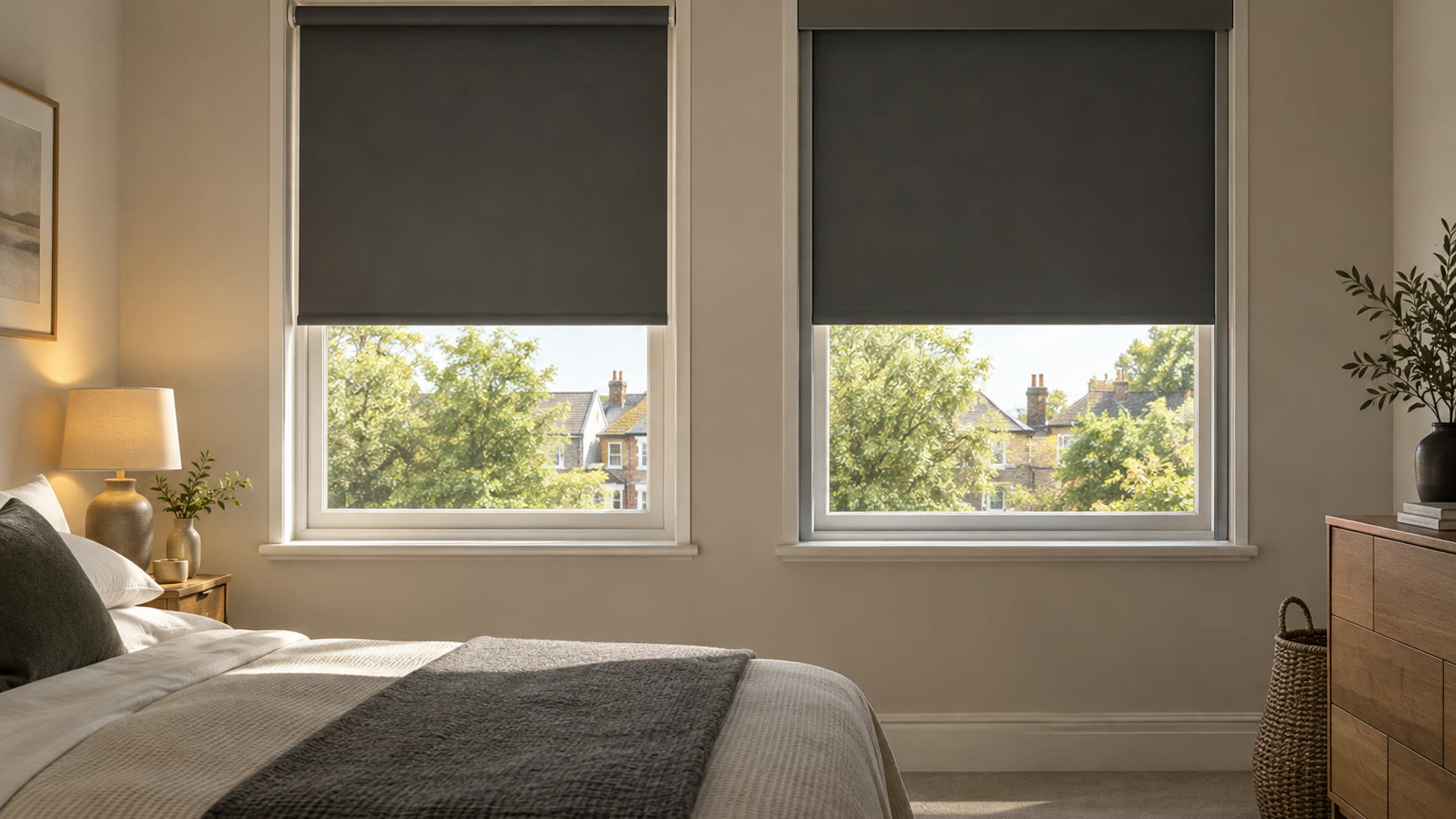
What changes when a roller has a cassette?
A standard roller has a tube, brackets and a hanging sheet of fabric. The roll is visible, and the cloth has to clear the brackets as it moves. That means the cloth is generally narrower than the complete mechanism. A cassette adds a housing around the roll, producing a tidier head and reducing direct top light. It may also protect the rolled fabric from dust.
The important distinction is between a top cassette and a full cassette-and-channel system. The first only addresses the upper part of the blind. The second pairs the head with vertical rails that overlap or guide the cloth edges. Product titles sometimes use “cassette blackout” for either arrangement, so inspect the supplied-parts diagram before comparing prices.
The British Blind and Shutter Association's product-characteristic guidance provides context for how different blind constructions behave. Neither “blackout” nor “cassette” is a promise of a perfectly dark room. Installation tolerance, wall shape and the sill junction still affect the result.
Read the light path before upgrading
Lower your current blind in daylight and stand where the light bothers you. If a bright stripe appears above the roll, a cassette or top pelmet may help. If the sides shine, a top cassette alone will leave the problem. If the fabric itself glows, you need different material. If light enters under the door or another window, neither blind change addresses the main route.
This diagnosis prevents paying for a large casing when a simpler outside overlap would do. Conversely, replacing an opaque open roller with another opaque open roller rarely changes edge leakage unless the fitting or width changes.
Cassette and standard blinds at a glance
| Feature | Standard roller | Cassette roller | What matters in practice |
|---|---|---|---|
| Head | Exposed roll and brackets | Roll enclosed in a housing | A cassette can reduce top glow but needs headroom |
| Sides | Cloth clearance visible | Clearance remains unless rails are supplied | Check the actual rail specification |
| Fitting | Usually simple brackets | Larger housing; rails may need careful alignment | Depth, level and opening sash clearance |
| Upkeep | Easy to see and dust | More corners and channels | Access to clean and service parts |
| Cost and flexibility | Broad standard range | Often more components or custom sizing | Balance benefit against measurement risk |
The table describes formats, not universal performance ratings. An outside-mounted standard roller with generous overlap may darken a particular room more effectively than a poorly fitted cassette of the wrong width.
The standard roller's strengths
An open roller is familiar, compact and widely available in stock sizes. The tube and brackets are accessible for cleaning and adjustment. It can often be fitted inside or outside a recess. A face fit with enough wall overlap can hide much of the direct side light without rails.
Its weaknesses are equally straightforward: the roll and side clearance remain exposed, the bottom bar may stop above a sill, and the cloth can drift sideways if the blind is installed out of level. The FURNISHED example in our product section has a substantial range of sizes, but its stated fabric width is narrower than the overall mechanism. That difference must be included in an outside-recess calculation.
Chain-operated rollers also require child-safety planning. The Office for Product Safety and Standards explains the risks of accessible loops and the need to fit supplied safety devices. A cordless option can remove a hanging chain, but only if the complete product and installation suit the window.
What a cassette and rails can improve
The cassette hides the roll. Well-matched side rails overlap the cloth path, reducing the exposed vertical strips that a standard roller leaves. A lower bar that meets a suitable sill can complete the coverage. The result can be noticeably darker, particularly at a sunlit window, when all parts align.
The Sol Royal K24 example combines a cassette and adhesive side rails. It suits a flat, clean, compatible mounting surface. Its performance depends on the rails remaining aligned and firmly attached. Adhesive can be unsuitable for textured paint, damp frames or delicate finishes. Read the preparation and cure instructions rather than treating “no drill” as self-explanatory.
Even a complete system may show a faint halo at a crooked corner or bottom joint. A rail can also pinch the fabric if the casing or reveal is not level. A more elaborate system increases the number of measurements and surfaces that must be correct.
Measure the assembly, not just the cloth
For a standard roller, distinguish bracket width, fabric width and drop. For a cassette, add headrail height and projection, rail width, fixing surface and lower finish. Check whether window handles, trickle vents or an inward-opening sash conflict with any part. A shallow recess can be too tight for a bulky cassette even if a slim roller fits.
If drilling, use suitable fixings for the actual substrate and check for hidden services. If attaching rails with adhesive, test surface compatibility and plan removal in a rental. A custom system may have limited return options when ordered to incorrect dimensions. If the reveal is visibly tapered or uneven, ask the maker how they specify the size.
The control must remain accessible without creating a hazard. Some cassette rollers retain a looped chain; the housing does not make the chain safer. Install the supplied tensioner or other safety device exactly as directed, and keep cots and climbable furniture away. Our child-safe blind guide covers this in more detail.
Cleaning and long-term use
Dust the exposed face of either blind with a suitable soft tool. On a cassette system, also inspect side channels for grit. A particle trapped in a tight rail can abrade the fabric over many cycles. Never force a blind that sticks or rises unevenly. Check alignment, debris and any loose mounting before operating it again.
Open the blind regularly to inspect condensation around the glass and frame. A closely fitted system can hide moisture. Keep necessary ventilation and emergency escape routes usable. If a bracket loosens, repair the fixing rather than masking movement with extra adhesive or pulling harder on the control.
Which format makes sense?
Choose a standard roller if you want a simple everyday blind, can give it enough outside overlap or will layer it with curtains. Choose a cassette with side rails when bright perimeter strips are a significant problem, the window can take accurate fitting and you value convenient daily operation. A top-only cassette is a narrower upgrade for top glow and appearance.
If a roller's sides are the issue but its mechanism is sound, compatible retrofit side tracks may be worth considering. For a rental or awkward shape, a temporary cover may provide more flexible coverage. The best choice is the one that fixes the observed light path while remaining safe, serviceable and easy enough to use every day.
Products for this job
Examples of the two formats
One is a familiar open roller; the other includes a cassette and adhesive rails. Check the exact selected variant and fitting instructions.
FURNISHED blackout roller blind, black, 60 × 165 cm
Best for: A familiar daily blind in a standard bedroom
A conventional coated roller blind with a broad size range and several fitting positions. It is useful when you want an everyday blind rather than a panel that must be removed each morning.
What stands out
- Many width and drop options are listed
- Can be fixed inside or outside the recess
- A trim-to-width route for awkward standard sizes
Keep in mind
- The fabric is about 4.5 cm narrower than the complete mechanism
- The looped chain and supplied safety device must be fitted correctly
- An ordinary roller does not seal the sides
- 60 × 165 cm
- Coated polycotton
- Bracket mounted
- Chain controlled
Sol Royal K24 cassette blackout blind with side rails, black, 90 × 175 cm
Best for: A framed no-drill installation on a smooth window
A no-drill cassette roller supplied with adhesive side rails. The frame manages the routes around the fabric more directly than an open roller, provided the window surface is flat, smooth and carefully prepared.
What stands out
- Top cassette and side rails are supplied as one system
- Adhesive installation avoids conventional drilling
- Several listed widths and three neutral colours
Keep in mind
- Surface preparation and flatness are critical
- The cloth is narrower than the complete mechanism
- The looped chain and safety device need careful positioning
- 90 × 175 cm variant
- Polyester
- Adhesive side rails
- Chain controlled