
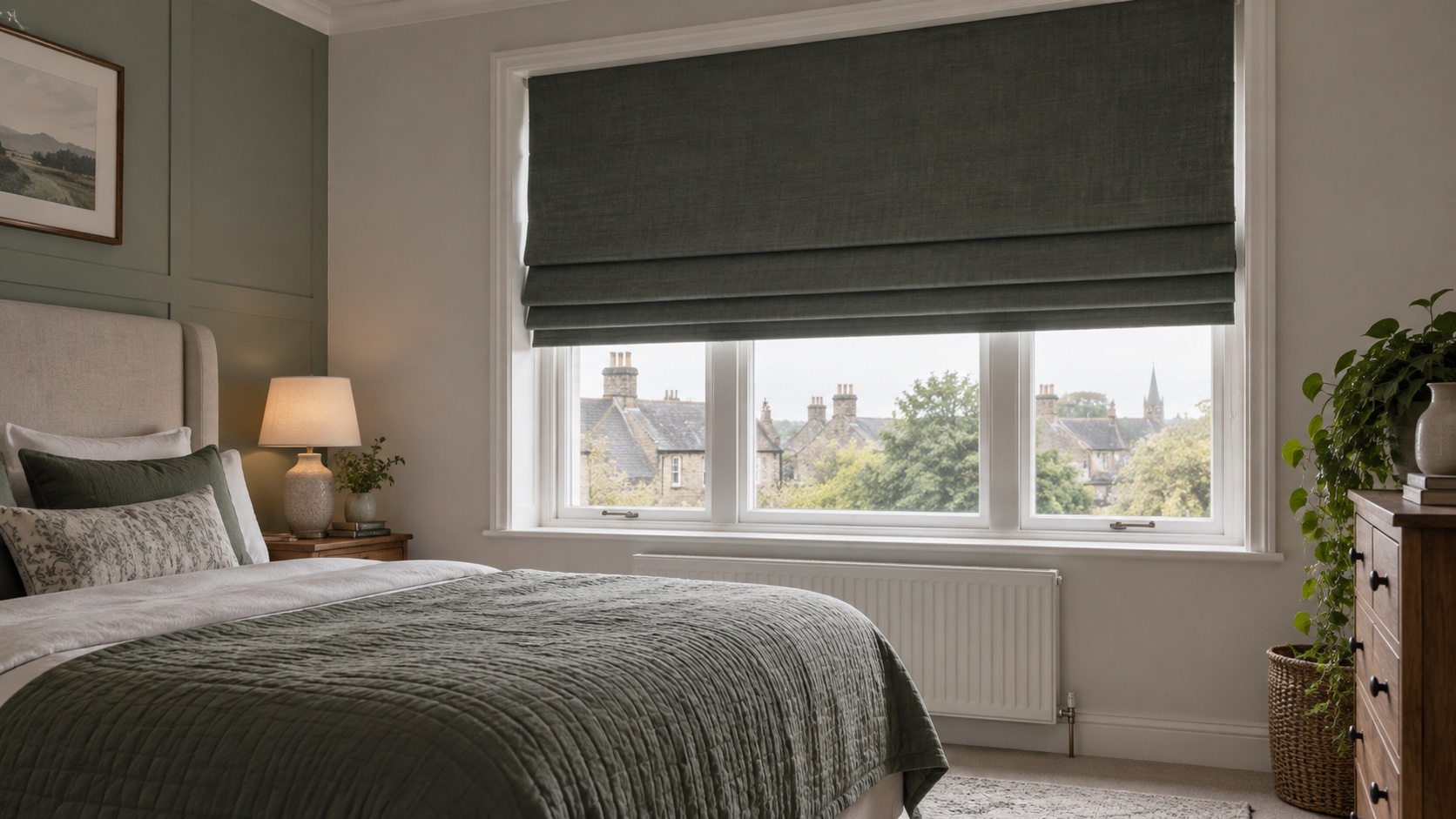
What makes a Roman blind different?
A Roman blind is a fabric panel that gathers into horizontal folds as it rises. It has a softer presence than a flat roller and can use decorative face fabric with a separate blackout lining. The BBSA's Roman-blind overview describes the rods and folds that create this shape. The design is appealing in a furnished bedroom, but the folded stack remains visible across the upper part of the window when the blind is open.
Construction matters. Rows of stitching can pierce an opaque lining and show as small points of light. A loosely hanging lining can behave differently at the sides from a bonded one. The BBSA Roman product-characteristics sheet explains these limitations and states that Roman blinds do not offer a sealed blackout result. Ask for the lining type and a daylight sample rather than judging by a photograph of a closed blind.
How much light should you expect?
An opaque Roman panel can deal with light through the main fabric. It cannot fill the operating clearance around the edges by itself. An inside-recess blind normally needs room to travel without rubbing the walls; that gives daylight a path at each side. A face-fit blind can overlap the opening and hide more of those strips, provided there is wall space for its complete width and its folded stack above the glass.
| Detail | Why it matters | What to inspect |
|---|---|---|
| Blackout lining | Controls transmission through cloth | Sample held against bright daylight |
| Stitch method | May leave pinpricks | Maker's construction description |
| Side clearance | Allows operation but admits light | Recess or outside-fit diagram |
| Raised stack | Covers part of the glass | Stack height and sash access |
If side light is the primary complaint, a Roman blind may be a decorative layer over a closer-fitting roller or tracked system rather than the only treatment. That pairing needs enough space for both headrails and safe access to the window. Our roller-versus-Roman comparison weighs those approaches in more detail.
Before ordering a Roman blind
Measure the opening at several heights and note any tile, handle or trim that narrows the path. Record the headrail position, likely raised stack and whether the blind can lift clear of an inward-opening sash. For a bay window, adjacent Roman blinds may touch or leave angled gaps; the BBSA guidance makes clear that a bay needs its own layout rather than repeated straight-window measurements.
Control choices include chains, cords and some motorised or safe-by-design arrangements. A label such as “child-safe” is not enough to judge a particular installation. The OPSS guidance on blind cords explains the hazard and safety-device requirements; the BBSA advice recommends designs without accessible operating loops where suitable. Keep beds and climbable furniture away from the window.
Roman blinds are a good choice when fabric character and a softened room matter alongside darkening. If the requirement is the lowest possible perimeter light from one treatment, compare a cassette or side-tracked system before ordering. Check a seller's exact fabric, control and dimensions, not just the familiar Roman shape.
Questions worth putting to the seller
Ask whether the blackout layer is separate, bonded or stitched through, and whether the maker can send a sample that includes the construction rather than only the face cloth. Confirm the blind's raised stack height for your proposed drop. A deep stack can shade the upper glass even when the blind is nominally open; this may be welcome in a bright room but awkward where winter daylight is valued. For an inside-recess order, ask how much clearance is deducted and what happens if the reveal is not square. For a face fit, ask what bracket spacing and wall fixing are required for the blind's weight. Finally, request the exact control and safety-device details, especially where a child could visit the room. A beautiful fabric swatch cannot answer these mechanical questions.