
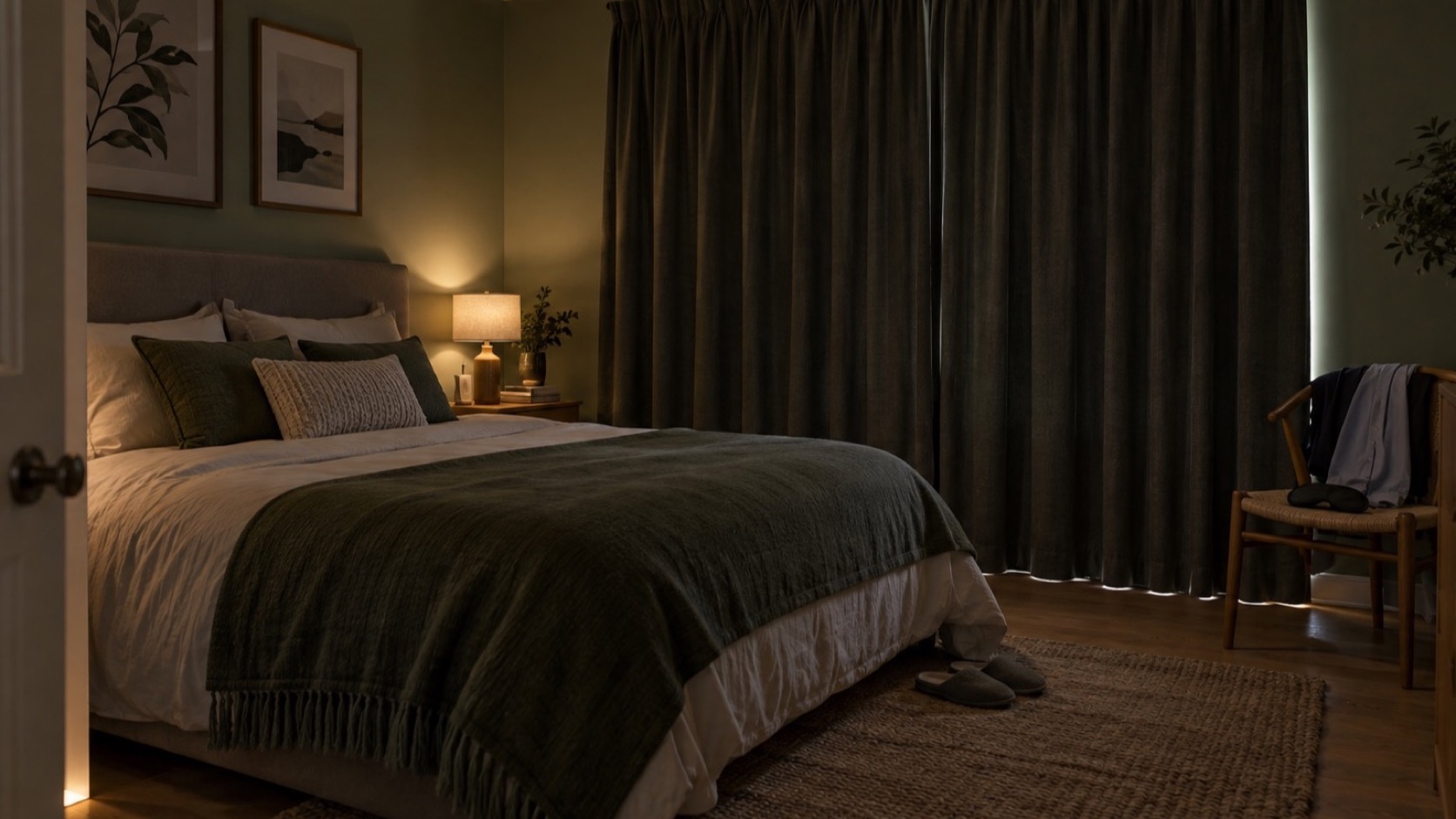
Audit the room at the time you sleep
Close the current coverings during the brightest part of your intended sleep period and let your eyes adjust. Mark the routes rather than simply describing the room as “too bright”. Common sources are side strips around a roller, a top glow above curtains, the centre join, fanlights, door gaps and small electronic indicators.
Repeat the check on a sunny and overcast day if possible. Low morning sun can reach under one treatment while high afternoon light exposes another edge. Street orientation, season and reflective neighbouring walls all change the pattern.
Decide what is genuinely intrusive from the bed. A fine halo behind a headboard may matter less than a direct bright line across the pillow. This keeps the budget focused and avoids turning the room into a complicated sealed box.
The Health and Safety Executive’s shift-work guidance recommends making the environment favourable for sleeping and includes heavy curtains, blackout blinds or eye shades among ways to darken a bedroom. It also discusses noise, routine and comfortable temperature. Darkness is one part of a practical environment, not a guaranteed outcome.
Build the window treatment in layers
Start with opaque coverage over the main glass. A roller is compact and easy to operate; a cellular blind offers a softer pleated format; a removable panel suits temporary rooms. Confirm that the material itself is genuinely opaque by viewing a sample against strong light.
Next, control the perimeter. Face-fit a blind with useful overlap where the wall permits, or add curtains on a pole or track mounted above and beyond the recess. Curtains should retain folds when closed and overlap at the centre. Returns towards the wall reduce the outer routes.
Layering works because the edges are staggered. The recess blind’s gaps sit behind the curtain body, while the curtains’ centre join sits in front of opaque blind fabric. This is usually more forgiving than asking one mechanism to match an uneven opening perfectly.
When to use side tracks
If narrow bright strips remain after good measurement, a cassette blind with side channels may be worthwhile. It guides the cloth and manages the vertical routes directly. A full framed cellular system is another option for a deep square recess. Our light-sensitive sleeper blind guide compares those formats as light-control options without promising a health outcome.
Tracks add fitting precision and cost. Check handles, vents, sill and opening path. A channel does not resolve light above a curtain pole or under the door, so compare its likely gain against simpler adjustments.
Temporary solutions
A suction panel attaches to clean smooth glass and travels easily. A hook-and-loop cover can overlap an irregular frame. Both require removal for full daylight and daily checks for condensation or loose fittings.
Renters should test surface compatibility and ask permission before adhesive or drilling. Do not assume “removable” means mark-free. Store the panel dry and keep all cups, tabs and bags away from children.
Control the rest of the room safely
Door light can be surprisingly dominant once the window is dark. Adjustments must preserve safe operation and any fire performance. Do not wedge a fire door, block a required gap or attach material that could jam the latch. A removable floor-level blocker may be appropriate only where it creates no trip or escape hazard.
Cover or switch off unnecessary indicator lights using the device manufacturer’s safe method. Do not cover ventilation openings or heat-producing equipment. Place charging devices out of sight rather than wrapping them in fabric.
Mirrors can reflect a small gap towards the bed. Repositioning one may be more effective than buying a darker curtain. Pale walls make residual light more noticeable but are not a problem in themselves; a targeted fix at the source is preferable to repainting the room very dark.
Noise and temperature
Room darkening does not control every daytime disturbance. The HSE notes that daytime sleep can be affected by noise and warmer temperatures. Address each route separately: communicate quiet periods, use appropriate sound management and keep the room comfortably ventilated.
Blackout products are not active cooling. Shade sunlit windows before the room heats, then ventilate when outside air is cooler and it is safe. Do not block trickle vents or trap a radiator behind curtains in cold weather.
Make the setup easy to repeat
The best system is one you will close after a demanding shift and open again without a lengthy installation. A fitted blind plus curtains usually wins for daily use. A removable panel is reasonable for occasional night shifts or a temporary room but can become burdensome twice a day.
Set the room before travelling home if another household member can do so safely, or create a simple sequence: lower blind, close curtains, check centre overlap, remove visible devices and place an eye mask within reach. Avoid a routine that requires standing on furniture.
Open coverings after rest to admit daylight, inspect the glass and dry condensation. Regular opening prevents a darkened window from becoming an ignored damp area. Clean tracks and operate blinds smoothly so they remain dependable.
Child and household safety
If children live in or visit the home, choose cordless blind controls wherever possible. The UK blind-cord guidance explains the danger from loops and the need for correctly fitted safety devices. Keep beds and climbable furniture away from controls.
Do not conceal an unsecured chain behind heavy curtains. Ensure every occupant can open the window covering and leave the room. A dark environment should not compromise smoke alarms, exits or access to a dependent person.
A sensible upgrade order
First, correct obvious fitting issues: level the blind, close the curtain pair fully and move the pole higher or wider if practical. Second, add a complementary layer. Third, consider tracks or a full-frame system for persistent perimeter light. Address door and device light last, once the main source is controlled.
This order produces useful improvement at each stage and reduces the risk of overspending on a window while another route remains dominant.
What room darkening can and cannot do
A controlled, dim environment can support a daytime sleep routine, and official HSE advice includes darkening measures. It cannot guarantee sleep, correct an unsafe shift pattern or treat insomnia, fatigue or another medical condition. Persistent problems deserve appropriate professional advice.
Aim for a room that is dark enough, quiet enough, comfortable and simple to operate. For product choices focused on irregular schedules, see our blackout blind guide for shift workers and curtain guide for shift workers.
Products for this job
Useful formats for daytime rooms
A framed cassette, opaque curtains and a removable panel address different constraints. Choose by the room and daily routine rather than darkness wording alone.
Sol Royal K24 cassette blackout blind with side rails, black, 90 × 175 cm
Best for: A framed no-drill installation on a smooth window
A no-drill cassette roller supplied with adhesive side rails. The frame manages the routes around the fabric more directly than an open roller, provided the window surface is flat, smooth and carefully prepared.
What stands out
- Top cassette and side rails are supplied as one system
- Adhesive installation avoids conventional drilling
- Several listed widths and three neutral colours
Keep in mind
- Surface preparation and flatness are critical
- The cloth is narrower than the complete mechanism
- The looped chain and safety device need careful positioning
- 90 × 175 cm variant
- Polyester
- Adhesive side rails
- Chain controlled
Deconovo blackout eyelet curtains, black, 46 × 54 in, pair
Best for: An affordable ready-made eyelet pair
A widely sized pair of soft eyelet curtains made for a standard pole. The dark colour is useful where room darkening matters more than a pale decorative finish.
What stands out
- Many size and colour variants are grouped under the listing
- Pair format suits conventional bedroom windows
- Simple eyelet heading is quick to hang on a compatible pole
Keep in mind
- Darkening depends on pole position, width and centre overlap
- Eyelets can leave a bright band above a low-mounted pole
- The listing's thermal wording is not a measured room-saving guarantee
- 46 × 54 in
- Pair
- Eyelet heading
- Polyester
Easynight Blackout Blind, regular 150 × 145 cm
Best for: A removable cover with generous edge overlap
A cut-to-size blackout sheet fixed around the window frame with removable hook-and-loop attachments. It can cover the complete opening more closely than an ordinary roller blind and packs into a storage bag between uses.
What stands out
- Can be cut for an unusual window shape
- Hook-and-loop attachment can reduce perimeter gaps
- No drilling and a storage bag is included
Keep in mind
- Adhesive suitability depends on the frame finish
- Less convenient than a blind for frequent daylight access
- The fabric can look utilitarian in a finished bedroom
- 150 × 145 cm
- Cut to size
- Hook-and-loop fixing
- Storage bag