
The short answer
Cover the window edges, not just the glass
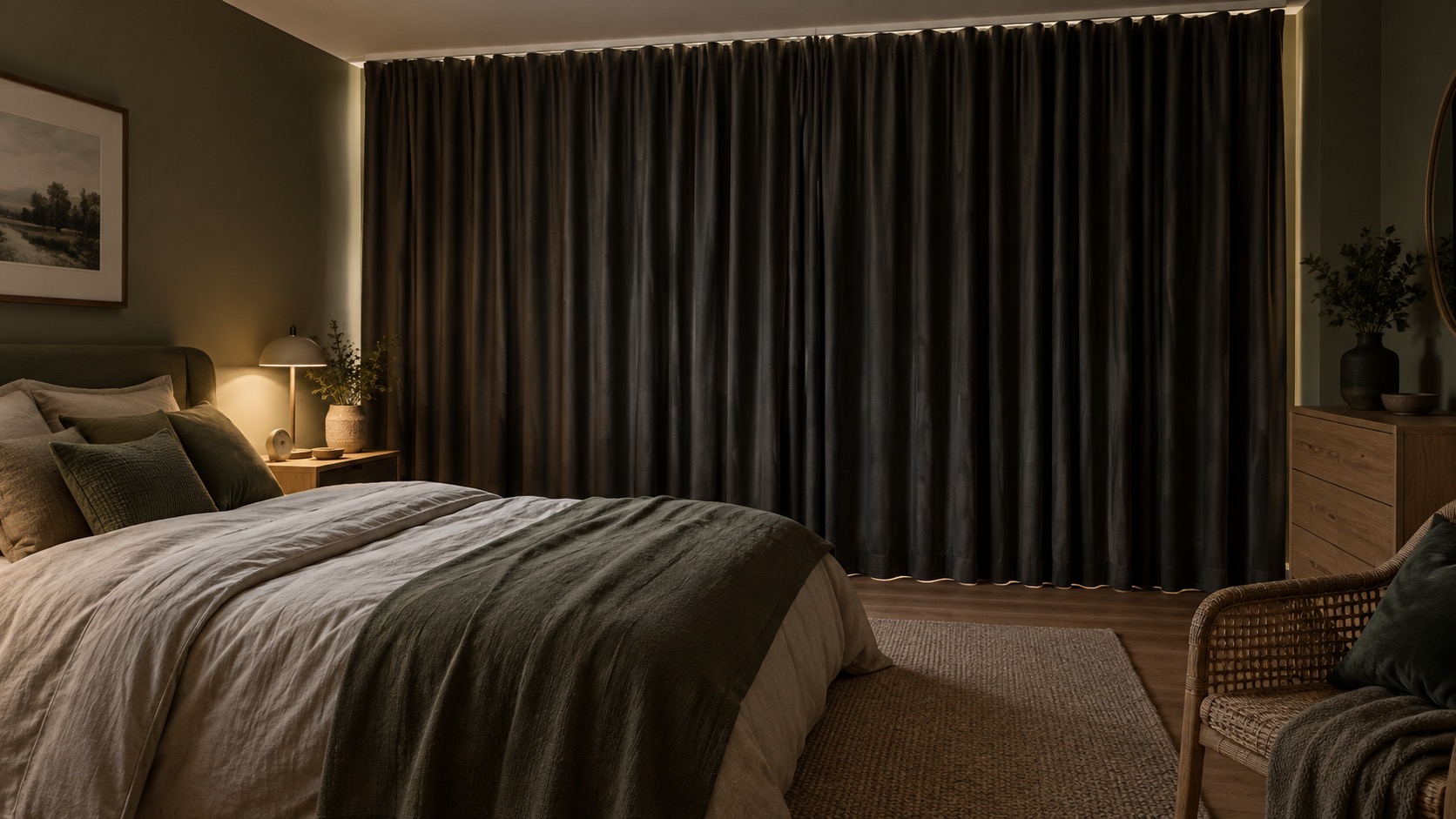
For daytime sleep, a wide opaque pair mounted above and beyond the opening is usually more effective than a darker fabric squeezed onto a narrow pole. A blind-and-curtain layer can catch low sun from different angles and remain easy to reset after every shift.
[object Object]
Choose enough curtain width for folds and a deliberate centre overlap.
Keep the routine simple enough to open fully after waking for daylight and ventilation.
Product shortlist
Three practical curtain options
The pairs differ mainly in backing, face colour and size family. The installation determines whether they handle low daytime sun.
Deconovo blackout eyelet curtains, black, 46 × 54 in, pair
Best for: An affordable ready-made eyelet pair
A widely sized pair of soft eyelet curtains made for a standard pole. The dark colour is useful where room darkening matters more than a pale decorative finish.
What stands out
- Many size and colour variants are grouped under the listing
- Pair format suits conventional bedroom windows
- Simple eyelet heading is quick to hang on a compatible pole
Keep in mind
- Darkening depends on pole position, width and centre overlap
- Eyelets can leave a bright band above a low-mounted pole
- The listing's thermal wording is not a measured room-saving guarantee
- 46 × 54 in
- Pair
- Eyelet heading
- Polyester
Deconovo total-blackout coated curtains, pale khaki, 46 × 72 in, pair
Best for: A lighter face with an opaque backing
A coated-back eyelet pair intended to stop light through the cloth itself. The lighter face gives a softer room look while the backing does the opacity work.
What stands out
- Coated backing rather than relying only on a dark yarn
- Pair format
- Multiple listed colour and size variants
Keep in mind
- Coated fabrics need care-label-led cleaning
- Heavier curtains need a suitable pole and fixings
- Perimeter gaps remain unless the track or pole extends well beyond the window
- 46 × 72 in
- Pair
- Eyelet heading
- Coated back
PONY DANCE blackout eyelet curtains, grey, 46 × 54 in, pair
Best for: A grey pair across a standard window
A soft grey two-panel eyelet set with a very broad group of size variants. It is a practical neutral choice when you can create useful overlap beyond the window.
What stands out
- Two-panel set
- Many width and drop combinations are listed
- Neutral colour works with layered blinds
Keep in mind
- Room darkening varies with the selected colour and installation
- A pole close to the recess can expose top and side light
- Exact dimensions must be checked on the selected variant
- 46 × 54 in
- Two panels
- Eyelet heading
- Grey
At a glance
Choose the exact drop and combined width for your pole. A short or narrow pair cannot be corrected by darker fabric.
| Option | Best for | Visual effect | Construction cue | Main trade-off |
|---|---|---|---|---|
| Deconovo black pair | A deep-colour daytime room | Dark and focused | Dense polyester | Can visually dominate |
| Deconovo coated pair | A light room when open | Soft neutral | Opaque coated back | Coating needs careful cleaning |
| PONY DANCE grey pair | Layering over a blind | Neutral | Dense polyester | Check selected colour opacity |
Diagnose the room during sleeping hours
Test the bedroom at the time you need it dark. Low morning or evening sun can enter at a shallow angle that is invisible during a midday check. Close the existing treatment, wait for your eyes to adjust and note every bright route.
A uniform glow through the cloth points to insufficient opacity. A bright vertical line means the side or centre coverage is weak. A band near the ceiling points to a low-mounted pole or open track. Light around the door, an electronic display or a roof window is a separate problem and will not be fixed by buying heavier curtains for the main window.
Take photographs from the bed position. They make it easier to plan overlap and avoid buying a different fabric with the same geometry.
The three options in more detail
Deconovo black pair: deep face colour
The black pair is a straightforward ready-made choice for a room where visual darkness is the priority. The listing groups many dimensions, which helps when the pole is wider than the recess. The 46 × 54 inch pair is only one variant, so select the drop and width for your actual layout.
Black face colour can make the closed wall look darker, but it does not seal edges. Check the top position, centre meeting point and side return. In a small room, the appearance may feel heavy when closed, so balance it with lighter walls and bedding if that matters.
Deconovo coated pair: pale khaki outside the sleep period
The coated-back option uses its backing for opacity, allowing a lighter face. This suits a bedroom that needs to feel calm and bright once the curtains are opened. The 72-inch drop can cover a taller window, subject to the radiator and floor layout.
Treat the backing carefully. Follow the care label and avoid high heat or harsh scrubbing. The pair can be heavier than an unlined decorative curtain, so verify the pole and fixings.
PONY DANCE grey pair: adaptable second layer
Grey is a flexible choice for layering over an existing roller. The blind handles privacy and the centre of the glass; the curtains cover its exposed edges. The two-panel format is easy to draw from the centre after a shift.
Opacity can vary with colour and batch, so confirm the selected variant rather than relying on the family title. Calculate the combined flat width and preserve fullness when closed.
Fit high, wide and with enough fabric
Measure the pole or track rather than the window glass. Extend beyond the recess where the wall and furniture allow, creating space for the panels to stack clear of the glass when open. Position above the opening to reduce top light, while checking the lintel and any vents.
The pair needs enough combined width to form folds when closed. Fullness helps the panels meet at the centre without tension and gives more material at the sides. If the eyelets are spread flat, every small movement can expose a slit.
A wraparound pole or return track takes the side edge towards the wall. A centre-overlap carrier on a track can place one panel slightly in front of the other. A securely built pelmet addresses the top route. Choose robust purpose-made hardware rather than tape, loose blankets or pins.
Layering for demanding daylight
A recess roller plus face-fitted curtains is a practical combination. The blind blocks most of the glass area and the curtains hide its narrow sides. Because the two layers sit at different depths, their gaps do not line up.
If you already own an opaque roller, improve its alignment and add wider curtains before replacing both. If the roller control is looped, fit its supplied safety device and keep it away from children. For a new family-room installation, a cordless blind is preferable.
For a roof window, use a code-specific rail-guided blind. An ordinary curtain hanging vertically cannot follow the slope. See our VELUX code guide for the matching process.
Create a repeatable post-shift routine
The darkest theoretical arrangement is not helpful if it takes fifteen minutes to build every day. Curtains should draw smoothly, meet in the same place and open fully after waking. Marking the centre overlap on the track or using a small sewn-in overlap can make the result repeatable without loose clips.
Deal with small light sources separately. Turn displays away, use device settings or apply removable manufacturer-approved covers that do not block ventilation. A door draught excluder may reduce hall light, provided it does not obstruct safe exit.
After waking, open the room-darkening layers and ventilate appropriately. This lets the window area dry and restores useful daylight. The site does not make medical sleep claims: if persistent sleep difficulty affects your health or safety, seek appropriate professional advice.
Summer and winter use
Curtains can shade sunlit glass. GOV.UK hot-weather guidance for England recommends covering windows exposed to direct sun and ventilating when outside air is cooler, if safe. Close the treatment before the room heats rather than expecting it to cool an already hot space.
In winter, a closed lined pair can reduce the sensation of cold downdraught beside a window, but it does not repair failing seals or glazing. Inspect for condensation and keep required ventilation open. Avoid trapping a working radiator behind floor-length curtains.
Do not rely on retailer “thermal” wording as a temperature guarantee. Orientation, glazing, fabric size and behaviour all change the outcome.
Cleaning and maintenance
Dust with a clean low-suction upholstery attachment. Follow the exact care label, especially for coated backing. Check eyelets, hooks, track runners and wall brackets, as daily opening and closing creates repeated load.
Keep the hem off damp sills and away from heaters. If condensation forms behind the pair, dry the window area and investigate the cause. A musty smell is not a normal trade-off for darkness.
Bottom line
Choose the black Deconovo pair when deep face colour suits the bedroom, the pale coated pair when the room should feel lighter outside sleeping hours, or the grey PONY DANCE pair as a neutral layer over a blind.
Whichever fabric you choose, invest in width, wall overlap and smooth daily operation. For blind-first alternatives, see our blackout blinds for shift workers.
Clear answers
Frequently asked questions
Short answers to the fitting, use and care questions that most often change the result.
Are blackout curtains good for night-shift workers?
They can reduce daylight and visual disturbance when fitted with enough coverage. They do not guarantee sleep, but a consistent darkening routine can make the room more practical for daytime rest.
Is black the best colour for daytime sleep?
Not automatically. A pale curtain with an opaque backing can stop light through the cloth. Edge coverage, centre overlap and top treatment usually matter more than face colour.
Should blackout curtains go over a blind?
Layering is often effective because curtains cover the side gaps of a recess blind. Use a safe control and make sure the two treatments do not snag or block ventilation and opening windows.
How do I stop light above a curtain pole?
Mount the pole or track higher where the structure permits, or use a securely fitted pelmet. A ceiling track can also reduce the top route. Do not block vents or use loose improvised fabric.
Can blackout curtains reduce daytime noise?
Heavy fabric may soften some high-frequency reflection inside the room, but it is not acoustic glazing and should not be sold as soundproofing. Deal with window seals and external noise through appropriate building measures.