
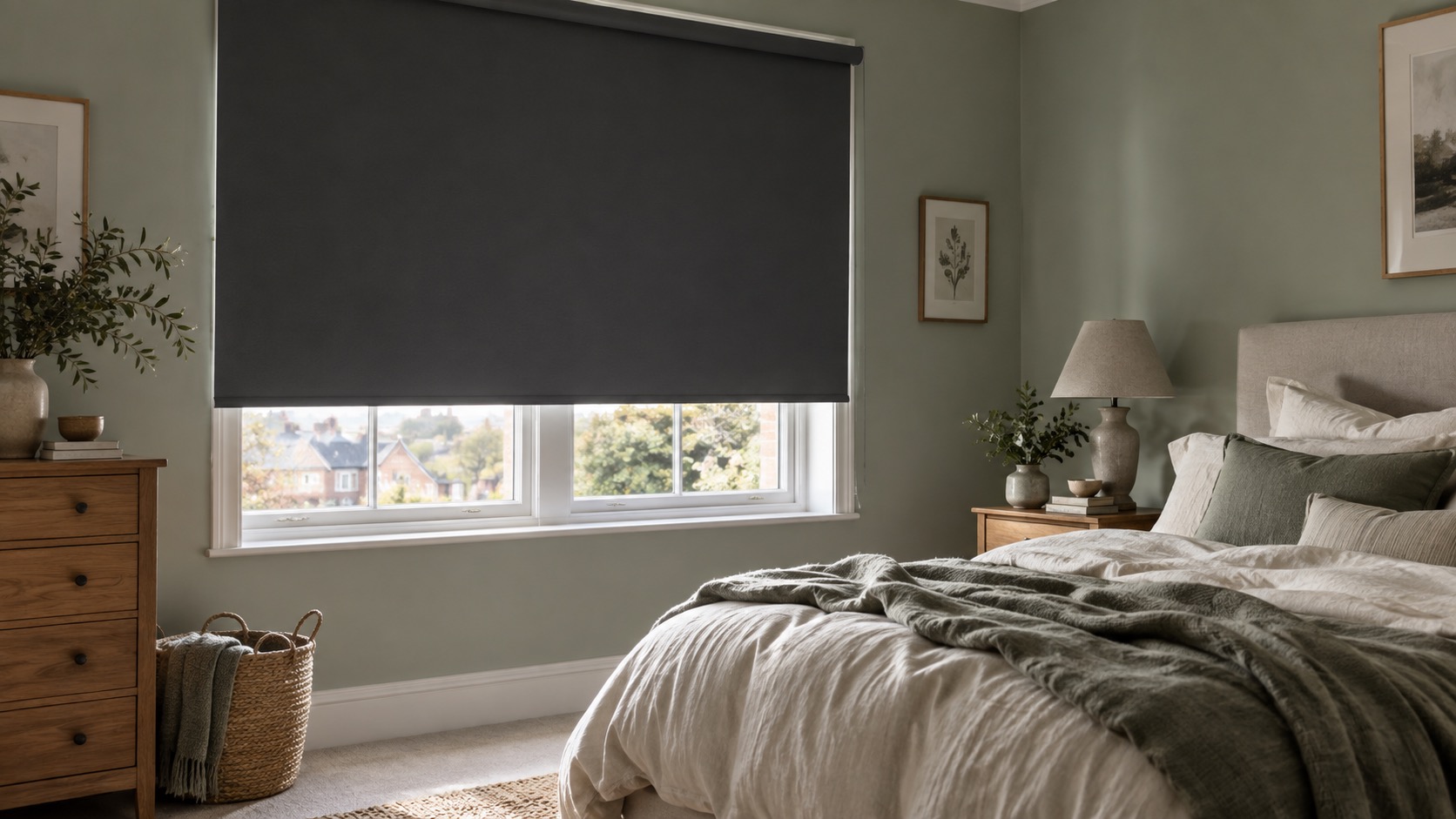
The short answer
Match the mechanism to the window before choosing a colour
The strongest roller-blind choice is the one whose complete width, fabric width, fitting method and control suit the opening. A standard bracketed roller is flexible, a clip-on model avoids drilling on a compatible frame, and a cordless spring shade removes the operating loop.
For darkness, compare fabric coverage rather than the headline mechanism width.
Outside-recess overlap can reduce bright side strips where the wall and handles allow it.
In children’s rooms, a cordless design is preferable; any supplied safety device is a required part of installation.
Product shortlist
Three roller formats worth comparing
Each solves a different fitting problem. Select the exact size and variant only after measuring the real bracket position and checking the instructions.
FURNISHED blackout roller blind, black, 60 × 165 cm
Best for: A familiar daily blind in a standard bedroom
A conventional coated roller blind with a broad size range and several fitting positions. It is useful when you want an everyday blind rather than a panel that must be removed each morning.
What stands out
- Many width and drop options are listed
- Can be fixed inside or outside the recess
- A trim-to-width route for awkward standard sizes
Keep in mind
- The fabric is about 4.5 cm narrower than the complete mechanism
- The looped chain and supplied safety device must be fitted correctly
- An ordinary roller does not seal the sides
- 60 × 165 cm
- Coated polycotton
- Bracket mounted
- Chain controlled
Amazon Basics blackout roller blind, dark grey, 56 × 150 cm
Best for: A compact adhesive-and-clip installation
A compact roller blind whose clip-and-adhesive mounting avoids drilling into the frame. The listed fabric is opaque, but the roller mechanism still leaves perimeter routes for daylight.
What stands out
- Mounting clips are listed as requiring no drilling
- Available in several compact widths
- Raises and lowers like a normal roller blind
Keep in mind
- Adhesive removal can affect delicate surfaces
- The cord tensioning device is safety-critical
- The 150 cm drop will not suit every window
- 56 × 150 cm
- Polyester
- No-drill clips
- Cord controlled
LazBlinds cordless no-drill blackout shade, black, 36 × 72 in
Best for: A window where a control loop is best avoided
A spring-operated cordless shade that attaches without conventional drilled brackets. It removes the hanging loop found on many ready-made rollers, but its stick-on installation still needs a compatible, clean surface.
What stands out
- Cordless spring operation
- No conventional drilling
- Opaque black fabric in the featured variant
Keep in mind
- A fixed ready-made width will not suit every recess
- Adhesive or pressure fittings still depend on the surface and instructions
- No-drill does not guarantee mark-free removal
- 36 × 72 in
- Cordless
- No-drill mounting
- Black
At a glance
These are open roller systems, not sealed cassettes. The cloth may be opaque while perimeter light remains.
| Option | Best for | Control | Fitting route | Watch for |
|---|---|---|---|---|
| FURNISHED roller | A conventional everyday installation | Looped chain | Drilled brackets | Fabric narrower than complete blind |
| Amazon Basics roller | A compatible frame without drilling | Cord with tensioner | Clip-and-adhesive | Surface and drop compatibility |
| LazBlinds cordless shade | Avoiding a hanging control loop | Cordless spring | No-drill mounting | Ready-made imperial sizing |
What makes a roller blind a good buy?
Start with geometry. The tube, control and brackets form the complete blind, while the fabric is narrower. A blind can fit neatly between two recess walls yet leave a bright strip on both sides. Product listings are not consistent about whether the headline width describes the cloth or the overall mechanism, so confirm both before ordering.
Next choose where the blind will sit. A recess fit looks integrated and preserves wall space. A face fit can extend beyond the opening, which is often more useful for room darkening. Check that the proposed brackets land on sound material and that the roll clears handles, coving, vents and the opening arc of the window.
Finally assess the control. A looped chain is familiar, but its supplied tensioning or breakaway device must be installed exactly as directed. The Office for Product Safety and Standards warns that blind cords and loops can endanger young children. A cordless spring mechanism removes the operating loop and is the clearer choice where children live or visit.
The three options in more detail
FURNISHED: a conventional bracketed roller
This is the most adaptable format in the shortlist. It uses drilled brackets and is offered across a broad family of sizes, so it suits a room where a permanent everyday blind is wanted. The listing allows recess or face fitting and says the fabric is approximately 4.5 cm narrower than the complete mechanism.
That width difference is the key buying fact. In a 60 cm recess, a complete blind of the same nominal width does not give 60 cm of cloth. For a darker result, consider a face fit wide enough for the fabric—not merely the brackets—to overlap the opening. Confirm the trimming limit before cutting anything.
The chain control needs its safety device fixed to a suitable adjacent surface. If that cannot be done, choose another control format.
Amazon Basics: compact clip-and-adhesive fitting
This model is relevant when conventional drilling is not wanted and one of its ready-made widths suits the frame. It retains normal roller operation, but the attachment method depends on compatible clean surfaces and careful alignment. The listed 150 cm drop is a hard practical limit.
No-drill does not mean consequence-free. Adhesive can mark weak paint or aged finishes, and a clip may compress a seal or prevent a window closing if it is not designed for that frame. Test the layout with the window open and shut. The cord tensioning device remains safety-critical.
LazBlinds: a cordless spring shade
The cordless format is the strongest point here. The blind is raised and lowered from its bottom bar, avoiding a hanging control loop. That can simplify a nursery or family room, although the fitting and furniture position still need ordinary care.
Its ready-made dimensions are stated in inches, so convert once and check the exact selected variant. A no-drill mount must fit the actual frame and leave seals, handles and opening sections working normally. As with any open roller, the sides are not sealed.
How much overlap do you need?
There is no universal number because brackets, fabric deductions and window details differ. For a face fit, mark the proposed fabric edges on the wall with removable tape. Inspect the window at its brightest time and see whether the marks extend beyond the visible opening. Add enough top coverage that light cannot easily pass behind the roll, while keeping vents and openings clear.
For a recess fit, measure width at the top, middle and bottom, plus the drop at three positions. Record recess depth and every obstruction. Follow the selected seller’s rule about deductions; never subtract twice. Our recess measuring guide gives a focused worksheet.
Blackout fabric versus a blackout installation
Opaque cloth deals with light through the material. It does not close the air and light routes around an open roller. The usual weak points are beside the fabric, above the roll and below the bottom bar when a sill is uneven.
If those gaps matter, there are three sensible upgrades. Face fit the roller with more overlap. Add full curtains mounted higher and wider than the opening. Or move to a cassette blackout blind with compatible side channels. Avoid improvised side cords, loose magnets or anything that interferes with escape, ventilation or safe window operation.
Colour, backing and room direction
Do not assume black face fabric is always the darkest performer. A pale textile with an effective opaque backing may stop light through the cloth just as well and look calmer during the day. Dark unbacked material can still glow.
Room direction changes the test. East-facing windows receive low morning sun; west-facing rooms can be demanding in the evening; roof windows see the sky directly. Test the existing opening during the relevant period and photograph the light routes. That evidence is more useful than a generic percentage in marketing copy.
Daily use and maintenance
Operate a roller from the centre of its bottom bar where applicable, or pull the chain smoothly without jerking. If the fabric tracks sideways, stop and check that the brackets are level. Continued use can crease or fray the edge.
Dust with a clean microfibre cloth or low-suction upholstery tool while the blind is fully extended. Check the care label before spot cleaning. Do not soak coated fabric, use abrasive cleaners or roll it up while damp. Adhesive and clip-on fixings should be checked periodically for movement.
The practical verdict
Choose the FURNISHED roller when you have a solid fixing surface and want the flexibility of a conventional permanent blind. Choose the Amazon Basics format only where the frame, surface and exact dimensions suit its clip-and-adhesive method. Choose the LazBlinds shade when eliminating the operating loop is the priority and its ready-made dimensions match.
None is a universal winner. The best blackout roller is the one whose fabric covers the right area, whose mechanism fits without obstruction and whose control can be used safely every day.
Clear answers
Frequently asked questions
Short answers to the fitting, use and care questions that most often change the result.
What is the best type of blackout roller blind?
For most rooms, the best type is the one that can be face fitted with useful overlap and operated safely. For stronger edge control, choose a purpose-made cassette with side channels. For a child’s room, prioritise a safe-by-design cordless control.
Do black roller blinds block more light than pale ones?
Dark fabric can look less luminous, but a genuinely opaque pale coated fabric can also stop light through the cloth. Installation gaps, backing and construction matter more than face colour alone.
Can I fit a blackout roller without drilling?
Yes, if the window and product are compatible. Options include clip-on frame brackets, adhesive systems and tension-fit designs. Check frame thickness, seals, opening clearance and surface instructions before ordering.
Should a roller blind go inside or outside the recess?
Inside is tidy and compact; outside can create better overlap and reduce side light. Choose after checking handles, vents, opening sections, wall space and the available fixing surface.
Are blackout roller blinds suitable for nurseries?
A safe-by-design cordless model can be a practical choice. Keep the cot and climbable furniture away from the window, follow the instructions and never leave a looped control or loose accessory within reach.