
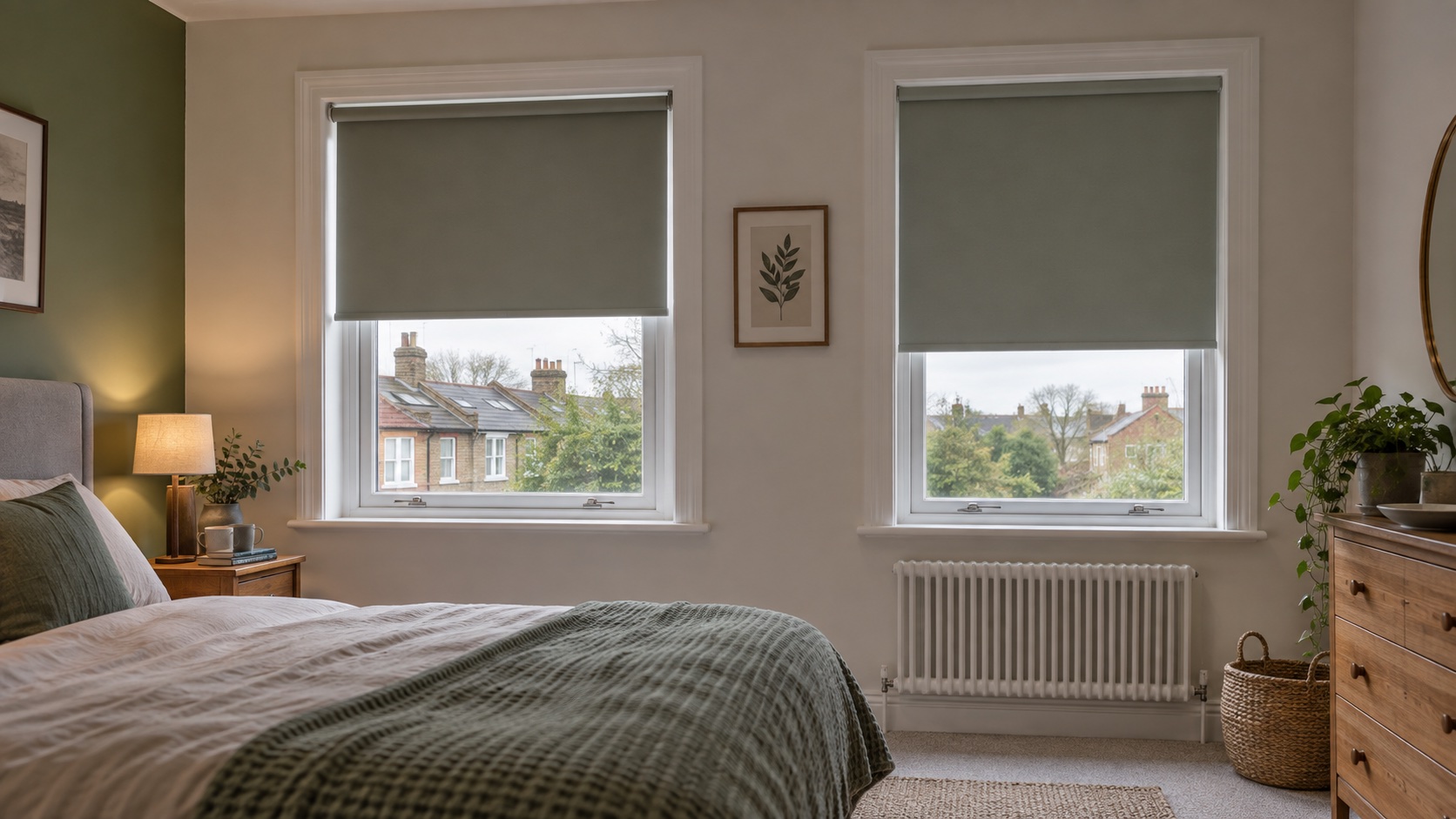
When a ready-made blind is enough
Standard-size blinds can be a sensible first purchase for a straightforward bedroom window. They offer a defined size, familiar hardware and a less involved order. The trap is treating the width in a listing as the width of opaque cloth. On a roller, brackets and the chain mechanism take up space. The BBSA roller-blind characteristics note that fabric is narrower than overall blind width and that an ordinary roller does not seal the reveal.
If a ready-made blind is a little wider than the opening, an outside-recess fit may create useful side overlap. If it is a little narrower, fitting it inside a recess can make daylight strips prominent. Check the listed drop too: a blind that barely reaches the sill may leave a bright lower band. Some products can be trimmed, but only the manufacturer's permitted method counts; a saw and scissors are not a universal answer.
What made-to-measure changes
A custom order lets you specify dimensions for an awkward recess, choose a fabric and sometimes add a frame or side guides. Those options can solve problems that a stock size cannot. They also introduce a more exact ordering process. A made-to-measure free roller still needs operating clearance; a framed blind depends on a square, deep enough opening and sash clearance. “Made for my window” is not the same claim as “no light can pass around it”.
The TIPIACE framed cellular example below is ordered to chosen dimensions and adds a perimeter frame. That is materially different from the standard FURNISHED roller. It may be useful where side leakage matters, but only when the specific recess, fitting depth and window operation suit the frame. For the wider choice among framed systems, see total-blackout blind systems.
| Factor | Ready-made | Made-to-measure |
|---|---|---|
| Width choice | Stock increments or a maker-approved trim | Entered dimensions within supplier limits |
| Ordering risk | Size may not suit the window | Wrong dimensions can be hard to remedy |
| Edge control | Depends on mounting and format | Depends on mounting and chosen system |
| Best fit | Regular opening, practical overlap | Irregular size or specialist frame |
Measure once, then check the supplier's language
Record width at the top, middle and bottom, and drop at both sides and centre. Note handles, vents, tiles and anything that narrows the usable space. Decide whether the blind will sit within the reveal or over it. Our measuring guide explains the basic sequence; the final order must still follow the seller's own diagram. Some suppliers deduct clearance from a recess measurement, while others ask for the exact finished size. Do not make a deduction twice.
Check the selected variant, colour, control side, chain safety device and return terms at checkout. A sample is worth requesting if fabric transmission or colour matters. Compare the whole-system cost guide rather than stock and custom headline prices alone. For a child's room, the OPSS blind-cord advice remains relevant regardless of whether the blind is stock or custom. The better value is the blind that fits the window and daily routine without requiring a second purchase to correct an avoidable gap.
A useful example: a slightly uneven recess
Imagine a recess that is wider at the top than at the sill. A stock blind chosen from the top width may rub or fail to enter the lower section. One chosen from the narrowest width may work smoothly but leave a larger light strip higher up. A custom blind can be cut for the usable width, yet it still cannot be rectangular and touch both uneven walls throughout its travel. A face-fit installation with overlap may be the better answer for darkness if the surrounding wall permits it. This is why three width measurements and the proposed fitting position are more informative than a single centre measurement. If a seller offers a measuring service, ask what their guarantee covers and retain the agreed dimensions.
Products for this job
Two different ordering routes
A standard roller and a custom framed cellular blind illustrate the difference in fitting commitment; measure against each maker's own instructions.
FURNISHED blackout roller blind, black, 60 × 165 cm
Best for: A familiar daily blind in a standard bedroom
A conventional coated roller blind with a broad size range and several fitting positions. It is useful when you want an everyday blind rather than a panel that must be removed each morning.
What stands out
- Many width and drop options are listed
- Can be fixed inside or outside the recess
- A trim-to-width route for awkward standard sizes
Keep in mind
- The fabric is about 4.5 cm narrower than the complete mechanism
- The looped chain and supplied safety device must be fitted correctly
- An ordinary roller does not seal the sides
- 60 × 165 cm
- Coated polycotton
- Bracket mounted
- Chain controlled
TIPIACE framed top-down bottom-up cellular blackout blind, black
Best for: A made-to-size recess with flexible top-down control
A custom-size honeycomb blind inside a full aluminium frame. The fabric cells conceal the internal lift cords, while the frame addresses side leakage more directly than a free-hanging cellular blind.
What stands out
- Full frame manages perimeter light
- Cordless top-down bottom-up operation
- Custom dimensions for non-standard openings
Keep in mind
- Needs a deep, square recess and screw fixing
- Custom products require especially careful measurement
- The configured item may not be returnable if dimensions are wrong
- Custom size
- Honeycomb fabric
- Aluminium frame
- Cordless manual control