
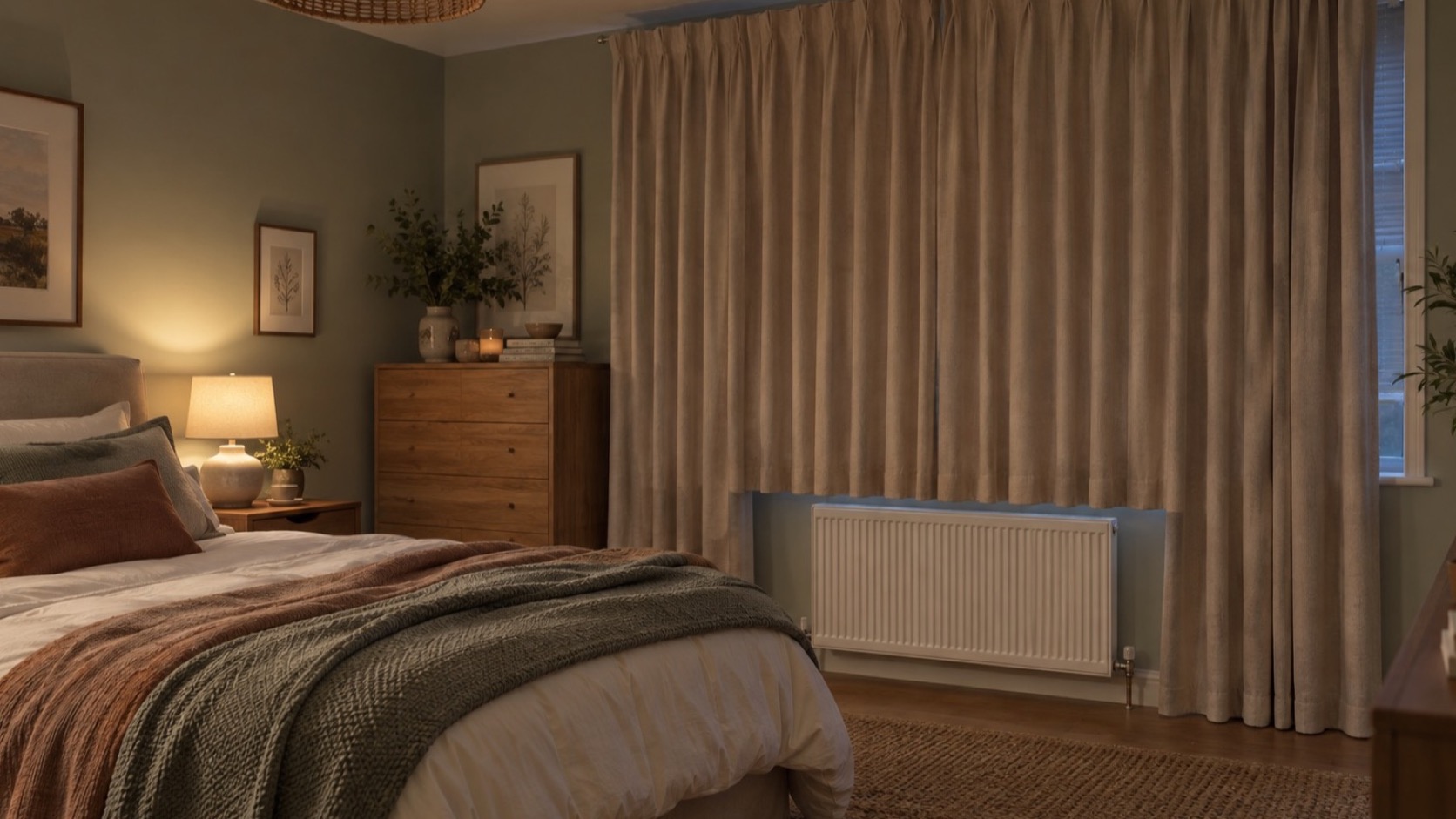
How closed curtains can help
A cold window exchanges heat with the room in several ways. Warm room air meets colder glazing, surfaces radiate heat towards one another, and air can move through unwanted gaps. A closed curtain creates another boundary and holds a relatively still layer of air near the glass. That can slow part of the heat flow and reduce the chilly downdraught people sometimes feel beside a window.
Blackout fabric is often dense or coated, so it may perform this role better than a very open weave. However, opacity is not a thermal rating. Two equally dark curtains can have different thicknesses, linings and edge gaps. A beautiful heavy pair can also perform poorly if it hangs flat, parts at the centre or stops well inside the window edges.
The Energy Saving Trust’s window guidance includes thermally lined curtains among the measures that can improve comfort around windows. Its broader advice is consistent with a simple routine: use curtains as a movable layer, not as a substitute for efficient glazing, sound seals or appropriate ventilation.
Blackout, lined and thermal: useful distinctions
Blackout means the main material is intended to stop visible light passing through it. A coating, tightly woven yarn or separate blackout lining may provide that opacity. Lined means there is a second fabric behind the decorative face; that lining may be ordinary, blackout or interlined. Thermal is a broad retail description rather than a promise of a fixed whole-room result.
An interlined curtain normally contains a soft insulating layer between the face and lining. A coated ready-made curtain may achieve opacity with less bulk. Both can be useful, but compare weight, heading, dimensions, window-facing colour and care requirements. Do not assume the thickest-sounding product is suitable for the pole or easy to maintain.
What matters more than the label
Coverage and fullness
Measure the pole or track, not only the glass. The combined flat width of the panels needs to exceed that span so they retain folds when closed. Full folds help the fabric meet at the centre and create a deeper air layer. Provide wall overlap on both sides and, where practical, mount the treatment above the opening.
A wraparound pole or a track with returns can bring the outer edges towards the wall. A pelmet can reduce the open route above the heading. Neither must be airtight to be useful, but controlling the obvious top and side openings makes the layer more coherent.
Window condition
Curtains cannot repair a draughty sash, failed double-glazing unit or missing seal. On a windy day, use a safe method to locate air movement, then arrange repair. If the frame is sound but the glass feels cold, a well-fitted curtain can still improve comfort by separating occupants from that cold surface.
Persistent condensation deserves attention. Moisture hidden behind a heavy curtain can damage the fabric, reveal and frame. Wipe condensation, ventilate appropriately and investigate recurring damp. Never cover a required vent simply to make the room darker or warmer.
Radiators and furniture
Long curtains commonly hang in front of radiators positioned below windows. When the heating is on, a closed panel can trap warm air against the glass. That works against the purpose of heating the occupied room. Consider sill-length curtains, a suitable blind-and-curtain combination or a way to keep the fabric safely behind a shelf without touching a hot surface.
Keep furniture far enough from the cloth for air to circulate. Avoid pushing a bed against a cold exterior wall solely so curtains can reach the floor; room layout, ventilation and damp risk matter too.
A practical winter routine
Open the curtains in the morning to dry and inspect the window area. If low winter sun reaches the glazing, let it contribute daylight and some solar warmth. Once the window is no longer receiving useful light, close the curtains fully, align the centre overlap and bring the outer edges towards their returns.
The Energy Saving Trust’s warm-home advice recommends thick or thermally lined curtains, closing them at night and avoiding blocked radiators. This is sensible behaviour guidance, not proof that every curtain will save the same percentage of energy.
If you use trickle vents, leave them operating as intended. Brief, purposeful ventilation may still be needed to manage moisture. The aim is not to create a sealed pocket around the window; it is to place a controllable layer between the room and the glazing while maintaining a healthy building.
Layering a blind and curtains
A recess blind covers the main glass area while curtains extend beyond the opening. Their edges are staggered, so the curtain hides the narrow side gaps left by the blind. This can improve both light control and the still-air layers at the window without demanding one perfect product.
Choose controls carefully. In rooms used by children, a cordless blind is preferable. If a chain or cord is present, fit every supplied safety device and keep beds and climbable furniture away. The additional curtain must not hide a loose control or make it hard to inspect.
What blackout curtains cannot promise
No ready-made curtain can guarantee a temperature rise, percentage heat-loss reduction or bill saving across UK homes. Results change with window area, orientation, outside weather, heating pattern, wall construction, draughts and occupancy. Retail claims based on fabric tests may not represent the installed room.
Curtains also cannot solve overheating by themselves. In summer, close them before strong direct sun heats the room, particularly on sun-facing windows. A pale window-facing surface can be a sensible choice. External shading usually intercepts more solar energy before it enters, and safe ventilation is valuable when outdoor air is cooler.
Finally, do not let thermal aims compromise fire safety, safe exits or appliance clearances. Keep fabric away from heaters and flames, use suitable fixings for heavy panels and follow the product’s care label.
The practical conclusion
Blackout curtains are a useful, relatively accessible layer. They work best when wide enough, closed at the right time, returned towards the wall and kept clear of radiators and vents. Treat their value as improved coverage and comfort at the window, not a guaranteed engineering result.
If darkness is the main objective, continue with our blackout curtain buying guide. If warmth is the priority, inspect the window condition first and use the curtain as one part of a wider plan.
Products for this job
Curtain constructions worth comparing
These examples show a coated pale pair, a dark ready-made pair and a neutral pair. The products are starting points; dimensions and installation determine whether they cover your window well.
Deconovo total-blackout coated curtains, pale khaki, 46 × 72 in, pair
Best for: A lighter face with an opaque backing
A coated-back eyelet pair intended to stop light through the cloth itself. The lighter face gives a softer room look while the backing does the opacity work.
What stands out
- Coated backing rather than relying only on a dark yarn
- Pair format
- Multiple listed colour and size variants
Keep in mind
- Coated fabrics need care-label-led cleaning
- Heavier curtains need a suitable pole and fixings
- Perimeter gaps remain unless the track or pole extends well beyond the window
- 46 × 72 in
- Pair
- Eyelet heading
- Coated back
Deconovo blackout eyelet curtains, black, 46 × 54 in, pair
Best for: An affordable ready-made eyelet pair
A widely sized pair of soft eyelet curtains made for a standard pole. The dark colour is useful where room darkening matters more than a pale decorative finish.
What stands out
- Many size and colour variants are grouped under the listing
- Pair format suits conventional bedroom windows
- Simple eyelet heading is quick to hang on a compatible pole
Keep in mind
- Darkening depends on pole position, width and centre overlap
- Eyelets can leave a bright band above a low-mounted pole
- The listing's thermal wording is not a measured room-saving guarantee
- 46 × 54 in
- Pair
- Eyelet heading
- Polyester
PONY DANCE blackout eyelet curtains, grey, 46 × 54 in, pair
Best for: A grey pair across a standard window
A soft grey two-panel eyelet set with a very broad group of size variants. It is a practical neutral choice when you can create useful overlap beyond the window.
What stands out
- Two-panel set
- Many width and drop combinations are listed
- Neutral colour works with layered blinds
Keep in mind
- Room darkening varies with the selected colour and installation
- A pole close to the recess can expose top and side light
- Exact dimensions must be checked on the selected variant
- 46 × 54 in
- Two panels
- Eyelet heading
- Grey