
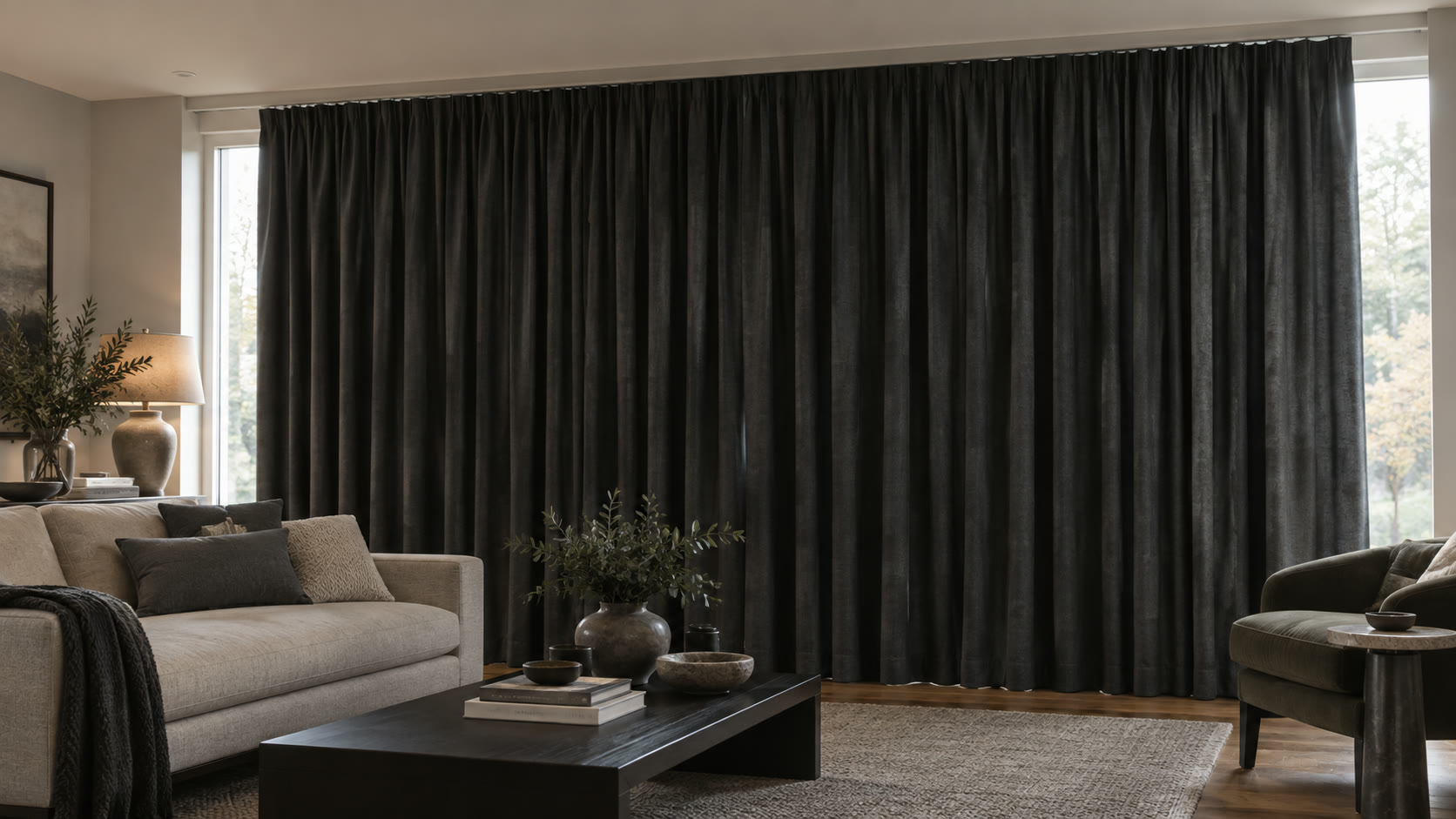
Measure the full treatment span
A wide window magnifies every small sizing error. Measure the opening, then choose a pole or track that can extend beyond the frame on both sides. Measure the usable traversable length of that hardware, excluding finials and any section that gliders cannot cross. If the opening is a door, allow for the swing, handles and floor finish. Dunelm's track-and-pole measuring guide gives a sound starting method for positioning and extending hardware.
Take measurements at several points if the floor, ceiling or frame may not be level. Record width and drop in one unit. Photograph the wall with the proposed bracket points marked, and identify the substrate before ordering heavy curtains. Check whether the window must open fully for ventilation or escape; an attractive wall-to-wall treatment must not block a required route.
For blackout use, plan the closed treatment first. A pair that looks beautifully full in the shop can fall short after the rail extends beyond the glazing. Our curtain measurement guide shows the full calculation; our fullness guide explains why combined flat width is compared with usable rail width.
Choose support before choosing the fabric
Wide, lined curtains can be heavy. The pole or track, brackets, gliders, hooks and anchors all carry that load. Check the product's stated weight limits and required bracket spacing. A long telescopic pole may need a centre support, which can stop rings passing across the centre. A track may use joined lengths, but not every glider crosses a splice smoothly. Confirm that the hardware can be fitted to the actual wall or ceiling structure—not just that its advertised length matches the opening.
A ceiling track can create a calm full-height appearance and bring the heading closer to the top of the window. A wall-mounted pole may be easier to retrofit. Some specialist tracks provide overlap arms or returns; Silent Gliss's documentation makes clear that these are model-specific components. Do not assume a bendable rail has them. Test the rail's movement before hanging the full pair.
The Speedy bendable track below is sold in a long length and includes gliders and brackets, but the seller describes it for light-to-medium curtains. A wide, heavy blackout installation needs its own load calculation and may require a different rated system. Treat the product as a format example, not a blanket recommendation for every wide window.
Choose panel count and heading carefully
Read the exact variant: is the advertised width one panel, the pair or a gathered width? The Joydeco pencil-pleat example below is a ready-made pair; check its individual flat width, drop, colour and hook requirement. A pencil-pleat heading can use a suitable track, but hooks are not included in that listing. It may be too narrow for a particular wide span, even if its photograph shows a broad window.
If two panels cannot provide adequate fullness, made-to-measure curtains or more than two panels may be practical. Extra panels create extra vertical joins, so choose where they meet and how they will move. A central leading-edge overlap may be easier to manage than several uncontrolled gaps. A large stack on either side can block glazing when open; estimate stack space before ordering.
For a bay or angled wall, a bendable or custom-bent track can follow the geometry, but its gliders and curtain weight must still suit the bend. A straight pole across a bay may leave a deep light pocket behind the fabric. A door needs clearance at the floor and a way to move the curtain quickly. These details can matter more than the nominal “blackout” label.
Finish the top, sides and centre
Wide curtains may reveal a long top strip if the track is low or the heading sits away from the wall. Side light grows more conspicuous when a broad glazed wall can be seen obliquely. A return-to-wall hardware end, high mounting or an additional close-fitting blind can solve different routes. The John Lewis curtain guide offers general pole-position starting points; adapt them to the room.
Check the centre after the panels have hung for a day and settled. If they pull apart, re-evaluate width rather than pinning the lining under strain. Keep radiators, damp sills and moving handles clear. For children's rooms, secure hardware and follow UK blind-cord safety guidance for any layered blind. A broad window can be darkened well, but the reliable solution is a supported system whose panels close fully every day.
Products for this job
Wide-span planning examples
The flexible track is listed for light-to-medium curtains; the pencil-pleat pair is a separate fabric example. Do not assume these two products are suitable together for a wide heavy installation.
Speedy bendable curtain track, white, 5 m
Best for: Planning a close-mounted pencil-pleat track
A cuttable, bendable track supplied with gliders and brackets for pencil-pleat curtains. It can be face- or top-fixed, but its own listing limits use to light- or medium-weight curtains.
What stands out
- Top- or face-fix options are listed
- Can be trimmed or bent for the layout
- Gliders and brackets are included
Keep in mind
- Listed for light- to medium-weight curtains only
- No built-in centre overlap or pelmet is claimed
- Fixings must match the wall or ceiling substrate
- 5 m total track
- White
- 50 gliders and 20 brackets listed
- Light- to medium-weight curtains
Joydeco black pencil-pleat curtains, 55 × 96 in, pair
Best for: A long, track-compatible curtain pair
A long two-panel black curtain set with a pencil-pleat heading for hooks or a compatible track. The listing describes light reduction rather than a sealed whole-window result.
What stands out
- Two 55-inch-wide panels are listed
- Pencil-pleat heading can use rings or a suitable track
- Long 96-inch drop suits some tall openings
Keep in mind
- Hooks are not included
- Seller describes partial light blocking rather than a room seal
- The large drop may need alteration for a shorter window
- 55 × 96 in each panel
- Two panels
- Pencil-pleat heading
- Hooks not included